

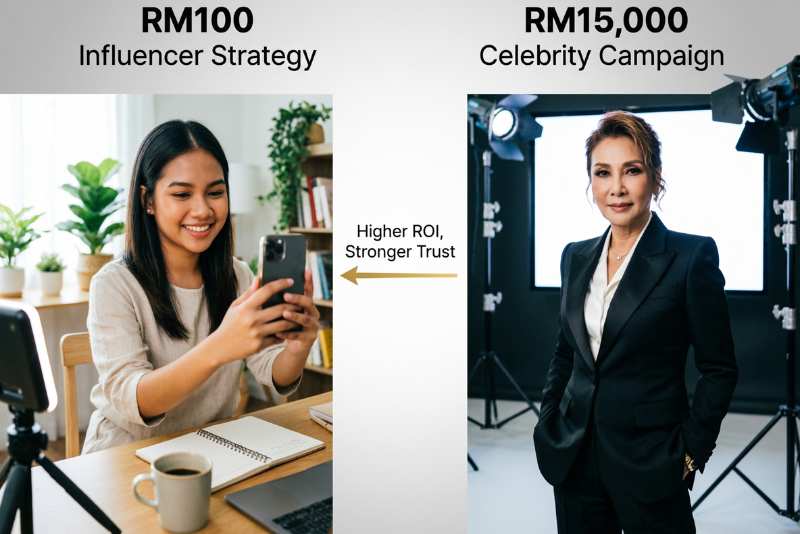
When I was starting out as a brand manager, I tried pitching to my CMO
“We should get [insert celebrity name] to post about our product. It’ll cost RM15,000 per post, but the reach will be massive.”
I was then asked the question, “How many packs of our RM12.90 snack do we need to sell just to break even on that one post?”
Silence. Shuffled papers. I mumbled something about “brand awareness.”
Here is the uncomfortable truth that most corporate FMCG offices in Malaysia still refuse to accept: A RM100 nano-influencer strategy—executed with discipline, at scale, and linked to actual sales—will almost always outperform a RM10,000 celebrity post. Not sometimes. Almost always.
The data is now overwhelming. My job today is to walk you through why RM100 influencer strategy outperforms the RM15,000 celebrity, and then give you the playbook to execute it by next week.
The Celebrity Trap: Why Big Names Deliver Small Returns
Let me be blunt about what a celebrity endorsement actually buys you in 2026.
A Malaysian celebrity with a million followers will charge you anywhere from RM5,000 to RM50,000 per post, depending on their tier. For that money, you get:
Reach. Many eyeballs, most of them the wrong eyeballs. A celebrity’s audience is broad because their fame is broad. Your premium granola does not need to reach every Malaysian. It needs to reach health-conscious urbanites who shop at Village Grocer.
Awareness, not trust. Only 59% of Southeast Asian consumers now say they are influenced by mega-influencers with over a million followers—a 7% drop from the previous year . Trust in big names is declining, not growing.
Zero attribution. Did that RM15,000 post sell any product? You will never know, because celebrity posts rarely carry trackable links or affiliate codes. You are buying exposure and hoping it trickles down to sales.
Meanwhile, brands that deploy the same budget across a squad of nano and micro-creators are seeing fundamentally different results. A beauty brand recently drove 40% more conversions using 20 micro-creators at RM1,000 to RM3,000 per post each, instead of one celebrity partnership . In Malaysia specifically, micro-influencers now deliver 11 times higher ROI than traditional display advertising, while charging a fraction of what celebrity endorsements cost .
This is not a trend. This is a structural shift in how consumers make purchase decisions. And most Malaysian FMCG brands are still budgeting as if it were 2018.
The Architecture of the RM100 Strategy
So what does a RM100 influencer strategy actually look like? It is not one thing. It is three distinct approaches, stacked together. Let me break them down.
Component 1: The Nano-Influencer Squad (RM50–RM200 per creator)
Nano-influencers are everyday Malaysians with 1,000 to 10,000 followers—a university student who reviews snacks in her宿舍, a young father who posts about quick meals between shifts, a home cook in Kelantan with a loyal following of local food lovers.
They are not polished. They are not professional creators. And that is precisely why they work.
In Malaysia, nano-influencers with 1,000 to 5,000 followers record an average engagement rate of 4.79%, dramatically higher than larger tiers where engagement often falls below 2% . These higher engagement rates translate into stronger interactions and—when linked to an affiliate code or trackable link—measurably better conversion.
The economics are absurdly favorable. Nano-influencers in Malaysia typically charge between RM50 and RM200 per post, or they will post in exchange for free product. For the cost of one RM10,000 celebrity post, you can activate 50 to 200 nano-creators, each speaking to a small, tight-knit community that actually trusts their recommendations.
This is not about reach. It is about density of authentic endorsement. When a consumer sees a celebrity holding your product, she thinks: “They paid her to hold that.” When she sees three different people she follows—none of them famous—all using your product in their real kitchens, she thinks: “Maybe I should try this.”
Component 2: The Shopee Affiliate Program (Performance-Based, Not Fee-Based)
This is the component that should make every FMCG CFO lean forward in their chair.
The Shopee Affiliate Program connects your products with content creators who earn a commission only when they drive a sale. Commission rates range from 4% to 13% depending on the product category, with the highest rates in beauty and fashion . For a RM12.90 product, that means you pay between RM0.52 and RM1.68 per sale—a cost per acquisition that makes Facebook ads look like setting money on fire.
During the most recent 11.11 campaign, local sellers who partnered with Shopee affiliates recorded seven times more orders via Shopee Video and six times more orders via Shopee Live. These are not vanity metrics. These are attributable sales at a known cost.
Even more impressively, brands like Naelofar have reported a 21x return on investment through the Shopee Affiliate program . That means for every ringgit spent on affiliate commissions, the brand generated RM21 in revenue.
The affiliate model solves the three fatal flaws of celebrity marketing in one stroke:
- Attribution: You pay only for sales, not for eyeballs.
- Authenticity: Affiliate creators tend to be micro and nano-influencers who build content around products they genuinely use.
- Scalability: You can onboard dozens of affiliates without upfront cost, letting performance data tell you which creators to deepen relationships with.
Component 3: User-Generated Content at Scale (The Multiplier Effect)
Here is a statistic that should reframe how you think about content budgets: independent customer reviews and user-generated content now carry more weight in purchasing decisions than celebrity or influencer marketing .
In plain language: a photo of your sambal on a real customer’s dinner table—posted organically, with no payment, no brief, no script—is more persuasive than a celebrity holding your bottle and smiling.
The RM100 strategy weaponizes this insight. When you activate 50 nano-creators, you do not just get 50 posts. You get 50 pieces of authentic, searchable, reusable content that can be:
- Repurposed on your product pages.
- Shared in your brand’s social channels.
- Embedded in your Shopee listings as social proof.
- Compiled into testimonial videos that live permanently in your content library.
- One campaign. Dozens of assets. Zero ongoing cost. That is the difference between renting attention from a celebrity and building a permanent brand asset.
The Malaysian Playbook: How to Execute This Strategy by Next Week
Theory is cheap. Here is the step-by-step execution plan.
Step 1: Find 20 Nano-Creators in Seven Days
You do not need an agency. You need a smartphone and two hours.
Open TikTok, Instagram, or Shopee Video. Search for the hashtags and keywords your target consumer uses: #masakanmalaysia, #quickmeals, #healthybreakfast, #sambal, #granola, whatever is relevant to your category.
Look for creators with 1,000 to 10,000 followers who are already posting content in your category. They are already making food content. They are already reviewing products. They are looking for new things to post about.
DM 30 of them. Say: “Hi, I love your content. I’m from [brand name]. We make [product]. Would you be open to trying a free sample? No obligations—if you genuinely like it and want to post, great. If not, no hard feelings.”
If 20 say yes, you have spent RM200 on product samples and shipping and built a nano-creator squad. If 10 of those 20 post organically, you have generated authentic content for approximately RM20 per piece.
Step 2: Enroll in the Shopee Affiliate Program
If your products are already listed on Shopee, you have access to the Affiliate Program. Activate it. Set your commission rate. Upload product samples and marketing materials for affiliates to use.
The platform will surface your products to affiliate creators who operate in your category. You set the commission rate. You only pay when a sale occurs. There is no upfront cost, no minimum spend, and no commitment beyond the commission you set.
Step 3: Give Creators a Loose Script, Not a Rigid Brief
This is where most corporate marketers get it wrong. They hand nano-creators a six-page brand guideline document with approved messaging, mandatory hashtags, and a list of forbidden words. The result is content that reads like a press release and performs like one.
Instead, give your creators three things:
The product. Let them use it in their own kitchen, their own way.
One core message. Not a script. A message. “This sambal is made with fresh cili padi from Kelantan, not paste.” That is it.
A trackable link or code. So you can measure what works.
Then get out of their way. The entire point of nano-influencers is that they speak in their own voice to their own community. The moment you make them sound like your brand manager, you destroy the authenticity that makes them valuable.
Step 4: Repurpose, Repurpose, Repurpose
Every piece of content a nano-creator produces should become permanent brand inventory.
Download the best-performing videos (with permission). Embed them on your Shopee product pages. Compile them into a “real reviews” highlight on Instagram. Turn quotes from their captions into testimonial cards for your website. Add their photos to your product listing’s image carousel.
As I argued in the previous post on content libraries, stock content compounds. A video made by a nano-creator today will still be driving sales six months from now if you embed it somewhere permanent. A celebrity post disappears from the feed in 48 hours.
Real-World Results: The RM100 Strategy in Action
This is not theoretical. The evidence is accumulating across the Malaysian market.
The Frozen Food Wholesaler: A 60-year-old frozen food wholesaler with zero social media presence had one food influencer post a 90-second TikTok showing how to get premium steak for a family at wholesale prices. That single video added RM100,000 in sales to one store in one month . The founder, previously the most unsocial-media person imaginable, now personally manages the company TikTok account.
The Content-Driven Sellers: During the Shopee 11.11 campaign, sellers who embraced content tools—Shopee Live, Shopee Video, and the Affiliate Program—saw up to 14 times more orders compared to sellers who did not. Sellers who used both Shopee Live and Shopee Video recorded up to 26 times more orders .
The Affiliate ROI: Naelofar, one of Malaysia’s most prominent local fashion brands, drove a 21x return on investment through Shopee’s Affiliate program in the first half of 2025 . This is not a brand spending millions on celebrity endorsements. This is a brand leveraging performance-based creator partnerships and letting the sales data speak.
These results share a common thread: real people, authentic content, measurable outcomes, and budgets that do not require board-level approval.
The RM100 Strategy Audit Checklist
Before you brief another celebrity proposal, run this audit on your current influencer approach:
- Cost Per Sale Calculation: For your last influencer campaign, can you calculate the exact cost per sale? If not, you bought awareness, not sales.
- Creator Tier Mix: What percentage of your influencer budget goes to nano and micro-creators versus macro and celebrity? If the answer is zero for nano, fix that this quarter.
- Affiliate Enrollment: Are your products enrolled in the Shopee Affiliate Program? If not, activate it today.
- Content Repurposing Pipeline: Do you have a system to capture nano-creator content and embed it permanently in your product pages? If not, build one.
- Engagement vs. Follower Count: Are you evaluating creators by their follower count or their engagement rate? A creator with 3,000 followers and 5% engagement will almost always outperform a creator with 100,000 followers and 1% engagement.
The One Thing to Remember
Here is the shift that separates the FMCG brands winning on a budget from those burning cash:
Celebrity marketing rents attention for a moment. Nano-influencer marketing builds trust that compounds over time.
The celebrity post vanishes from the feed. The nano-creator’s video sits on your product page, answering a skeptical shopper’s question at 11 PM. The celebrity endorsement feels like an ad. The nano-creator’s kitchen video feels like a recommendation from a friend.
Malaysian consumers have already made this shift. Trust in mega-influencers is declining. Engagement on nano-influencer content is rising. Platforms like Shopee are building entire ecosystems—affiliate programs, content tools, attribution systems—that make the RM100 strategy not just possible but measurably superior.
The question is whether your brand will adapt to the data, or keep writing checks to celebrities while a competitor with one-tenth your budget activates 50 real Malaysians who actually cook with your product, actually like it, and actually tell their communities about it.
The math is not complicated. The courage to act on it—that is the hard part.
