

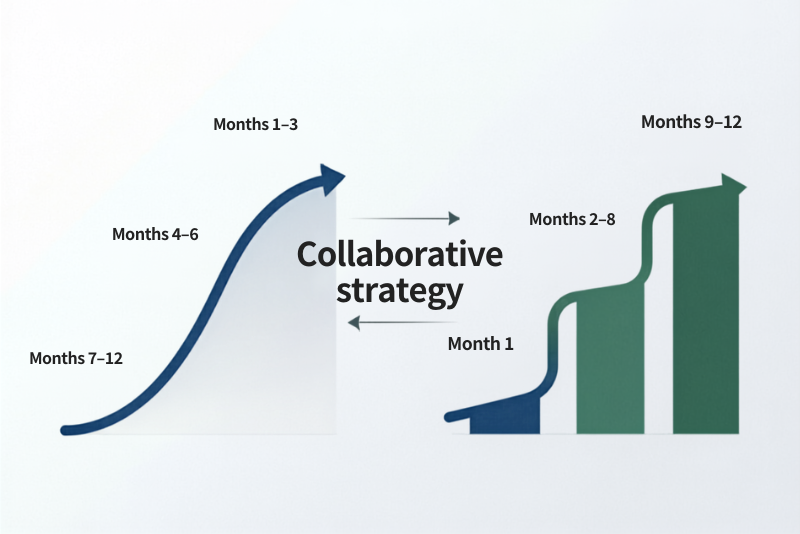
The lesson of PrintMY is not “SEO is better than Google Ads.” It is that the two channels serve different purposes, and the businesses that win use both—in the right sequence, at the right ratio, for the right objectives.
Here is the framework I would use if I were allocating RM10,000 for a Malaysian SME tomorrow, regardless of industry.
Phase 1 (Months 1–3): 70% Ads, 30% SEO
You need cash flow. You need data. You need to prove that your website converts visitors into leads or sales.
Google Ads (RM7,000): Spend your ad budget on high-intent, long-tail keywords only. If you are a printing company, do not bid on “printing.” Bid on “corporate brochure printing PJ same-day delivery.” If you are a plumber, do not bid on “plumber.” Bid on “24-hour emergency plumber Bangsar.” These keywords have lower volume but higher conversion rates. Your goal in Phase 1 is not volume. It is to validate that your landing pages convert and to learn which search queries signal genuine purchase intent. Use the remaining budget to test different offers—a free consultation, a downloadable guide, a discount code—and see which one drives the highest conversion rate.
SEO (RM3,000): Commission a technical SEO audit and keyword research. Identify the top 20 long-tail, high-intent keywords in your industry with moderate competition. Do not start writing content yet. Just build the map. Fix any technical issues on your website—slow loading speeds, broken links, missing meta tags, poor mobile experience—that are preventing Google from properly indexing and ranking your pages.
Phase 2 (Months 4–9): 50% Ads, 50% SEO
Your ads have given you data. You know which keywords convert, which offers resonate, and what your realistic cost per lead looks like. Now you start building the permanent assets.
Google Ads (RM5,000): Shift your ad spend toward the highest-converting keywords you identified in Phase 1. Reduce or eliminate spend on anything that did not convert. Your cost per lead should be improving. Use any positive-ROI campaigns to continue driving immediate business.
SEO (RM5,000): Commission 5–7 search-optimised pages targeting your top long-tail keywords. Each piece should be genuinely useful—a guide, a comparison, a checklist, an FAQ, a detailed answer to a common customer question. If you run an accounting firm, write “What Malaysian SMEs Need to Know About E-Invoicing in 2025.” If you own a hardware supply business, write “The Complete Guide to Choosing the Right Power Tools for Your Home Renovation.” The content must be good enough that someone who finds it through search actually reads it, trusts you, and contacts you.
Phase 3 (Months 10–12+): 30% Ads, 70% SEO
By now, your organic content should be starting to rank. Traffic is arriving without you paying for it. Your business is becoming visible in search for the queries that matter most to your customers.
Google Ads (RM3,000): Reserve your ad budget for seasonal promotions, new service launches, or specific campaigns where you need immediate reach. You are no longer dependent on ads for baseline lead flow.
SEO (RM7,000): Invest in more content, link-building, and content refreshes. Update your older articles to keep them ranking. Expand into new keyword clusters. Consider adding case studies, customer success stories, or industry-specific landing pages. The compounding effect is now working in your favour—each new page adds to the total surface area of your business in search results.
By Month 18, if you have executed this sequence with discipline, your organic traffic should be generating a meaningful percentage of your leads. Your Google Ads spend will be strategic and targeted, not a desperate attempt to keep the phones ringing. And your total cost per lead will have declined significantly, because the organic leads—which cost you nothing beyond the initial content investment—are subsidising the paid leads.
The 10-Question SEO vs. Google Ads Diagnostic Checklist
Before you spend a single ringgit on either channel, run through these questions. A “No” answer to any of them means your money is at risk.
- Conversion Rate Reality Check: Do I know the current conversion rate of my website—the percentage of visitors who actually enquire or purchase—and is it high enough to make paid search profitable at my industry’s average cost per click?
- Keyword Intent Audit: Have I identified the specific high-intent, long-tail keywords in my industry that signal purchase readiness (“buy,” “best,” “near me,” “cost,” “quote,” “emergency”), rather than just broad informational queries?
- Unit Economics Calculation: Have I calculated my net margin per customer after all costs, and confirmed that my projected cost per acquisition from Google Ads is lower than the lifetime value of that customer—or at minimum, lower than the profit from the first transaction?
- SEO Baseline Assessment: Does my website have the basic technical SEO foundations—fast loading speed, mobile optimisation, clean URL structure, proper meta tags—or would I be building content on a foundation that Google cannot properly index?
- Content Capability Check: Do I have access to a writer or content creator who can produce genuinely useful, search-optimised content about my industry, or would I be outsourcing to someone who does not understand my business or my customers?
- Time Horizon Honesty: Am I being honest with myself about my cash runway? If I need leads within 30 days to survive, SEO cannot be my primary channel. If I have 6–12 months of runway, I can afford the SEO build.
- Long-Tail vs. Broad Strategy: Have I designed my Google Ads campaigns to target long-tail, high-intent keywords first, or am I planning to bid on broad, generic terms that will drain my budget with low-converting clicks?
- Measurement Infrastructure: Do I have Google Analytics, conversion tracking, and UTM parameters properly set up so that I can distinguish between paid and organic traffic and measure which channel is driving leads and sales?
- Seasonality and Demand Cycles: Have I mapped the major seasonal demand spikes in my industry (tax season for accountants, festive seasons for retailers, year-end for corporate services) and planned to use Google Ads to capture that immediate demand while my SEO assets mature?
- Sequence Commitment: Have I committed to a phased approach—ads first for data and cash flow, SEO second for long-term asset-building—or am I about to split my budget evenly and hope both channels deliver simultaneously?
RM10,000 is not a “digital marketing budget.” It is a decision about whether you want to be a tenant or an owner. Tenants pay rent every month and own nothing. Owners pay a mortgage and build an asset. The smartest businesses use the tenant income to pay the mortgage—running ads to fund the SEO build—until the day comes when the asset pays for itself, and the rent becomes optional
