

I am not here to say that its a must to get halal certification. In fact, for some brands—those built around pork, alcohol, or a specific non‑halal culinary tradition—halal certification is either impossible or strategically nonsensical. Your product is char siu sauce made with lard. Your product is craft beer. Your product is a premium lap cheong that tastes of nothing without pork fat. Seeking halal certification for these products would require reformulating them into something unrecognisable and, frankly, unwanted by your core consumer. Either that or you are simply not ready yet. And its OK.
But I am here to make sure you understand what “choosing not to certify” actually costs you—in square metres of shelf space, in millions of consumers who will never see your product, and in the trust signals that even non‑Muslim Malaysian shoppers have come to expect from packaged food. Too many founders make this choice casually, thinking they can simply “sell to everyone except Muslims” and build a business on the remaining population. The maths is far more brutal than that.
The 60% Consumer Lockout
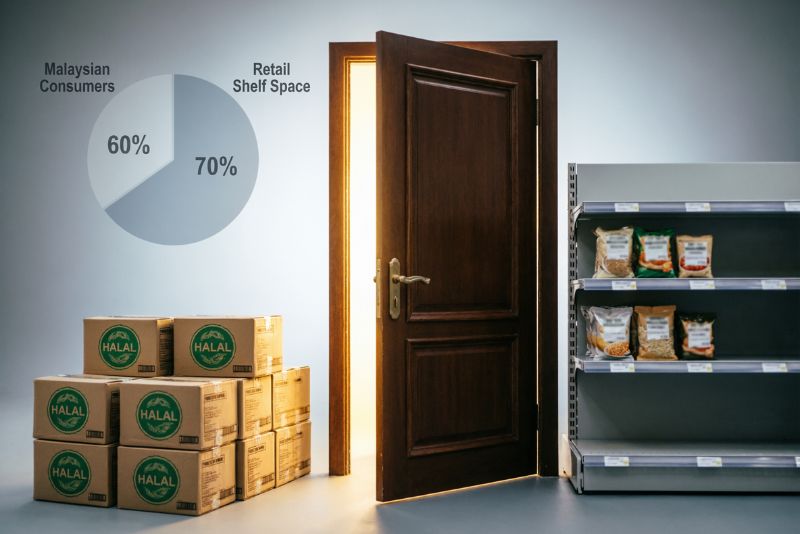
Malaysia’s citizen population is approximately 70% Bumiputera, the vast majority of whom are Muslim. The Malay Muslim community alone—without even counting Muslim Indians, Muslim Chinese converts, and the growing Muslim expatriate population—represents roughly 55–60% of the country’s consumers. When you choose not to pursue JAKIM halal certification, you are structurally excluded from reaching these consumers in any mainstream retail environment. They will not pick up a product without the halal logo. They will not consider it. The logo is not a preference; it is a category entry requirement.
The number is not 55–60% in isolation. Add the Muslim segment of the Indian community, the Muslim segment of the Orang Asli and Sabah/Sarawak indigenous groups, and the Muslim expatriates from the Middle East, Indonesia, and South Asia who shop at the same hypermarkets as everyone else. The total Muslim consumer base in Malaysia is closer to 63–65% of the population. Choosing non‑halal means you are left with the Chinese majority, the non‑Muslim Indian segment, the non‑Muslim indigenous segment, and the non‑Muslim expatriate segment—roughly 35–40% of the population, depending on how you count.
Even within that 35–40%, the assumption that “non‑Muslims don’t care about halal” is dangerously outdated. Research has shown that many non‑Muslim Chinese and Indian consumers in Malaysia actually prefer products with the halal logo because they associate it with stricter hygiene standards, better ingredient controls, and a government‑backed quality guarantee. The JAKIM logo has become a proxy for safety and trust, not just religious compliance. By choosing non‑halal, you are not only losing the Muslim market—you are losing a meaningful share of the non‑Muslim market that uses the halal logo as a purchase guideline.
The 70% Retail Shelf Lockout
If the consumer lockout were the only cost, it might be manageable. But the retail reality compounds the damage.
Malaysia’s modern trade—hypermarkets, supermarkets, convenience stores, and pharmacy chains—is dominated by retailers that serve a predominantly Muslim customer base. AEON, Lotus’s (formerly Tesco), Mydin, Giant, 99 Speedmart, and Guardian all carry halal-certified products as the default. These retailers allocate 95–99% of their shelf space to halal or halal‑certified products. The “Non‑Halal” section—if it exists at all—is a tiny, poorly lit corner, often positioned near the cleaning supplies or the back wall, invisible to the main traffic flow.
The maths is stark: roughly 70% of Malaysia’s formal retail shelf space is in chains that either ban non‑halal products entirely (like Mydin) or relegate them to a token corner (like AEON). If you choose non‑halal, you are not competing for the eye‑level shelf. You are competing for a shelf the consumer does not walk past. Your product will be placed next to other non‑halal items—alcohol, pork‑based products, imported goods without halal certification—in a zone that many Muslim shoppers actively avoid. The foot traffic that drives impulse purchases and category growth will never reach you.
And here is the kicker: even non‑Muslim shoppers do not necessarily browse the non‑halal corner. Malaysian Chinese consumers who are used to shopping in AEON or Lotus’s have been conditioned to find their food in the main aisles. They will not detour to a segregated non‑halal section unless they are specifically looking for a product that cannot be found elsewhere. Your char siu sauce, sitting in the non‑halal corner, is invisible to the casual shopper who might have picked it up if it were in the sauce aisle.
The Trust Premium You Forfeit
Beyond reach and shelf space, the halal logo carries a trust premium that affects purchase decisions across all ethnicities. A nationwide survey found that even among non‑Muslim consumers, halal certification is associated with cleanliness, food safety, and ethical sourcing. In a market where food safety scares periodically erupt—counterfeit ingredients, contamination incidents, unlicensed home‑based production—the halal logo is a shortcut to consumer confidence. By choosing non‑halal, you forfeit that shortcut entirely. You must build trust through other means: brand equity, traceability, third‑party certifications, influencer endorsement. Those are expensive and time‑consuming proxies for a single green logo that you could have obtained.
The Purpose of This Post
I am not telling you to get halal certification. I am telling you to make the choice with your eyes open. If your product is built around a non‑halal ingredient or cultural tradition, embrace that identity. But do not then try to force your product into channels designed for halal goods. Do not spend your listing fees on a non‑halal corner shelf at AEON and wonder why you are not selling. The fix, which I will detail in the third post, is to play the Non‑Halal Channel Game: build an entirely separate retail universe, owned by you and your community, where being non‑halal is not a liability but a badge of authenticity.
But before that, let me show you what happens when a brand gets this choice right. That is the case study.
In my next post, I will share with you the The Non‑Halal Market Readiness Audit: 10‑Point Checklist to understand whether your brand is truly ready to compete in the non‑halal space
