


Why This Audit Exists
Choosing not to pursue JAKIM halal certification is a legitimate strategic decision—for brands built around pork, alcohol, or a specific non‑halal culinary tradition. But that decision carries severe structural consequences: you are immediately locked out of roughly 60% of Malaysian consumers (the Muslim majority) and roughly 70% of formal retail shelf space. Your addressable market shrinks to approximately 35–40% of the population, and even within that segment, many non‑Muslim consumers use the halal logo as a trust heuristic.
This audit is designed to measure whether your brand is truly ready to compete in the non‑halal space. It forces you to confront the real size of your market, the viability of your channel strategy, the resilience of your consumer trust signals, and the structural risks of being excluded from the halal mainstream. In under 45 minutes, you will score your readiness across 10 critical dimensions and identify the gaps that could kill your brand before it reaches the shelf.
How to use this audit
- Read each question and its expanded explanation carefully.
- Work through the detailed sub‑checks to gather evidence.
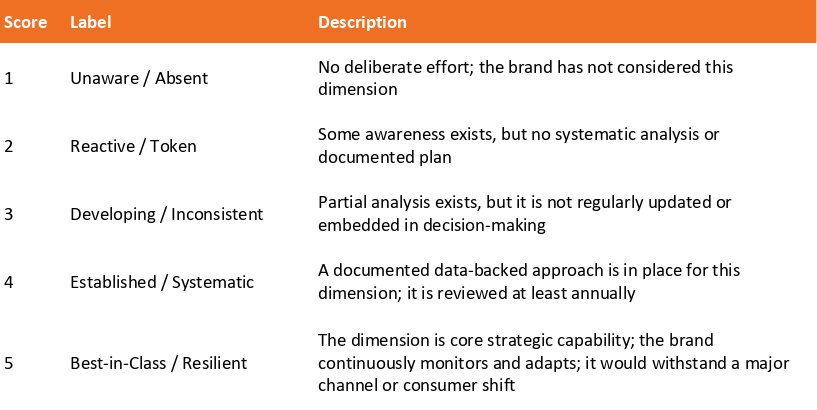
- Assign an honest score from 1 to 5 using the rubric provided.
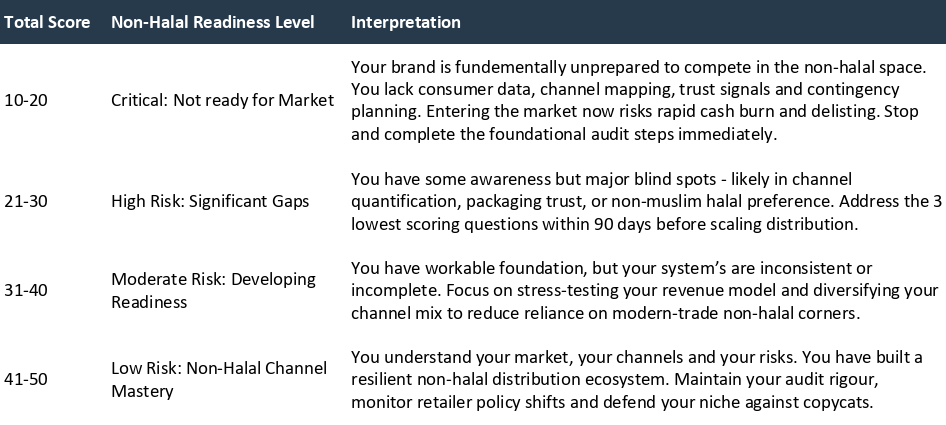
- Tally your total score and consult the Scoring Summary.
- Use the Market‑Size Calculator and Retail‑Channel Prioritisation Matrix to build your strategic plan.
The full Non‑Halal Channel Strategy Toolkit, which includes a detailed remediation plan, a festive gifting calendar, and a pricing model for premium non‑halal goods, is available for purchase.
The 10 Diagnostic Questions
Question 1: Core Consumer Segment Identification
The Question: Have I clearly identified my core target consumer segments (Chinese, non‑Muslim Indian, expatriate) and validated that my category has sufficient demand within this 35–40% population slice?
Expanded Explanation: The non‑Muslim population of Malaysia is not a monolith. It includes Chinese Malaysians (the largest non‑Muslim group, predominantly Buddhist, Christian, or Taoist), non‑Muslim Indians (Hindus, Christians, Sikhs), indigenous non‑Muslim groups (especially in Sabah and Sarawak), and expatriates. Each segment has different food cultures, income profiles, and retail behaviours. A premium pork jerky brand will find its primary audience among Chinese consumers. A non‑halal Indian pickle brand will target a different subset. You must know the exact size, location, and spending power of your target segment—not just “non‑Muslims.”
Detailed Sub‑Checks:
- Have I obtained the latest DOSM population data and extracted the non‑Muslim segments by ethnicity and religion?
- Have I cross‑referenced ethnicity with geography (e.g., Chinese‑majority areas in Klang Valley, Penang, Johor) to identify high‑density clusters?
- Have I estimated the total household count and average household income for my target non‑Muslim segments?
- Have I analysed category‑specific consumption data (e.g., per‑capita pork consumption, demand for non‑halal sauces) to validate that my category has sufficient volume potential within the target segment?
- Have I conducted qualitative research (interviews, shop‑alongs) with at least 15 consumers from my primary target segment to understand their specific needs and purchase triggers?
Scoring Rubric:
1: I have not identified my specific target segment within the non‑Muslim population. I assume “non‑Muslims” will buy my product.
3: I have a rough demographic profile, but I have not quantified the addressable market size or validated category demand with data.
5: I have a precise, data‑backed profile of my primary and secondary target segments, including population estimates, geographic clusters, income brackets, and category‑specific consumption patterns. This profile is updated annually and directly informs my distribution and marketing decisions
Question 2: Modern‑Trade Non‑Halal Shelf Mapping
The Question: Have I mapped all modern‑trade retailers in my target geography and determined which ones maintain non‑halal corners or dedicated non‑halal shelf space?
Expanded Explanation: The “non‑halal corner” is not a standardised feature. Some AEON stores have a small, poorly lit section; others do not. Lotus’s operates non‑halal sections in certain locations only. Mydin bans non‑halal products entirely. Village Grocer and Jaya Grocer may carry imported non‑halal items but with strict segregation. 99 Speedmart does not carry non‑halal food. You cannot build a distribution strategy on assumptions. You must physically visit every major retail banner in your target area, document the non‑halal shelf space (if any), measure its dimensions, observe foot traffic, and note the adjacent products.
Detailed Sub‑Checks:
- Have I compiled a complete list of modern‑trade retailers within a 20‑kilometre radius of my target consumer clusters?
- Have I physically visited at least 80% of these stores, photographed the non‑halal section (if present), and recorded its exact dimensions, shelf count, and lighting conditions?
- Have I noted the brands and categories already present in the non‑halal section and assessed competitive density?
- Have I spoken to store managers or category buyers to confirm the process for listing non‑halal products, any additional fees, and whether non‑halal ranges are growing or shrinking?
- Have I mapped which retail banners have a corporate policy to phase out non‑halal sections entirely?
Scoring Rubric:
1: I have not mapped any retailers. I assume non‑halal sections exist and will be available.
3: I have visited a handful of stores, but I do not have a systematic map or buyer contacts.
5: I maintain a detailed, regularly updated map of all modern‑trade retailers in my geography that carry non‑halal products, including shelf dimensions, competitive set, listing requirements, and buyer contact information. This map is used to plan every new store entry.
Question 3: Opportunity Cost of Muslim Market Exclusion
The Question: Have I calculated the opportunity cost of being excluded from the 60% Muslim consumer base in terms of revenue, category share, and retailer relationships?
Expanded Explanation: This is not about guilt. It is about arithmetic. You need to know the total size of your category in Malaysia—halal and non‑halal combined—and then calculate what percentage of that total you are permanently excluded from. If the halal segment of your category is growing faster than the non‑halal segment, your opportunity cost is compounding. This calculation will tell you whether your non‑halal niche is large enough to sustain your revenue targets, or whether you are building a business in a shrinking pond.
Detailed Sub‑Checks:
- Have I obtained category‑level market size data (from Nielsen, Euromonitor, or retailer sell‑out data) that includes both halal‑certified and non‑halal products?
- Have I segmented the category by halal status and estimated the revenue pool available to non‑certified brands?
- Have I compared the growth rates of the halal and non‑halal segments over the last three years to project future market dynamics?
- Have I quantified the specific retailer relationships (listing slots, promotional opportunities, category captaincies) I am excluded from by not carrying a halal logo?
- Have I stress‑tested my revenue model: what happens if the non‑halal segment shrinks by 10% due to rising halal preference among non‑Muslims?
Scoring Rubric:
1: I have never quantified the opportunity cost. I believe my product is unique enough to transcend the halal/non‑halal divide.
3: I have a rough estimate of the halal market size, but I have not modelled its impact on my P&L or growth targets.
5: I have a detailed financial model that quantifies the revenue I am forgoing, the growth trajectory of the halal segment, and the minimum market size the non‑halal segment must sustain to hit my revenue targets. This model is reviewed quarterly.
Question 4: Alternative Trust‑Building Mechanisms
The Question: Do I have a credible plan to build trust and quality perception without the halal logo, using alternative certifications (ISO, HACCP, MeSTI) or brand storytelling?
Expanded Explanation: The halal logo is a powerful trust guideline for both Muslim and non‑Muslim consumers. Without it, you must build trust from scratch. Alternative mechanisms include MeSTI (Makanan Selamat Tanggungjawab Industri) certification from the Ministry of Health, HACCP, ISO 22000, or even third‑party lab testing prominently displayed on your packaging. Beyond formal certifications, brand storytelling—transparent sourcing videos, founder authenticity, customer testimonials—fills the trust vacuum. A non‑halal brand cannot be a faceless commodity; it must be a humanised, trusted maker.
Detailed Sub‑Checks:
- Have I secured at least one government‑recognised food safety certification (MeSTI, HACCP) and is it displayed on my packaging?
- Have I produced and published a brand origin story that explains who makes the product, how it is made, and why I chose not to pursue halal certification?
- Do I have a plan to generate and curate user‑generated content (UGC) and independent reviews that serve as social proof?
- Have I briefed my customer service team on how to answer the question “Why is this product not halal?” in a way that reinforces trust rather than sounding defensive?
- Have I tested my packaging with target consumers to confirm that the absence of a halal logo does not trigger a negative quality inference?
Scoring Rubric:
1: I have no alternative trust signals. I rely entirely on the product itself to convince consumers.
3: I have MeSTI or HACCP certification, but I have not invested in brand storytelling or UGC.
5: I have a comprehensive trust‑building ecosystem: food safety certifications, a compelling brand story, a UGC strategy, trained customer service, and packaging that has been consumer‑tested for trust inference. This ecosystem is reviewed semi‑annually.
Question 5: Packaging Audit for Non‑Halal Trust
The Question: Have I audited my packaging to ensure that the absence of a halal logo is not interpreted as “untrustworthy” by non‑Muslim consumers who use the logo as a hygiene guideline?
Expanded Explanation: Many non‑Muslim Malaysian consumers have been conditioned to see the halal logo as a marker of general food safety. Its absence can trigger a subconscious question: “If it isn’t halal, what else isn’t it?” Your packaging must proactively counter that inference. Clean design, clearly displayed alternative certifications, “Contains Pork” or “Non‑Halal” disclaimers that are transparent rather than apologetic, and premium material quality all signal that the absence of the logo is a deliberate choice, not an oversight or a sign of poor manufacturing standards.
Detailed Sub‑Checks:
- Have I conducted a packaging audit with at least 20 target consumers, asking them to describe what the packaging communicates about safety and quality?
- Is my “Non‑Halal” or “Contains Pork” label prominent, clear, and designed as a badge of authenticity rather than a warning sticker?
- Are alternative certifications (MeSTI, HACCP, ISO) displayed with equal or greater prominence than the missing halal logo would have had?
- Does my packaging design use colour, typography, and material quality to signal premium positioning and manufacturing care?
- Have I benchmarked my packaging against successful non‑halal brands (in Malaysia or regionally) that have built strong consumer trust?
Scoring Rubric:
1: My packaging makes no reference to halal status and provides no alternative trust signals. I assume consumers will figure it out.
3: I have a small “Non‑Halal” disclaimer, but I have not tested its impact on consumer trust or designed alternative certification visibility.
5: My packaging has been consumer‑tested for trust inference. Non‑halal status is communicated transparently and authentically. Alternative certifications are prominent. The overall design signals premium quality and deliberate choice.
Question 6: Non‑Halal Corner Shelf‑Space & Foot‑Traffic Analysis
The Question: Do I know the exact shelf‑space dimensions and foot‑traffic patterns of the non‑halal corners in my target retailers, and have I designed my packaging to stand out in that low‑visibility environment?
Expanded Explanation: The non‑halal corner is the retail equivalent of a witness protection programme—small, poorly lit, and far from foot traffic. If you are going to play in this space, you must design for it ruthlessly. Measure the exact shelf depth and height. Observe how shoppers move through the store and whether they ever pass the non‑halal section. Design your packaging to “pop” from 10 feet away, using bold colour blocks and top‑down readability (as covered in my earlier 3‑Foot Rule post. You cannot design for the eye‑level shelf and hope it works in the non‑halal corner. It will not.
Detailed Sub‑Checks:
- Have I measured the exact shelf depth, height, and width of the non‑halal corner in each of my top five target retailers?
- Have I conducted foot‑traffic observations (at least 30 minutes per store, at two different times of day) to estimate how many shoppers pass the non‑halal corner?
- Have I tested my packaging at the actual shelf distance and angle using the Squint Test (from the 3‑Foot Rule post)?
- Does my packaging use high‑contrast colour blocking and large, bold typography visible from 10 feet away under harsh fluorescent lighting?
- Have I considered adding a shelf‑ready tray, riser, or shelf talker to increase visibility within the non‑halal section?
Scoring Rubric:
1: I have never measured a non‑halal shelf or observed foot‑traffic patterns. I ship my product in a standard carton and hope for the best.
3: I have a general sense that non‑halal corners are low‑traffic, but I have not designed packaging specifically for that environment.
5: I have precise shelf‑space and foot‑traffic data for all key stores. My packaging is designed and tested for the specific sightlines, lighting, and distances of the non‑halal corner. I use shelf‑ready merchandising units to maximise visibility.
Question 7: Alternative Channel Volume Potential
The Question: Have I quantified the volume potential of alternative channels—Chinese medical halls, specialty grocers, pork retailers, online platforms, restaurants, and hotels—that do not require halal certification?
Expanded Explanation: The non‑halal channel universe extends far beyond the modern‑trade non‑halal corner. The real volume for many non‑halal FMCG brands lies in channels that are invisible to halal‑focused competitors: Chinese medical halls, specialty pork butcheries, independent non‑halal grocers, e‑commerce platforms, Chinese restaurant supply, hotel banquet kitchens, and corporate gifting (especially during Chinese New Year). Each channel has its own margin structure, volume profile, and relationship dynamics. You must quantify the volume potential of each before you can allocate your trade spend intelligently.
Detailed Sub‑Checks:
- Have I compiled a list of all non‑halal retail and food service channels in my target cities, with estimated outlet counts?
- Have I conducted a “day in the life” audit of at least three outlets in each channel type to understand their customer flow, product mix, and stocking patterns?
- Have I estimated the realistic sell‑through volume per outlet per month for each channel type?
- Have I calculated the blended gross margin I would earn selling through each channel (accounting for different discount structures, delivery costs, and listing fees)?
- Have I ranked each channel by total volume potential and margin attractiveness?
Scoring Rubric:
1: I have not explored channels beyond modern trade. I assume the non‑halal corner is my only offline option.
3: I have a list of a few alternative channels, but I have not quantified volume or margin potential.
5: I maintain a quantified, ranked channel prioritisation matrix (see Appendix) with estimated monthly volume per outlet, blended margin, and a phased entry plan for each channel.
Question 8: Non‑Muslim Halal Preference Assessment
The Question: Have I assessed whether any non‑Muslim segments in my category actually prefer halal‑certified products, and what percentage of the non‑Muslim market I am losing by not certifying?
Expanded Explanation: The assumption that “non‑Muslims don’t care about halal” is often wrong. Research indicates that many non‑Muslim Chinese and Indian consumers prefer halal‑certified products for perceived hygiene and quality reasons. This is especially true in categories where trust is paramount: infant formula, dairy, cosmetics, pharmaceuticals. If a significant portion of your non‑Muslim target segment actively seeks out the halal logo, your addressable market shrinks further. You must quantify this loss. Do not assume. Survey or interview your target consumers.
Detailed Sub‑Checks:
- Have I conducted a survey of at least 50 target consumers (Chinese and non‑Muslim Indian) asking whether they look for a halal logo when buying products in my category?
- Have I analysed my category’s purchase data (if available) to see whether halal‑certified brands over‑index among non‑Muslim households?
- Have I quantified the percentage of the non‑Muslim addressable market that I am losing due to halal logo preference?
- Have I investigated whether certain sub‑categories (e.g., baby food, dairy) have stronger halal preference among non‑Muslims than others?
- Have I considered whether a “halal‑certified but containing no pork/alcohol” variant could capture the halal‑preferring non‑Muslim segment without compromising my brand identity?
Scoring Rubric:
1: I have never researched non‑Muslim halal preference. I assume all non‑Muslims will buy non‑halal products.
3: I am aware of the phenomenon but have no data. I have not quantified the loss.
5: I have primary survey data or category‑level consumer panel data that quantifies halal preference among my target non‑Muslim segments. This data is factored into my addressable market sizing and product development decisions
Question 9: Non‑Halal Inquiry Response Policy
The Question: Do I have a clear policy for handling consumer questions about why the product is not halal‑certified, and does my response reinforce my brand positioning rather than sounding defensive?
Expanded Explanation: Every non‑halal brand will eventually face this question—from a Muslim consumer, a non‑Muslim who is curious, or a social media commenter. If your response is inconsistent, evasive, or apologetic, it will damage trust. You need a written, rehearsed response policy that is transparent, respectful, and aligned with your brand voice. For a pork‑based brand: “Our products contain pork and are proudly non‑halal. We are transparent about our ingredients so that all consumers can make informed choices.” For an alcohol‑based brand: “This product contains alcohol and is not halal‑certified. We respect Malaysia’s diverse dietary needs and encourage consumers to check labels carefully.”
Detailed Sub‑Checks:
- Have I drafted a standard, brand‑aligned response to the question “Why is this product not halal?”
- Is the response transparent about the specific non‑halal ingredient or reason, rather than vague?
- Is the response respectful of Muslim consumers while remaining unapologetic about my brand’s identity?
- Have I trained every customer‑facing team member (social media, customer service, retail promoters) on this response?
- Have I posted the response proactively in an FAQ section on my website or Shopee store to reduce repetitive inquiries?
Scoring Rubric:
1: I have no prepared response. I answer each inquiry spontaneously and inconsistently.
3: I have a general idea of what to say, but it is not written down or trained.
5: A documented response policy is in place, aligned with the brand voice, trained across the team, and published proactively on my digital channels. It is reviewed quarterly for cultural sensitivity and accuracy.
Question 10: Non‑Halal Corner Phase‑Out Scenario Stress Test
The Question: Have I stress‑tested my business model against the scenario where a major retailer that currently carries my non‑halal product suddenly decides to phase out non‑halal corners entirely?
Expanded Explanation: Retailers are under no obligation to maintain non‑halal sections. As the Malaysian Muslim consumer base grows and halal‑certified supply chains become more efficient, some retailers may decide that the reputational risk and space inefficiency of non‑halal corners are no longer justified. If AEON or Lotus’s eliminated their non‑halal section tomorrow, would your business survive? If 70% of your revenue comes from non‑halal corners in modern trade, the answer is probably no. You must model this scenario and build a contingency plan.
Detailed Sub‑Checks:
- Have I identified what percentage of my total revenue comes from modern‑trade non‑halal corners versus alternative channels?
- Have I momelled the financial impact of losing access to all modern‑trade non‑halal corners over a 12‑month period?
- Do I have a plan to reallocate inventory, marketing spend, and sales resources to alternative channels if a delisting occurs?
- Have I diversified my channel mix so that no single retailer accounts for more than 20% of my non‑halal revenue?
- Have I spoken to my retail buyers about their long‑term plans for non‑halal sections to gauge future risk?
Scoring Rubric:
1: I have never considered this scenario. My entire business depends on modern‑trade non‑halal corners.
3: I am aware of the risk, but I have no formal contingency plan or diversified channel mix.
5: I have a quantified phase‑out scenario model, a diversified channel mix that limits any single retailer to <20% of revenue, and a documented contingency plan that can be activated within 30 days. My retail buyer relationships include ongoing conversations about the future of their non‑halal sections.
Market‑Size Calculator for the Non‑Muslim Segment
Use this simplified calculator to estimate the total addressable non‑Muslim consumer base for your category. All figures are based on publicly available DOSM estimates and may require adjustment for your specific geography and category.
Step 1: Input Base Population
| Segment | Population (approx) | % Muslim | Non-Muslim Population |
| Bumiputera (Malay + Indigenous) | 23.6 mil | ~98% | ~0.5 mil |
| Chinese | 7.5 mil | ~5% | ~7.1 mil |
| Indian | 2.2 mil | ~25% | ~1.65 mil |
| Others + Non-Citizens | 1.3 mil | ~30% | ~0.9 mil |
| Total | 34.6 mil | ~10.15 mil |
Step 2: Filter by Geography and Income (Your Specific Target)
| Filter | Your Estimate |
| A. Total non-Muslim population in your target cities (eg Klang Valley, Penang, Johor) | ___________ |
| B. % of that population within your target income bracket (eg M40/T20 for premium goods) | __________% |
| C. % of that population that consumes your category at least once a month | __________% |
| D. Addressable Consumer Base (A x B x C) | ___________ |
Step 3: Translate to Revenue
| Metric | Calculation | Your Estimate |
| E. Estimated annual consumption per addressable consumer (units) | ________ | |
| F. Average retail price per unit (RM) | ________ | |
| G Total Addressable Market (D x E x F) | RM _____ |
Worked Example
A premium pork jerky brand targeting Chinese consumers in Klang Valley, Penang, and Johor:
- Non‑Muslim Chinese population in target cities: ~3.5 million
- M40/T20 income bracket: ~60% → 2.1 million
- Monthly pork snack consumption: ~20% → 420,000
- Addressable Consumer Base: 420,000
- Annual consumption per consumer: 12 packs
- Retail price per pack: RM18.90
- Total Addressable Market: 420,000 × 12 × RM18.90 = RM95.3 million
This is the theoretical maximum. Realistic capture rate (Year 3–5) might be 1–3% of this figure, or RM1–3 million.
Retail‑Channel Prioritisation Matrix
Use this matrix to rank alternative non‑halal channels. Score each channel from 1 (very low) to 5 (very high) on each criterion. The Total Score indicates relative priority.
| Channel | Consumer Fit | Foot Traffic | Competitive Density | Ease of Entry | Margin Potential | Total Score |
| Chinese Medical Halls | 5 (core audience) | 3 (moderate) | 2 (low competition) | 4 (relationships exist) | 4 (good) | 18 |
| Pork Specialty Shops | 5 (perfect fit) | 2 (low volume) | 2 (low) | 3 (requires pitch) | 4 (premium) | 16 |
| Independent Non-Halal Grocers | 5 | 3 | 3 | 3 | 3 | 17 |
| E-commerce (Shopee/Lazada) | 4 | 5 (high traffic) | 4 (crowded) | (5 easy to list) | 3 (after fees) | 21 |
| Own DTC Website | 5 | 1 (must drive traffic) | 1 (no competition) | 3 (requires marketing) | 5 (highest markgin) | 15 |
| Corporate Gifting (CNY) | 5 | 4 (seasonal spike) | 3 | 3 (requires outreach) | 5 (premium bundles) | 20 |
| Hotels & Restaurants (B2B) | 4 | 3 | 2 | 2 (longer sales cycle) | 3 (bulk discounts) | 14 |
Scoring Guide:
- Consumer Fit: How perfectly does this channel reach your core non‑Muslim target consumer?
- Foot Traffic: How many potential buyers pass through or visit this channel?
- Competitive Density: How many competing non‑halal products are already in this channel? (Lower is better.)
- Ease of Entry: How difficult is it to get listed or start selling?
- Margin Potential: What net margin can you retain after channel costs?
Disclaimer
This Non‑Halal Market Readiness Audit, including all diagnostic questions, expanded explanations, scoring rubrics, sub‑checks, the market‑size calculator, and the retail‑channel prioritisation matrix, is provided for informational and educational purposes only. It does not constitute professional business, legal, halal certification, or regulatory advice.
The demographic data used in the market‑size calculator is based on publicly available estimates from the Department of Statistics Malaysia (DOSM) and may not reflect the most current census figures or local variations. Users should verify all population, income, and consumption estimates against their specific product category and target geography.
The scoring system and readiness classifications are designed as a self‑assessment framework. They are not a substitute for formal market research, financial modelling, or consultation with qualified professionals. Every business has unique circumstances that may not be fully captured by this generic diagnostic tool.
Halal Certification and Labelling: Brands choosing not to pursue halal certification are responsible for ensuring compliance with all applicable Malaysian food safety and labelling regulations, including those enforced by the Ministry of Health (MOH) and the Ministry of Domestic Trade and Cost of Living (KPDN). “Non‑Halal” and “Contains Pork” labelling requirements should be verified with current regulatory guidelines.
Nature of Case Studies: Any case studies or examples referenced in this audit or associated toolkit are illustrative and may be composites based on real‑world dynamics. They are not intended to represent the specific experience or performance of any named company unless explicitly cited from public sources.
The author and publisher make no representations or warranties, express or implied, regarding the accuracy, completeness, or suitability of the information contained in this audit. To the fullest extent permitted by law, the author and publisher disclaim all liability for any loss, damage, or expense—financial or otherwise—arising from reliance on this material.
By using this audit, you acknowledge that you have read and understood this disclaimer. If you are uncertain about your brand’s regulatory obligations or market viability, consult a qualified business advisor or legal professional
Choosing not to get halal certification is not a failure. It is a strategic fork. One path leads to a cramped, invisible corner of a store where your product slowly expires. The other path leads to a parallel universe of channels, communities, and rituals that actively seek out what you make.
