

The difference between products that failed and products that flew off shelf was never the recipe. It was never the branding. It was never the TikTok video with the trending audio.
It was the size of the pack and the number on the price tag.
In the corporate office, we call this Price Pack Architecture (PPA) . It sounds like something you’d need a McKinsey team and a six-figure retainer to understand. It’s not. It’s actually the simplest, most overlooked profit lever in FMCG—and it’s the one lesson I wish every Malaysian startup founder had tattooed on their forearm before spending a single ringgit on a Meta ad.
The Malaysian Reality Check: Why PPA Isn’t Optional Here
Before we get into the “how,” let’s talk about the “why.”
The Consumer Squeeze: Food and beverage prices in Malaysia have jumped nearly 18% since 2020. Meanwhile, 77% of Malaysians are struggling with rising living costs. Even with the minimum wage adjusted to RM1,700, 63% of households say government measures have barely eased the pressure. And here’s the kicker: 86% of shoppers are hyper-aware of price increases. One in three say they’re simply buying less.
The Government Reality: KPDN (Ministry of Domestic Trade and Cost of Living) actively enforces price controls on essential goods, especially during festive seasons. Fines for violations can hit RM500,000 for corporations. If you’re in staples, you can’t just “raise prices” when margins get tight—you need a smarter architecture.
The Channel Fragmentation: Malaysia’s retail landscape is a tale of many worlds. On one corner, 99 Speedmart dominates the convenience space with over 2,600 stores. On another, Lotus’s operates 70 hypermarkets and AEON runs 34 stores plus malls. Meanwhile, kedai runcit (mom-and-pop shops) still account for nearly 46% of retail market share. As one local FMCG operator bluntly put it: “What works for a petrol station doesn’t work in a pasar mini. Pricing precision is power.”
In other words: You are selling to a cautious, price-aware, multi-channel, multi-income population. Every sen matters. And the only way to capture value across this fragmented landscape is through smart Price Pack Architecture.
The Mistake I See 90% of Malaysian Startups Make
They launch with one SKU. One size. One price point.
“Here’s our premium granola. It’s RM28.90. It’s 350g. Enjoy.”
And then they wonder why it’s collecting dust at Village Grocer and completely invisible at 99 Speedmart.
Here’s what that single-SKU approach actually communicates to the Malaysian shopper:
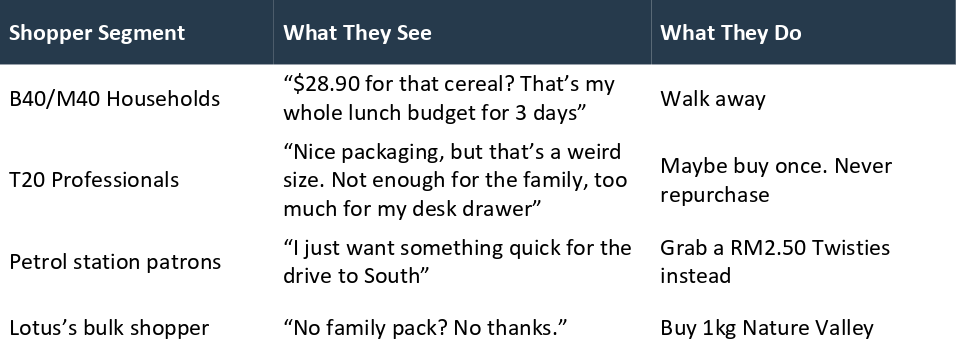
One SKU, one size, one price point is not a strategy. It’s a hope. And hope is not a P&L line item.
What Price Pack Architecture Actually Looks Like in Malaysia
PPA is simply the strategic planning of different pack sizes, formats, and price points for different occasions, channels, and consumer segments.
Let me show you what this looks like in the real Malaysian market—and no, you don’t need to be Nestlé to do it.
Case Study #1: The “Goldilocks” Price Band
There’s a Malaysian beauty brand that hit RM1.72 billion in GMV. Here’s how they structured their pricing:
Entry-level: RM2.58 lipstick for trial and TikTok impulse buys.
Core range: 58% of revenue came from the RM11–RM100 price band—affordable enough for a young working woman, premium enough to feel like a treat.
Premium tier: Bundles up to RM100+ for the serious beauty buyer.
They also leveraged bundling, which drove 62% of total sales. That’s PPA at work: the bundle is a “pack” with a different role—it increases basket size, solves choice paralysis, and improves margin.
Case Study #2: ZUS Coffee’s “Pricing Gap” Strategy
ZUS Coffee didn’t try to beat Starbucks at RM16 a cup. They didn’t try to beat the kopitiam at RM3 a cup. They found the gap.
Their specialty coffee sits between RM7 and RM10—premium enough to feel like a treat, but accessible enough for daily consumption. By 2025, they had 743 stores in Malaysia, more than Starbucks’ 320.
The lesson: PPA isn’t just about size. It’s about finding the price band where you can be the big fish.
Case Study #3: Eco-Shop’s Radical Simplicity
On the opposite end of the spectrum, Eco-Shop built a multi-billion ringgit valuation on a single price point: RM2.60 for everything.
But notice: This is PPA. The architecture is fixed price, variable product. They remove decision fatigue entirely. You walk in, you know exactly what you’re spending. The “pack” is the basket, not the individual SKU.
This works brilliantly for the B40 segment. But it only works because their entire supply chain and sourcing model is built around that RM2.60 anchor. You can’t half-commit to this model.
The Four Questions Every Malaysian Founder Must Answer
If you’re reading this and you currently have one SKU and one price, pull out a notebook. Here are the four questions I used during quarterly reviews:
- “Who cannot afford you right now—and do you want them to?”
In Malaysia, this is a brutally honest question. If you’re a premium brand and you’re okay staying premium, fine. But if you want B40 and lower M40 households—who are actively “waiting for promotions, switching to store brands, and evaluating product quality more closely”—to enter your franchise, you need an entry pack.
This doesn’t mean cheapening your brand. It means creating a trial SKU—a smaller size, a sachet, a sample pack—that gets the product into their hands for RM2 to RM5.
- “Which channel are you designing for?”
The pack that sits on a 99 Speedmart shelf (small, impulse-friendly, under RM10) is fundamentally different from the pack that sits in an AEON hypermarket aisle (larger, value-forward, family-sized). One size fits all = one channel fits all = you’re leaving money on the table.
- “What’s the ‘decoy’ in your lineup?”
This is the psychology hack that corporate giants use constantly: the middle option effect.
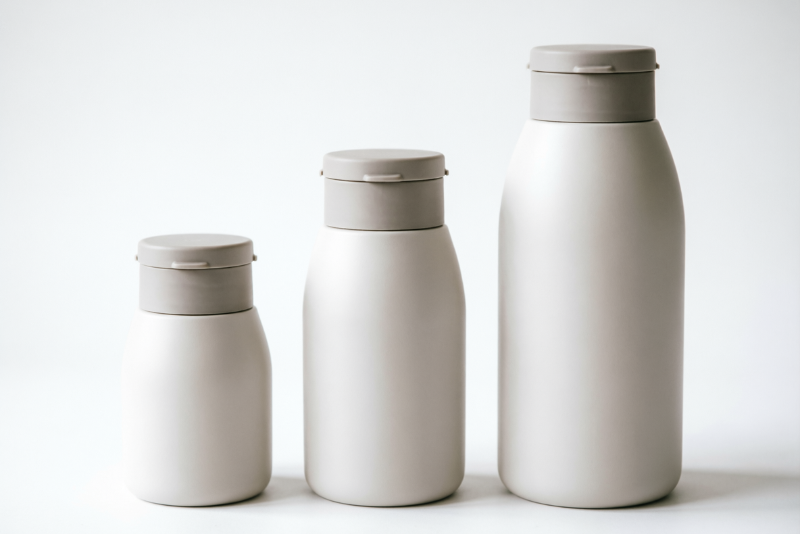
Offer three sizes. The smallest is “for trial.” The largest is “for value.” The middle one is where your margin lives. The middle one looks like the smart choice. Consumers naturally gravitate toward it.
- “What’s the occasion?”
PPA is often summarized as the OBPPC framework: Occasion, Brand, Price, Pack, Channel. The order matters. Occasion comes first.
Is this for a quick breakfast on the LRT? → Single-serve, grab-and-go, RM3–5.
Is this for stocking up before Raya? → Bulk pack, promotional price, family-sized.
Is this for a gift? → Premium packaging, higher price point, no discount expected.
If you can’t name the occasion for each SKU, you don’t have an architecture. You have a collection of sizes.
The Malaysian Startup Playbook: PPA Without the Corporate Overhead
You don’t need a pricing team in Singapore or a Nielsen dataset to do PPA. Here’s the stripped-down, founder-friendly version that works in Malaysia:
Phase 1: Launch with a “Gateway” Pack
Your first SKU should not be your flagship. It should be your gateway drug. Small enough to be affordable. Good enough to be memorable.
In Malaysia, where 77% of consumers are cost-conscious, the RM5–RM10 range is the magic window for trial. ZUS Coffee proved it with RM7–10 premium coffee. The beauty brand proved it with RM2.58 lipstick. Find your number.
Phase 2: Add the “Anchor” Pack Within Six Months
Once you have distribution and repeat buyers, introduce a larger format that makes the original pack look like a smart trial purchase. This is the anchor. It’s not meant to be your biggest seller—it’s meant to make your core SKU look like a good deal.
Phase 3: Bundle Before You Discount
Discounts train customers to wait. Bundles train customers to spend more. That beauty brand’s 62% of sales coming from bundles is not an accident. It’s intentional architecture.
Phase 4: Design for SARA and Festive Seasons
The SARA cash aid and duit raya move billions of ringgit during Ramadan and Chinese New Year periods. If you’re not thinking about a festive pack or a value bundle priced around RM10, RM20, or RM50 during these windows, you are invisible to millions of Malaysians with cash in hand.
The Two Traps That Kill Malaysian PPA
Trap #1: The “Loyalty” Trap
Founders fall in love with their core customer and design everything for that one segment. “But our fans love the 250g jar!”
Great. Keep the 250g jar. But also make a 100g trial jar for new customers and a 500g value jar for families. You’re not betraying your fans; you’re growing the base. Loyal customers will keep buying their preferred size. New customers need a door to walk through.
Trap #2: The “Wait Until We’re Bigger” Trap
“We’ll figure out pack sizes once we have more distribution.”
Wrong. You won’t get more distribution without the right pack sizes. Buyers at Lotus’s and AEON evaluate new SKUs based on whether the pack fits their shelf, their price band, and their shopper’s occasion. Show up with the wrong pack, and you won’t get a second meeting.
The Corporate Lesson I Learned the Hard Way
Early in my career, I launched a product in a 500g format because “that’s what the competitor did.” It failed. Not because the product was bad. Because the pack was wrong for the channel and the consumer.
Later, I learned that in corporate, we spend hours debating PPA before a single ingredient is finalized. We ask: What’s the role of each pack?
The small pack recruits.
The medium pack drives repeat.
The large pack drives margin and basket size.
Startups skip this conversation entirely. They pick a size based on “what feels right” or “what the co-packer can do cheapest.” And then they spend years wondering why they can’t crack 99 Speedmart.
The Final Word
Price Pack Architecture is not a corporate buzzword. It’s the difference between a product that collects dust on a shelf and a product that moves.
In Malaysia right now, with consumers “deliberate, waiting for promotions, switching to store brands, and evaluating product quality more closely before parting with their ringgit,” you cannot afford to guess.
Stop launching products. Start launching systems of products. Your next SKU shouldn’t be a new flavor. It should be a new price pack.
