


In the corporate office, we waste millions on “validation” that is essentially theater. We hire fancy agencies to ask 12 people in a room with a two-way mirror if they “feel” a sense of “premiumness” from a matte black label. We call this The Boardroom Test. It’s validation designed to make the SVP of Innovation feel safe, not to make the product successful.
You don’t have that luxury. You have a kitchen, a Google Doc, and maybe access to ChatGPT. Good. You are forced to use the only validation method that actually works: The Mom Test.
But here’s the rub—most people misunderstand The Mom Test. And when they misunderstand it, they end up with The Mom Trap, which is worse than no research at all. Let’s break down the difference so you don’t launch a $20 jar of pickled carrots that nobody except your aunt buys.
The Boardroom Test: How Corporate Lies to Itself
I’ve sat in rooms where we “validated” a flavor based on the fact that the CEO’s wife liked it at a dinner party. This is The Boardroom Test in its purest form: Data by Anecdote.
The typical Boardroom Test goes like this: “I showed the concept to my neighbor, who is a total foodie, and she said she’d pay $8.99 for this.”
This is validation cancer. Why?
- Courtesy Bias: Your neighbor doesn’t want to hurt your feelings. Your board member wants you to stop talking so they can get to lunch.
- The Wrong Demographic: Your neighbor in Desa Park City is not shopping at a Mydin in Subang Jaya.
- Hypothetical Money is Free: Saying you’ll pay $8.99 is different from physically handing over $8.99 when you’re tired and just want Oreos
The Boardroom Test exists to confirm the hypothesis. The Mom Test exists to shatter the hypothesis.
The Mom Test (The Real One): The Art of Shutting Up
Most founders think The Mom Test means: “Hey Mom, do you like my new protein bar?”
Wrong. That’s a trap. Your mom loves you. She will lie to protect your ego.
The real Mom Test (coined by Rob Fitzpatrick, and adopted by every successful FMCG hustler) has one rule: Don’t ask anyone if they like your product. Ask them about their life.
You don’t have a Nielsen panel. You have a Giant Hypermarket’s parking lot and the ability to be slightly uncomfortable talking to strangers.
Here’s the difference between the Trap and the Test when you have $0 budget.
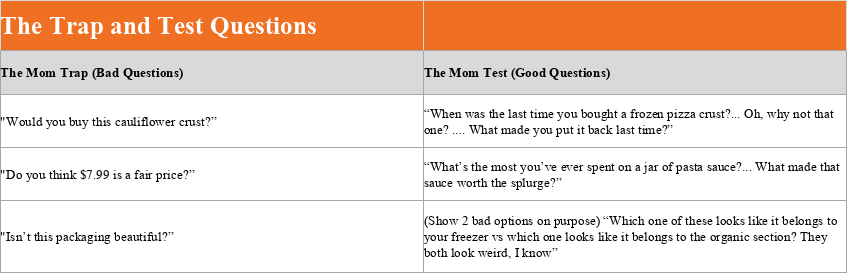
The FMCG-Specific Mom Test Playbook (For When You’re Broke)
You can’t afford a CLT (Central Location Test). Here’s how you get 80% of the insight for 0% of the cost.
- The “Dry Pantry” Interrogation
Instead of asking about your product, ask about the gap in their pantry.
Go to a friend’s house (one who won’t lie to you). Open their cabinet. Point to the second-best jar of soy sauce or the half-empty bag of chips.
Ask: “You clearly eat this. What’s the one thing about this that pisses you off every time you open it?”
The Corporate Insight: That “piss off” moment is your White Space. It’s the reason the $1B category has a 1% hole in it. Maybe the bag doesn’t reseal. Maybe the soy sauce is too watery. That’s your product brief, written by the consumer, for free.
- The “Buyer Remorse” Audit at the Checkout
This is the cheapest focus group in the world. Go to a grocery store on Sunday afternoon. Stand near the checkout of the aisle you want to enter (e.g., the coffee mixes aisle).
Watch people. Wait for someone to pick up a NESCAFE mix or a Aik Cheng mix—your competition. Then watch them put it back on the hook.
Politely (and I mean politely, don’t be a creep) approach them outside the store: “Hey, I’m sorry to bother you—I’m working on a coffee startup and I just saw you look at the coffee mixes. You’re exactly who I need to learn from. Can I ask why you put that bag back? I won’t try to sell you anything.”
The Corporate Insight: You just learned the Barrier to Purchase. The label is too busy. The price per pack felt off. The flavor was boring. That’s gold.
- The Dump Dinner Test (The Ultimate Validation)
In FMCG, liking is not validation. Repeat Purchase is validation.
You don’t have a store, so simulate one.
Give away 20 units of your product to friends-of-friends—not friends. Tell them: “This is a market test. I don’t want you to tell me if you liked it. I want you to text me in two weeks and tell me if you finished the bag or if it’s still sitting in the back of the pantry getting stale.”
The Corporate Insight: This is Velocity. If they didn’t finish the bag before the bag went stale, you have a Product Efficacy problem or a Craveability problem. No amount of marketing will fix a product that gets forgotten in the cabinet.
When The Mom Test Meets The Boardroom Test
Here’s the nuance the corporate guys miss: You actually need both, just at different stages and with massively different weights.
Use The Mom Test for the WHAT. (What is the job to be done? Why is the current option broken?)
Use The Boardroom Test for the HOW. (How does this scale? How do we make the P&L work?)
The Final Word
Stop asking people if they “like” your product. It’s a useless question that generates warm feelings and zero sales.
Go find the person who is angry about the can of tuna they bought last week. Go find the person who is ashamed of the amount of money they spend on yogurt.
That’s your 1%. That’s your validation.
Now get out of the spreadsheet and go stand in a grocery store aisle. Your research budget is a cup of coffee for the store manager and a thick skin.
