

In June 2017, Nature Republic—one of South Korea’s most visible K-beauty exporters—abruptly announced the closure of all 11 of its Malaysian stores. A red “CLOSED” stamp was placed across an image of their brand ambassador, K-pop idol group EXO, on their Facebook page. The brand that had ridden the Korean Wave into shopping malls across the Klang Valley was gone.
The official narrative pointed to a corporate scandal in Seoul. Nature Republic’s founder, Jung Woon-Ho, had been convicted on illegal gambling and bribery charges, sending the parent company into financial distress. That was true, and it certainly accelerated the brand’s decline. But it was not the full story.
Long before the scandal broke, Nature Republic was already losing in Malaysia. Not to competitors with better products. Not to a market that rejected K-beauty. But to a structural inability to adapt its promotion mechanics, pricing model, and channel strategy to the cultural purchase triggers of its most important customer segment: Malaysian Chinese consumers.
This is the case study that should be taught in every global brand’s APAC market entry workshop—because the mistakes Nature Republic made are being repeated right now by brands across categories that assume “promotion strategy” is universal.
The Counterfeit Problem Was Really a Pricing and Channel Problem
The most visible symptom of Nature Republic’s troubles was the counterfeit epidemic. Knock-off versions of their hero product—the Aloe Vera 92% Soothing Gel—flooded Malaysian e-commerce platforms and roadside bazaars. Blog posts appeared to help consumers distinguish between “real” and “fake” gels. Cases of severe allergic reactions from counterfeit products began surfacing on social media, potentially scaring users away from even authentic products.
Nature Republic’s response was to post on Facebook warning consumers not to buy from unauthorised resellers—and then to specifically call out Hermo, a reputable Malaysian e-commerce platform that sourced authentic K-beauty products directly from Korea.
This was not a counterfeit problem. It was a pricing and channel problem dressed in counterfeit clothing.
Malaysian Chinese consumers—the backbone of the K-beauty customer base in Malaysia—are value-conscious, digitally savvy, and promotion-driven. They comparison-shop across platforms. They wait for bundle deals. They calculate the cost-per-millilitre. When the exact same authentic Nature Republic Aloe Vera Gel was available on Hermo at a 30% discount through a bundle promotion, and in the official store at full retail price with no promotional mechanic beyond the occasional price-off, the consumer made the rational choice. Nature Republic lost the sale—not to a counterfeit, but to its own product, sold through a channel that understood Malaysian Chinese promotion preferences better than Nature Republic did.
PWP vs. Pure Discount: The Cultural Blind Spot
Here is the insight that Nature Republic never internalised, and that continues to confound global FMCG brands entering Malaysia.
Price-based promotions—straight discounts, percentage-off mechanics—have their place. Price-offs remain the dominant promotional mechanism in Malaysian FMCG, accounting for 21.0% of value share. But Multi Promos and Products with Free Gifts grew significantly in recent years, increasing their value share alongside Price-Offs. Not only did more shoppers purchase their groceries through these mechanisms, but the number of trips shoppers go on to purchase via these mechanisms increased as well.
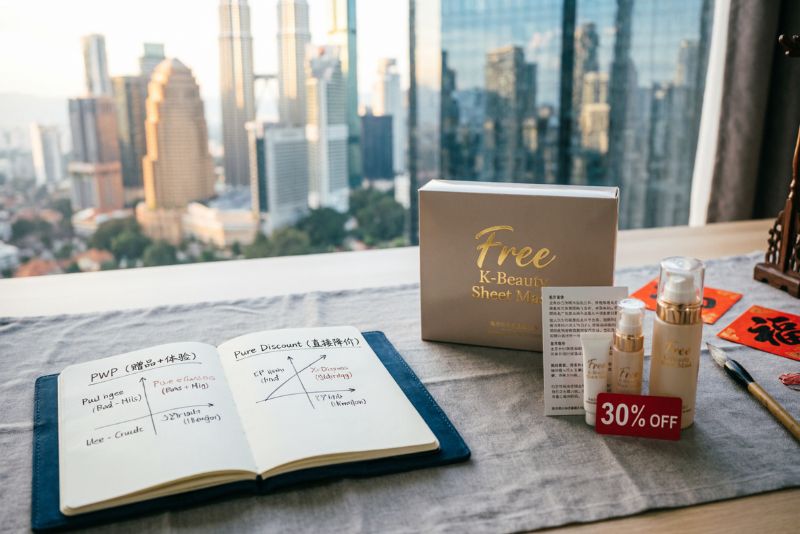
The Malaysian Chinese consumer, in particular, indexes high on value-added promotion mechanics: Purchase with Purchase (PWP), bundle deals, gift-with-purchase, and multi-buy offers. These mechanics satisfy three cultural purchase triggers simultaneously:
- Value calculation: The Malaysian Chinese shopper is a calculator. A 20% discount on a RM49.90 moisturiser saves RM9.98. But a “Buy One Get One Free” or a “Buy Moisturiser, Get Travel Kit at RM1” feels like a win—because the perceived value of the free or discounted item is anchored at its full retail price, not its cost.
- Gifting orientation: Research comparing gift-giving behaviour between Malay and Chinese consumers in urban Malaysia confirms distinct occasions and motivations for gift-giving. The Chinese consumer’s cultural orientation around gifting—particularly during Chinese New Year—makes gift-with-purchase a naturally resonant mechanic in a way that a 15% price-off can never be.
- Scarcity responsiveness: Limited-run gifts with purchase tied to seasonal or zodiac themes trigger faster purchase decisions. Scarcity is a powerful conversion trigger among Malaysian shoppers, particularly during festive windows.
A global beauty brand that lands in Malaysia running the same 20%-off sitewide promotion that worked in Myeongdong will underperform against a competitor who understands that the Malaysian Chinese shopper would rather pay full price and receive a deluxe sample set, a zodiac-themed pouch, or a “Buy 2, Get 3rd at RM1” mechanic.
The Stock Availability Trap
There was a third failure in Nature Republic’s Malaysian operations, and it is one that almost every global brand entering the market underestimates: stock availability.
A Vulcan Post journalist investigating the brand’s decline noted: “I can’t say for sure if this is the case in stores other than Klang Valley that I’ve visited, but when I walk into a Nature Republic store to look for a very specific item, I’m usually told that the item is sold-out.”
When hero SKUs are consistently out of stock, the Malaysian consumer does not wait. She substitutes. She goes to Innisfree, or Laneige, or to one of the dozens of other K-beauty brands competing for the same shelf. In a promotion-driven market where 97.5% of shoppers have purchased on promotion, and 34.5% of shopping trips involve a promotion, the consumer’s loyalty is to the deal—not to the brand. If your product is out of stock during a promotion window, she will buy the competitor’s product that is available and on deal.
The K-Beauty Gold Rush That Followed—and What the Winners Understood
Nature Republic’s exit did not signal the failure of K-beauty in Malaysia. Quite the opposite. In 2024 alone, South Korea’s cosmetics exports to Malaysia were approximately USD 120 million, ranking third in Malaysia’s cosmetics import market share after Chinese and European/American brands, accounting for about 12% of the total.
The K-beauty brands that succeeded—Innisfree, Laneige, Sulwhasoo, and newer entrants—understood that halal compliance, localisation strategies, and digital channels would determine future growth. They understood that the Malaysian Chinese consumer wants PWP, bundle deals, and exclusive gifts. They understood that the Malay consumer requires JAKIM halal certification as a non-negotiable entry requirement. And they understood that the Indian consumer—often overlooked—represents a distinct segment with its own festive calendar and promotion preferences.
Nature Republic’s failure was not a K-beauty failure. It was a localisation failure. The brand treated Malaysia as a distribution endpoint—a place to ship products designed for Korean consumers and promoted with Korean mechanics. The winners treated Malaysia as three distinct markets sharing a single passport.
The 10-Item Audit Checklist: Is Your Promotion Strategy Ready for Malaysia’s Multicultural Reality?
The following 10‑point audit is a preview of the full Malaysian Promotion Localisation Audit. To access the complete checklist—with competitive benchmarks, A/B testing templates, and ready‑to‑use calculation sheets—you can purchase the paid version.
10 questions to pressure‑test your strategy (teaser):
- Have I documented which promotion mechanics (price-off, bundle, multi-promo, free gift, PWP) perform strongest with each target ethnic community?
- Have I A/B tested a Purchase with Purchase or gift‑with‑purchase mechanic against a pure price discount among Malaysian Chinese consumers?
- Am I actively monitoring unauthorised e‑commerce channels for price erosion, and have I addressed the root cause—not just sent takedown notices?
- Do I maintain a minimum three‑week stock buffer on hero SKUs during promotional windows to prevent the out‑of‑stock substitution that kills repeat purchase?
- Have I designed distinct bundle packs for CNY, Raya, and Deepavali with culturally relevant pricing (RM68, RM88) and gift components?
- Beyond legal action, am I competing on value perception so the authentic product feels like a better deal than the counterfeit?
- For cosmetics/personal care targeting the Bumiputera segment, have I secured JAKIM halal certification, not just a “Muslim‑friendly” label?
- For my last five promotions, have I measured whether the volume lift was truly incremental or just cannibalised baseline sales?
- Am I using limited‑edition gifts, zodiac‑themed collectibles, or capped‑quantity offers to trigger the scarcity response Malaysian Chinese consumers favour?
- Are my distributors incentivised on sell‑through velocity (units per store per week), not just sell‑in volume?
Get the full audit: The paid version includes the complete Promotion Mechanic‑by‑Ethnicity Matrix and a P&L sensitivity tool for each mechanic [Purchase the Malaysian Promotion Localisation Audit here.]
The Nature Republic story has a footnote that most people miss. When the brand pulled out of Malaysia, it did not lose to a superior product. It lost to the same product—available cheaper, with better bundle deals, through channels that understood what Malaysian consumers actually wanted. The product was right. The promotion mechanics were wrong. And in Malaysian FMCG, the promotion mechanic is the product
