

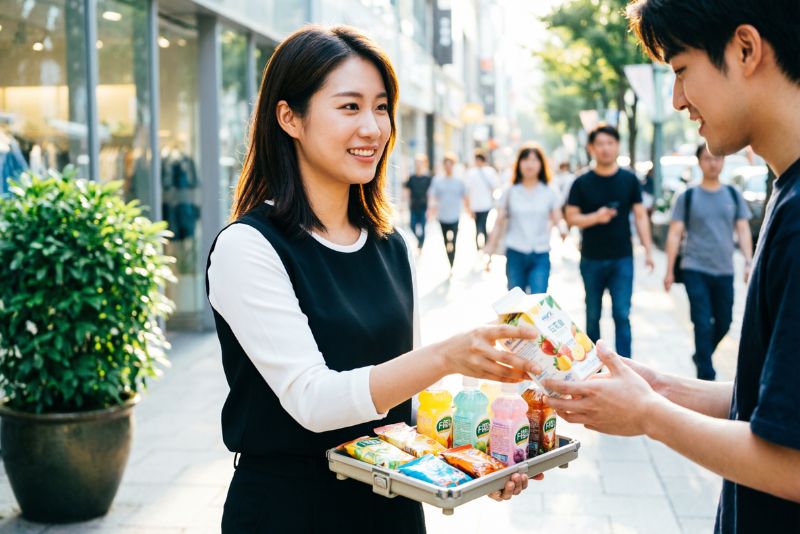
Let me describe a scene that has played out in every AEON, Village Grocer, and Jaya Grocer across the Klang Valley for decades.
A brand pays a staffing agency RM3,000 for a weekend activation. The agency sends two part-timers. They are university students. They were briefed via a WhatsApp message at 11 PM the night before. They arrive late. They have not tasted the product. They wear the branded t-shirt backwards.
For eight hours, they stand behind a small table, staring at their phones. When a shopper approaches, they mumble: “Mau try? Sedap.” The shopper takes a cube of your premium artisanal cheese on a toothpick, chews, nods politely, and walks away. No purchase is made. No story is told. No memory is formed.
The brand manager receives a report: “300 samples distributed. High foot traffic.” The report does not mention that 280 of those samples went to the same five aunties who circled back for free snacks three times.
This is the Sampling Industrial Complex. It is expensive. It is passive. And for a small FMCG brand in Malaysia, it is a slow leak of cash that will kill you before you ever reach the eye-level shelf.
Here is the alternative: Guerrilla Demoing. It costs a fraction of the price. It requires no agency. And when done right, it converts at a rate that makes the RM3,000 weekend activation look like a tax you voluntarily paid for disappointment.
Why Traditional Sampling Fails Small Brands
Before I give you the playbook, let me make the diagnosis painfully clear.
Reason 1: The Promoter Does Not Care About Your Brand
A part-time promoter paid RM10-12 an hour does not know the story of why you spent two years sourcing wild Tualang honey from Pedalaman. They cannot answer the question: “Is this sugar-free or just no-added-sugar?” They cannot handle the objection: “RM24.90 for a granola? I can buy oats for RM5.”
In a premium sampling scenario, the person handing out the sample is the brand. If that person is disinterested, your product tastes 30% worse. I have seen this in blind taste tests. The same product, sampled by a passionate founder, scores significantly higher on purchase intent than when sampled by a bored temp. That is not science. That is human psychology.
Reason 2: The Agency Model Incentivizes Volume, Not Conversion
Most sampling agencies are measured on reach: number of samples distributed, number of interactions, number of hours staffed. They are not measured on how many jars you sell off the shelf that day. They are not measured on whether the consumer comes back next week.
When your Key Performance Indicator is “cups emptied,” your team will empty cups. They will stand at the busiest junction of the store and hand samples to anyone with a pulse. They will not qualify the shopper. They will not tell a story. They will simply deplete your sample stock and go home.
Reason 3: The Cost Destroys Any Hope of ROI
Let me give you a realistic Malaysian costing. A weekend sampling activation at a mid-tier grocer:
- Agency fee: RM2,500–RM3,500 (including promoter wages, management, reporting)
- Product samples: RM300–RM500 (product cost, disposable cups, toothpicks)
- Promotional materials: RM200 (bunting, wobblers, shelf talkers)
Total: RM3,000–RM4,200 per activation.
Now, if your product retails for RM14.90 and your net revenue per unit after retailer margin is RM9.00, you need to sell 333 to 467 additional units just to break even on that weekend. If the promoter generates 40 incremental sales, you have lost money.
The Guerrilla Demo Playbook
Guerrilla sampling rejects all of the above. It replaces paid disinterest with unpaid passion. It replaces rented reach with earned trust. And it operates on the principle that the best person to put your product into a stranger’s mouth is someone who genuinely loves it.
Here are seven tactical methods, ranked by cost and difficulty.
Tactic 1: The Founder’s Table (Saturday, 10 AM to 2 PM)
This is the most obvious tactic and the least used. Founders are afraid of looking small. They want to project an image of scale—”We have an agency handling our activations.”
You are the best salesperson your product will ever have. You know the ingredient story. You know the reason the packaging has a matte finish. You know the exact face to make when someone says, “Wah, mahalnya.”
Once a month, book a demo slot at your best-performing store. Do not pay an agency. Pay yourself. Stand behind your product for four hours. Talk to shoppers. Watch their faces when they taste it. Ask them what would make them buy. This is the most powerful consumer research you will ever conduct, and it costs you nothing but your Saturday morning.
Cost: RM0 (beyond store slot fee, if any).
ROI: Incalculable, because you learn something every time.
Tactic 2: The Customer-to-Promoter Pipeline
You have fans. They are in your DMs. They leave five-star reviews on Shopee. They tag you in Instagram stories of their breakfast. Use them.
Identify five of your most vocal, passionate repeat customers—real people who already advocate for your product without being paid. Message them: “Hey, we’re doing a sampling session at Village Grocer Bangsar this Sunday. Would you be free to help for two hours? We’ll pay you RM50 an hour in cash, plus a month’s supply of product. No script. Just talk about the product the way you already do.”
Now you have a promoter who:
- Uses the product at home.
- Speaks about it with genuine enthusiasm.
- Is likely demographically similar to the shoppers you want to convert.
Costs you RM100 and some free stock, not RM3,000.
Cost: RM150–RM300 per session.
ROI: High, because authenticity converts.
Tactic 3: The Store Champion Program
In many Malaysian kedai runcit and even some independent grocers, the cashier or the owner’s wife is the most trusted recommender in the store. Shoppers ask them: “Which kicap is better?” They answer. The shopper buys.
Turn that person into your guerrilla promoter.
Walk into five independent grocers or mini-markets where your product is listed. Ask the owner: “I’d like to leave a tray of samples at the counter. If a customer buys my product, give them a free sachet of our new flavor. And for every jar you sell this month, I’ll give you RM1 per unit as a thank you.”
You are not hiring them. You are incentivizing them. The cost is purely variable—you pay only when a sale occurs. The promoter is already there, already trusted, already standing at the point of purchase.
Cost: RM1 per unit sold, plus sample stock.
ROI: Proportional to sales; zero fixed cost.
Tactic 4: The Nano-Influencer Live Tasting (Shopee and TikTok)
I have written about the RM100 influencer strategy before, but this is its sampling application.
Instead of paying a nano-creator to post, pay them to sample your product live during their Shopee Live or TikTok Live session. They cook with it. They taste it on camera. They answer questions about it in real time. Viewers watch, trust the creator’s reaction, and click the yellow basket.
This is a demo that reaches hundreds or thousands of people, costs you the product and perhaps a small fee, and generates attributable sales via affiliate links. It is sampling without the table, the toothpicks, or the bored part-timer.
Cost: Product samples + optional RM50–RM200 creator fee.
ROI: Trackable via affiliate sales.
Tactic 5: The Community Partnership (Piggybacking)
Your product does not exist in a vacuum. It pairs with something else. Your granola pairs with yogurt. Your sambal pairs with nasi lemak. Your cold brew pairs with milk.
Find a partner who already has a physical presence at a weekend market, a bazaar, or an event. A food truck. A pop-up stall. A farmer’s market vendor. Offer them free product and a small fee. Ask: “Can we place a small sampling tray at your counter? When someone buys your yogurt, they can try our granola on top.”
You are now sampling to a qualified, relevant audience—people who are already buying a complementary product—without paying for a booth, a permit, or a staffing agency.
Cost: Product + RM50–RM100 partner fee.
ROI: Highly targeted exposure to adjacent customers.
Tactic 6: The Surprise & Delight Drop
Not every demo needs to happen at a retail shelf. Sometimes the most effective sampling happens where the consumer is already hungry, already bored, or already in need of exactly what you sell.
Assemble 50 small sample packs. Add a handwritten note that says: “From our kitchen to yours. If you like this, find us at Village Grocer or order on Shopee. — [Your Brand Name]”
Now drop them at:
- The reception desk of a co-working space.
- The pantry of a corporate office (with permission from the office manager).
- A gym or fitness studio (if your product is protein or energy-focused).
- A parent-teacher association meeting (if your product is for kids).
Every single sample generates a potential word-of-mouth conversation. No staffing. No booth. No rental fee.
Cost: Sample product + packaging + your time.
ROI: Hard to track precisely, but zero fixed cost makes it infinitely scalable.
Tactic 7: The Booth-less Bazaar Walk
At a busy pasar malam or weekend market, a booth costs money. A tray does not.
Put on your branded t-shirt. Fill a tray with sample cups. Walk through the crowd. Offer a taste to anyone who makes eye contact. Smile. Say: “Homemade sambal, try?” If they love it, hand them a card with a QR code to your Shopee store.
Is this glamorous? No. Is it effective? Yes. Because you are not waiting for people to approach your table. You are putting the product directly into their path, exactly where they are, with zero friction.
Cost: Your time + sample stock + business cards.
ROI: Direct, personal, memorable.
The Measurement Problem: How to Know If It Worked
The most common objection I hear to guerrilla demos is: “But I can’t measure it like an agency report.”
You can. You just need to set up measurement before you start.
Method 1: The Simple QR Code
Print a small card with a QR code that leads to a special landing page or a Shopee store with a unique voucher code. Hand it to anyone who tastes the product. Track how many scans occur during and immediately after the demo window.
Method 2: The Weekend Velocity Check
If you demo on a Saturday, track the sales of that product in that specific store for the following seven days. Compare it to the average weekly sales before the demo. The lift—adjusted for any other promotional activity—is your demo ROI.
Method 3: The “Where Did You Hear About Us?” Question
If you have a Shopee store, add a mandatory question at checkout: “How did you hear about us?” Include “Tried a sample at [Store Name]” as an option. This gives you direct attribution.
The Guerrilla Demo Audit Checklist
Before you schedule another agency-sourced weekend activation, run through this:
- Founder Availability: Am I available to personally demo at least once a month? If not, have I identified a passionate team member who will?
- Customer Advocates: Have I identified five vocal fans who would happily demo the product for a small fee or free stock?
- Store Champions: Have I visited my top five independent retail accounts and offered the owner a small per-unit incentive for recommending my product at the counter?
- Nano-Creator Live Tastings: Have I briefed at least three nano-creators to sample my product live on Shopee or TikTok, with affiliate links?
- Community Partners: Have I identified three complementary food vendors at local markets and proposed a shared sampling arrangement?
- Surprise & Drop List: Have I identified five high-traffic, non-retail locations (offices, gyms, studios) where I can leave sample packs?
- Measurement Setup: Do I have a QR code, voucher code, or velocity tracking method ready before the demo begins?
- Agency Rethink: Am I currently spending money on a staffing agency for demos that could be replaced by any of the above tactics? If yes, kill it this quarter.
The One Thing to Remember
Here is the foundational insight I have carried through years of watching sampling strategies win and fail:
The person handing out the sample is the brand. If that person is bored, your product is boring. If that person is disengaged, your product is forgettable. If that person is passionate, your product is worth RM24.90—even if it is a jar of granola in a sea of RM8 oats.
You cannot buy passion from a staffing agency. You can only rent bodies. And the Malaysian consumer can smell the difference between a rented body and a true believer from the other end of the aisle.
Guerrilla demoing is not about being cheap. It is about putting the right person—you, your fan, your customer, your store champion—in front of the right shopper at the right moment. That person does not need a script. They need a product they genuinely believe in, and a reason to share it.
The RM3,000 agency fee is a convenience tax for brands that do not want to do the work. Do the work. The ROI will follow.
