

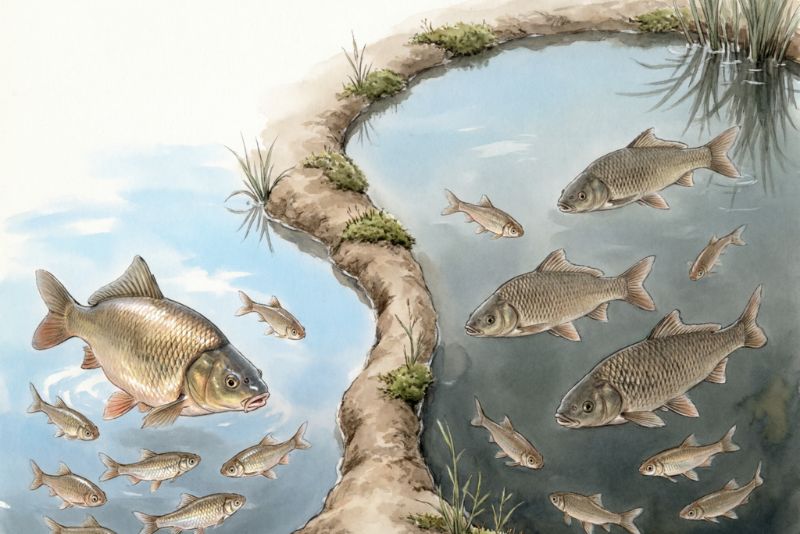
I’ll cut through the chase. If you’re a small FMCG player right now, you are likely bleeding cash and time fighting for shelf space in a closet-sized category. It’s time to stop chasing share and start chasing dollars. Aim for 1% of a $1 Billion category, not 50% of a $50 Million one.
Here’s why.
The “Red Pill” of FMCG Economics
There are two truths about resource allocation that corporate veterans know in their bones.
Truth #1: The Cost of Stealing Share is Logarithmic, Not Linear.
Getting from 0% to 10% market share in any category requires a certain amount of marketing spend and slotting fees. But getting from 40% to 50%? That cost doesn’t just double; it quintuples.
In a $50M niche, the last 10% of share is being defended by a desperate incumbent with zero margin for error. You will discount so heavily that your margin structure looks like swiss cheese. You’ll “win” 50% of nothing and a trophy that says “King of a Sinking Sandbox.”
Truth #2: The 1% Threshold in a $1B Category is Frictionless.
In a $1B category— like Snacks, Yogurt, or Biscuits—you are invisible to the Big Players until you hit about 3-5% share. At 1% ($10M in retail sales) , you are a rounding error on a P&L statement. They will not convene a war room to crush you. At 1%, you have scale. $10M in revenue buys you a real supply chain. It buys you a distributor who returns your calls. It buys you a slot on the top shelf, not the bottom “graveyard” shelf.
The Brutal Math Comparison
Let’s break this down like a real P&L review.
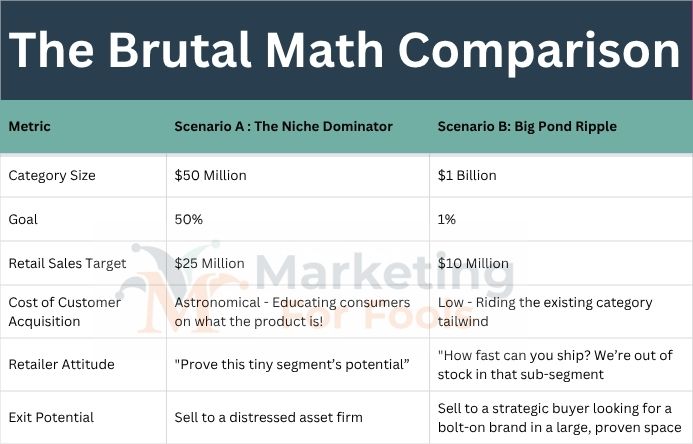
See the most painful irony: The “Big Pond” scenario requires less retail revenue to hit your goal. $10M is easier to achieve than $25M. And yet, most founders instinctively choose the $25M grind because it feels like there’s less competition.
“But the Big Category is Too Competitive!”
This is the #1 objection I hear, and it’s based on a misunderstanding of how competition works in FMCG.
Competition in a $50M niche is like fighting over the last lifeboat. It’s zero-sum. Every jar you sell is a jar the other niche player doesn’t sell. The buyers at Jaya Grocers know that. They will squeeze you on margin because if you leave the shelf, they can just fill it with private label.
Competition in a $1B category is actually collaborative noise. When you launch a new premium popcorn in a $3B snack aisle, you aren’t stealing from Twisties; you’re growing the premium tier of the category. You’re giving the Category Manager at Jaya Grocers something they desperately want: Higher $/g velocity.
When I was in corporate, we didn’t fear the brand taking 1% share in our category. We feared the brand taking 1% margin out of our category. If you aim for 1% share with a premium price point, we actually like you. You make the whole aisle look healthier and more expensive.
How to Execute the 1% Strategy
This isn’t about spray-and-pray. It’s surgical. Here’s the playbook we used in the office to make 1% work harder than 50%.
1. Find the “Neglected Sub-Segment” within the Giant
Don’t just say “I’m in the $10B Coffee Category.” Say, *”I’m in the $800M portion of the Coffee Category that is Ready-to-Drink and Oat-Based.”*
You need the macro current of the $1B category pulling you forward, but the micro niche to anchor your early adopter community. You use the giant category’s tailwind to offset the cost of the niche education.
2. Design for the Edge of the Shelf, Not the Center
You will never get the eye-level space in Lotuss on Day 1. Stop trying. Design your packaging to pop on the end-cap or on the secondary shelf. In a $1B category, 1% of shoppers are already looking for something new. Catch them as they walk past. You don’t need to convert the whole aisle; you just need to convert the bored shopper.
3. Sell Dollars, Not Units (The Category Manager Hack)
When you pitch a buyer for a $50M niche, you’re pitching “I’ll sell 50,000 units.”
When you pitch a buyer for 1% of a $1B category, you’re pitching “I will bring $10,000,000 in new, incremental dollar rings to this aisle.”
Retailers are measured on comp store sales growth. $10M is real money to a buyer. $1M (50% of a $2M niche) is a rounding error they will forget to reorder.
The Bottom Line
Everyone loves the idea of being a big fish in a small pond. But in FMCG, small ponds evaporate. They get delisted. They get crushed by the next trend cycle.
The $1 Billion ocean is vast, deep, and full of shelf-stable, high-margin, repeat-purchase customers. You don’t need to own the ocean. You just need a cup.
