

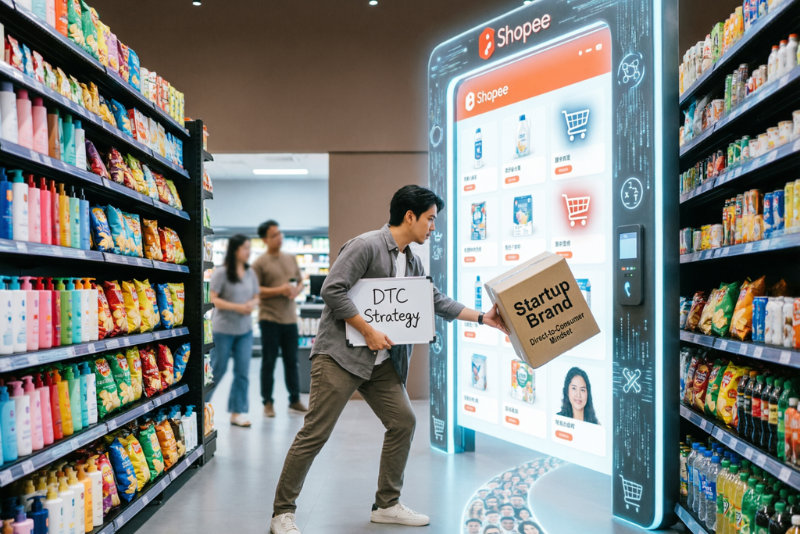
I wrote about The Shopee Trap last week for FMCG Starter brands but on the flip coin, established local FMCG brands too are failing at Shopee.
Here is the uncomfortable truth: Established local FMCG brands are losing on Shopee not because they lack brand equity—but because they treat Shopee as if it were a physical grocery shelf. And that mistake is every bit as costly as the startup’s mistake of treating Shopee as a DTC home.
Both groups fall into traps. But the traps are different. Startups mistake Shopee for a brand-building DTC channel. Legacy brands make the opposite error: they mistake Shopee for a passive distribution endpoint—a digital shelf where shoppers find you, pick you, and buy you, just like they do in Lotus’s or AEON.
That is The Grocery Aisle Trap. And it is quietly bleeding market share from some of Malaysia’s most beloved household names.
The Grocery Aisle Mindset: What It Looks Like and Why It Is Fatal
When I say “grocery aisle mindset,” here is what I mean. The brand manager at a legacy FMCG company thinks about Shopee the same way she thinks about a physical supermarket:
- List all SKUs. Just as you’d stock every variant on the shelf.
- Use a clean, recognizable pack shot. The same one that works at AEON.
- Price at or slightly below RSP. Protect offline channel pricing.
- Wait for shoppers to find you. They know the brand. They’ll search for it.
- Participate in monthly campaigns. The digital equivalent of an end-cap display during Raya.
This sounds rational. It sounds like good channel management. It is exactly how a well-run FMCG company should think about distribution.
And it is completely, fundamentally wrong for Shopee.
Here is why: In a physical grocery store, the shelf is static. A shopper walks down an aisle, scans the products, and picks the one she already knows or the one that catches her eye. The shelf does not change based on her behavior. The products do not rearrange themselves based on what she has previously bought. The shelf does not recommend, does not gamify, does not offer cashback in real time.
But Shopee is none of those things. Shopee is a dynamic, algorithmic, content-driven discovery engine—not a shelf. It has more in common with TikTok than with a Giant hypermarket.
The data makes this painfully clear. E-commerce is no longer just about fulfilling existing demand. It is about creating demand through content and discovery. Shopee’s own Seller Summit 2025 highlighted an expanding content ecosystem—Shopee Live, Shopee Video, and YouTube Shopping via Shopee Affiliates—powered by over 650,000 registered affiliates who collectively generated over 100 million pieces of video and livestream content in 2024, triple the previous year’s volume. Sellers who embraced these tools during the 11.11 Big Sale recorded up to 14 times more orders, with affiliate-driven Shopee Videos delivering 7 times more orders and Shopee Live driving 6 times more orders.
That is not a shelf. That is an entertainment and discovery platform that happens to process transactions. And if your strategy for it is “list all 47 SKUs and wait,” you are bringing a pasar malam stall to a television studio.
What Shopee Actually Is: A Discovery Engine, Not a Shelf
Let me break down the three structural differences between a physical grocery aisle and Shopee, because until you internalize these, no amount of campaign budget will save you.
Difference #1: Shelf Position Is Fixed. Search Ranking Is Fluid.
In Lotus’s, your product sits on Shelf 3, Position B. It stays there until the next planogram reset—maybe next quarter, maybe next year. A shopper who visits the soy sauce aisle every week sees your bottle in the same spot.
On Shopee, your product’s “shelf position”—its search ranking—is recalculated in real time based on dozens of signals. Shopee’s algorithm in 2025 weighs click-through rates, conversion rates, customer reviews, engagement signals, and more to determine whether your listing deserves page one or page ten. The platform has even split its search model into two separate systems: a cold-start model that gives new products a trial period of exposure, and a steady-state model that rewards products with stable, sustained performance over time.
The grocery-aisle brand manager assumes her brand’s offline equity will carry over: “Consumers know our brand. They will type our name into the search bar.”
But what happens when a competitor runs Shopee Live sessions five times a week, generating engagement signals that fuel their search ranking? What happens when a challenger brand’s Shopee Video content starts appearing in recommended feeds? The algorithm rewards activity, recency, and engagement—not brand heritage. Your 70-year-old brand, sitting passively on the digital shelf, gets buried under a pile of younger, hungrier brands that understand the game.
Difference #2: In a Grocery Aisle, You Compete With Adjacent Brands. On Shopee, You Compete With the Entire Internet.
The physical shelf has limited real estate. Your chili sauce competes against the four or five other chili sauce bottles within arm’s reach.
On Shopee, discovery is not limited to search results. Shoppers encounter products through Shopee Live streams, affiliate content, the “Daily Discover” feed, voucher-driven recommendations, and “Lagi Murah” tags. Around 60% of Malaysians use built-in features like daily vouchers, cashback offers, Shopee Coins, and the “Lagi Murah” tag to find deals. And notably, 58% of Malaysian shoppers now prioritize product quality and seller credibility over discounts when deciding whether something is worth buying.
This means your legacy brand is not just competing against other chili sauces in search. You are competing against every product—in every category—that is using content, affiliates, vouchers, and cashback to capture attention. The competition is not the brand next to you on the shelf. It is the brand that shows up in the consumer’s feed at the right moment, with the right incentive, validated by the right influencer.
Difference #3: A Grocery Shelf Cannot Build Loyalty. Shopee Can.
This is the most painful difference for established brands—because it represents an opportunity they are systematically leaving on the table.
On a physical shelf, a purchase is a transaction. The consumer buys, she leaves. The retailer owns the relationship. The brand may never know who bought their product.
On Shopee, the platform offers Shopee Mall Brand Memberships—a loyalty program that allows brands to identify and manage different customer segments through data analysis of customer profiles, purchasing habits, and preferences. Brands can set up membership tiers, award points for purchases, offer exclusive member benefits, and build customized shopping experiences.
This is not a shelf. This is a customer relationship management tool embedded inside a marketplace. And yet, I have sat across from brand managers at some of Malaysia’s most iconic FMCG companies who did not even know Brand Memberships existed, let alone have a plan to use them.
The result? Digitally native challenger brands are building loyalty programs, collecting customer data, and nurturing repeat buyers—all within Shopee’s ecosystem—while legacy brands treat the platform as a dumb pipe that moves boxes from warehouse to doorstep.
The Three Traps That Kill Established Brands on Shopee
Let me distill the ways the grocery-aisle mindset manifests into specific, fatal behaviors.
Trap #1: The “List Everything” Delusion
The thinking goes: *”We have 47 SKUs across five sub-brands. Our offline strength is our range. Let’s list them all.”*
This is the equivalent of demanding that AEON give you an entire bay for every product variant you have ever made. No physical retailer would agree to that. But on Shopee, there is no shelf constraint—so brands list everything.
The problem? Algorithmic fragmentation. When you list 47 SKUs without a content strategy, you are spreading your engagement signals across 47 listings. None of them accumulate enough reviews, enough sales velocity, enough click-through to climb the search rankings. You end up with 47 products sitting invisibly on page seven, while a competitor with three hero SKUs—backed by Shopee Live, affiliate content, and aggressive review generation—dominates the first page.
Trap #2: The “Same Pack, Same Price” Fallacy
Legacy brands are terrified of channel conflict. They do not want their online pricing to undercut their offline distributors. So they list their products at the same RSP, in the same pack format, with the same pack shot.
But the online shopper is not the offline shopper—even if she is the same person. Over 85% of Malaysian consumers now use a hybrid shopping model, switching between online and offline depending on the occasion, the product, and the incentive. Urban consumers particularly research online before purchasing offline, while East Coast consumers browse online but prefer to complete transactions in-store.
A 500ml bottle of soy sauce priced at RM8.90 that works beautifully on a Lotus’s shelf looks entirely different when it appears in a Shopee search result next to a challenger brand offering a 250ml trial bottle at RM4.90 with free shipping and 15% cashback. The legacy brand looks expensive. It looks inflexible. It looks like it does not understand how online shoppers make decisions.
Trap #3: The “Silent Shelf” Syndrome
In a physical store, your product can sell without saying a word. The pack design does the talking. Brand recognition does the heavy lifting. Shoppers see the familiar logo, reach, and go.
On Shopee, a silent listing is a dead listing.
As noted earlier, Shopee’s content ecosystem is the primary driver of visibility. Local sellers like Arwaafood—a preservative-free instant meal brand—built a community of over 660,000 viewers on Shopee Live in just three months by telling the story behind their ingredients and values. During the 5.5 Festival, their strategy of daily livestreams, strategic bundles, and timed vouchers drove a 144% increase in orders, with affiliate-driven efforts contributing over 40% of total orders.
Meanwhile, the legacy brand with 47 SKUs and zero livestreams wonders why its online sales are flat. It is not a mystery. It is the difference between a silent shelf and a 24/7 shopfloor salesperson who greets every customer, explains every product, and builds a relationship.
The Retailer Has Become the Competitor—And It Has Better Data
Here is a dimension of this trap that should keep legacy FMCG executives awake at night.
In a physical grocery store, the retailer and the brand have a symbiotic relationship. The retailer provides the shelf. The brand provides the product and the marketing pull. Both need each other.
On Shopee, the platform is increasingly blurring the line between retailer and competitor. Shopee’s own algorithms collect vast amounts of consumer behavior data—what shoppers search for, what they click on, what they abandon in cart, what price points convert—and that data informs everything from platform-level pricing recommendations to private-label product development.
Meanwhile, the platform’s fee structure continues to squeeze brand margins. Commission rates have risen from 3-5% to 4-7%. A platform support fee of RM0.50 per order (plus 8% SST) was introduced in July 2025. The cumulative effect can increase seller costs by approximately 20% per month, forcing brands to either raise prices or absorb margin erosion.
The legacy brand that treats Shopee as a passive shelf is essentially paying a mounting tax to hand its sales data to a platform that can—at any moment—identify the brand’s winning products and develop competing alternatives. This is not a retail partnership. This is an asymmetric information war, and one side does not even realize they are in it.
What Winning Looks Like: Brands That Escaped the Grocery Aisle Trap
Not every established brand is losing this battle. Some have figured out that Shopee is a different playing field—and have adapted accordingly.
Arwaafood is the textbook example of getting it right. This Malaysian brand sells preservative-free instant meals rooted in traditional recipes. Instead of listing their products and waiting for search traffic, they invested in Shopee Live storytelling—sharing the story behind their ingredients, their cultural roots, and their commitment to natural, healthy food. Their “mukbang” content on Shopee Video, created by affiliates, validates their product’s quality and taste for new buyers. In three months, their live sessions drew over 660,000 viewers. Their affiliate-driven efforts contributed over 40% of total orders during campaign periods.
Arwaafood is not a startup. They are an established Malaysian business that simply refused to treat Shopee as a grocery shelf. They treat it as a storytelling stage, a community hub, and a trust-building engine.
The contrast with most legacy FMCG brands could not be starker. One side is doing mukbang. The other side is uploading .jpg files of their 47 SKUs and calling it an e-commerce strategy.
JK Biscuits demonstrates the same principle from a different angle. This Perak-based business started as a humble fruit stall before evolving into a thriving online store shipping fresh produce nationwide. The challenge for fresh fruit is that shoppers want to touch, inspect, and choose. JK Biscuits adapted by using Shopee Live to cut fruit open on stream, showing customers exactly what they would receive. The founder said: “They know exactly what they’re getting.” That transparency built the trust that physical inspection normally provides—and it was only possible because they understood that Shopee is a platform for demonstration and interaction, not just a static product page.
The One Thing to Remember
Here is the truth I have learned from watching both sides of this battle:
Startups treat Shopee like a DTC home and bleed margin. Legacy brands treat Shopee like a grocery shelf and bleed relevance.
Both are wrong. Both lose. Both get beaten by the brands that understand what Shopee actually is: a discovery engine driven by content, community, and constant engagement.
Your brand’s offline heritage, your decades of trust, your category dominance in physical retail—these are extraordinary advantages. But they are not a strategy. A strategy is showing up every week on Shopee Live. A strategy is equipping affiliates with samples and letting them tell your story. A strategy is designing a membership program that turns a one-time buyer into a loyalist who chooses you—not because you were the cheapest, but because you earned the relationship.
Stop treating Shopee as a shelf. Start treating it as a stage.
Your consumers are already there, watching livestreams, scrolling videos, and discovering new brands. The only question is whether your brand will show up and perform—or sit silently on the bottom shelf, waiting to be found.
