

I once sat in a quarterly review where a junior brand manager proudly reported: “We posted 92 TikToks this month. Total views: 1.2 million. Engagement rate: 8%.”
I asked: “What did we sell?”
Silence.
Then, a nervous shuffle of papers. “Well, we can’t directly attribute sales to organic content, but we’re building brand awareness.”
This is the Content Flow Trap. It is the belief that the purpose of content is to keep the feed alive. Post, vanish, post again. Feed the algorithm. Chase the trend. Never stop.
I am here to tell you something that will sound like corporate heresy to the digital natives in your marketing team: Content that disappears in 24 hours is not an asset. It is an expense.
The most valuable content in FMCG is not the content that flows. It is the content that sits. That waits. That answers a question a consumer types into a search bar at 11:47 PM while standing in her kitchen wondering what to do with the half-empty jar of your sambal paste she bought last week.
That is stock content. And it sells when you are sleeping, when you are in a boardroom, and when your social media manager has quit and your TikTok account has gone dormant.
Flow vs. Stock: The Content Mindset Shift
I borrowed this framework from an old essay about internet media, but it applies with bulletproof precision to FMCG content strategy. Let me define it in clear, operational terms.
Flow Content is the feed. It is your daily TikTok, your Instagram Story, your Shopee Live session that disappears after 24 hours. It relies on the algorithm serving it to people right now. Its value is immediate, momentary, and almost entirely dependent on timing. It is like a newspaper—relevant today, lining a rubbish bin tomorrow.
Stock Content is the library. It is the product demo video that lives permanently on your Shopee listing. It is the recipe blog post on your website. It is the “how to store” guide pinned to your Instagram profile. Its value compounds over time. It is like a cookbook—equally useful on the day it is published and five years later. The best-performing posts for many brands are from months or years ago, steadily accumulating views and driving conversions.
The math is simple but brutal for brands that rely only on flow. As one industry analyst put it, posting daily social content without building a permanent library is like a supermarket paying staff to rearrange the shelves every morning but never actually stocking any product. The shelves look busy. The till is empty.
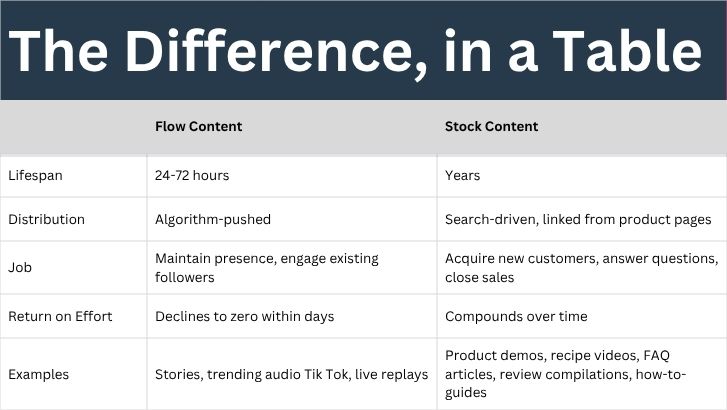 Neither is useless. Flow content keeps your brand alive in the daily scroll. But if your entire strategy is flow—if 100% of your content budget goes into things that vanish—you are building your brand on rented land with no foundations.
Most FMCG brands in Malaysia are doing exactly that. And then they wonder why their Shopee sales flatline the moment they stop posting.
Why the Content Library Matters More for FMCG Than for Any Other Sector
Here is a truth I have learned from decades of watching consumer goods categories: FMCG purchases are low-involvement, high-frequency, and driven by habit and trust. Nobody spends three weeks researching which soy sauce to buy. They buy what their mother used, or what they saw someone credible recommend, or what appeared when they searched “best soy sauce for fried rice” and found a helpful, detailed video.
But here is the catch: the moment of decision is tiny and often happens away from the shelf. As noted in the earlier post on bottom-shelf design, a shopper makes a product selection in as little as five seconds. That is not enough time to build trust from scratch. The trust must be built before the hand reaches for the bottle.
That is precisely what a content library does.
A well-constructed FMCG content library does three jobs simultaneously:
Discovery: It helps people who have never heard of your brand find you when they search for a problem your product solves.
Trust: It demonstrates your product in use, shows real people vouching for it, and answers the skeptical questions that block purchase.
Conversion: It closes the sale by removing the final uncertainty—”How do I use this? What does it taste like? Will my kids eat it?”
And it does these things while you are not working. Unlike a Shopee Live session that requires a host, a camera, and a schedule, a stock content video embedded on your product page works at 3 AM, during public holidays, and while you are on leave.
In Malaysia, where Shopee’s content ecosystem now rewards the accumulation of high-quality, permanent content—not just livestream volume—this shift has become urgent. The platform’s recommendation algorithm increasingly surfaces products with strong content depth: multiple videos, detailed descriptions, high review counts with rich media. The listing with one pack shot and zero videos loses to the listing with five use-case videos, a founder interview, and a UGC compilation. Every time.
The Four Shelves of Your FMCG Content Library
If you have zero stock content today, do not panic. You do not need a cinematic production. You need four types of content, and you can build them one at a time, with a smartphone and a kitchen counter.
Shelf 1: The “How to Use” Library
This is the workhorse. It answers the single most common question every FMCG product faces: “What do I actually do with this?”
For a sambal paste brand, this could be:
- 5 Ways to Use Sambal Belacan (That Aren’t Nasi Lemak)
- Sambal Fried Rice in 3 Minutes
- How to Marinate Chicken with Premium Sambal Paste
- A Week of Meals Starting with One Jar
Each video is 30-90 seconds. Each one can live on YouTube, on your Shopee listing, on your website, and as a pinned post on Instagram. Together, they form a library that a consumer can browse when she is standing in her kitchen, wondering whether your RM12.90 jar deserves her money.
This shelf serves the discovery job. Someone searches “easy sambal recipe” on YouTube or Google. Your video appears. They watch. They see your product in action. Trust begins.
Shelf 2: The “Behind the Scenes” Library
FMCG is a trust game, and trust is built on transparency. This shelf contains content that shows who makes your product, how it is made, and why.
This could be:
- A 2-minute factory walkthrough showing your production line and hygiene standards.
- A short film about the farmer who grows your key ingredient—say, the cili padi supplier in Kelantan or the pineapple grower in Johor.
- The founder’s story: why this product exists, what problem it was built to solve.
- A “day in the life” at your R&D kitchen, testing new flavors.
This content does not need to be updated. It sits permanently on your About page, your brand story tab on Shopee, and your YouTube channel. When a shopper on the fence types your brand name into Google, this is what convinces her that you are not just another private-label product with a nice label.
Shelf 3: The “Proof” Library
This is the shelf that turns skeptics into buyers. It consists of content created not by you, but by your customers, curated and organized.
Elements of this shelf:
- A compilation video of 10 real customer reviews, read aloud or shown as screenshots.
- User-generated content (UGC): photos and videos from customers using your product in their own kitchens.
- Before-and-after demonstrations: “This is what our energy drink looks like before a workout, and this is the result our customer achieved after 30 days.”
- Affiliate-created reviews on Shopee Video, embedded into your listing.
In Malaysia, affiliates are a massive, underutilized force. As I noted in a previous post, over 650,000 registered affiliates on Shopee generated more than 100 million pieces of video and livestream content last year. But most legacy FMCG brands treat affiliate content as a one-off campaign boost. The smart brand treats it as permanent library material—repurposed, embedded, and organized so that every new visitor to the product page encounters multiple voices vouching for the product.
Shelf 4: The “FAQ & Education” Library
Every category has a set of recurring consumer questions. Brands that answer them clearly and permanently win the search traffic and the sale.
For a premium honey brand:
- “Is your honey real? How to check honey purity at home.”
- “Why does honey crystallize? Is it safe to eat?”
- “How to store honey in a tropical climate.”
- “The difference between Tualang honey, Manuka honey, and wildflower honey.”
For a plant-based milk brand:
- “Is oat milk healthier than dairy? What the science actually says.”
- “Can you froth oat milk? Here is the technique.”
- “What to look for on the ingredients list of plant-based milk.”
These are blog posts, videos, and infographics. They rank on Google. They appear in search results for years. They drive consistent, passive traffic to your brand. And crucially, they position your brand as the category authority—not just a product, but a knowledgeable guide.
The Stock Content Audit Checklist
In my next post, I will be covering how you can build a content library on a Malaysian Start-Up budget but before you brief another TikTok trend, do an audit checklist of your current content assets. You can purchase the audit list here
