

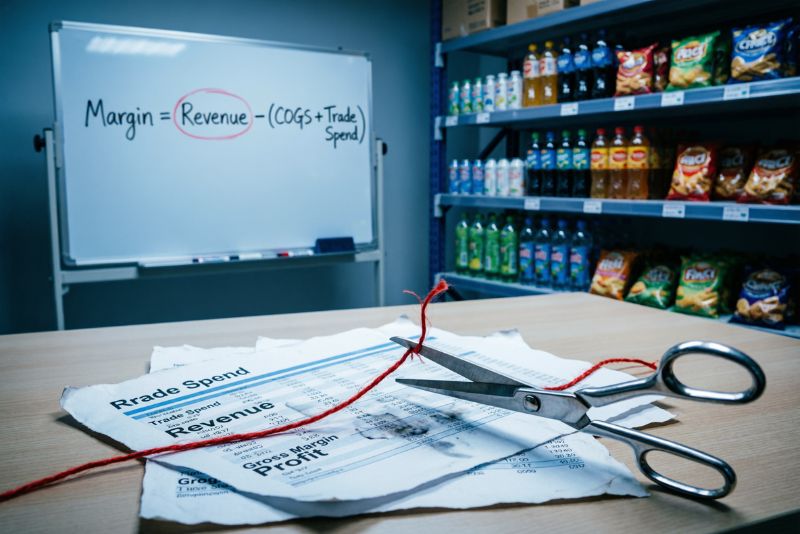
Question – “What’s your net revenue per unit after all trade deductions?”
If you’ve just pull out your COGS and deduct them from your list price and say, “About RM5.80.” then that number is wrong. Its not slightly wrong but dangerously, catastrophically wrong. The actual number, after listing fees, free fills, promotional discounts, coop advertising, slotting allowances, and retailer compliance penalties, should be closer to perhaps RM2.10? Your gross margin on paper was 42%. Your net revenue per unit after trade spend was 18%. You are, in effect, paying the retailer to sell your product.
This is trade spend. It is the quiet, compounding, structurally invisible tax that the FMCG industry imposes on brands that do not yet have the scale to negotiate from strength. And it is the number one reason small brands with great products and growing sales still run out of cash.
What Trade Spend Actually Is
Trade spend is every ringgit you pay—directly or through deductions—to get your product onto a shelf, keep it there, and persuade shoppers to pick it up instead of the product next to it. It is not one line item. It is a family of costs that multiply as your distribution grows.
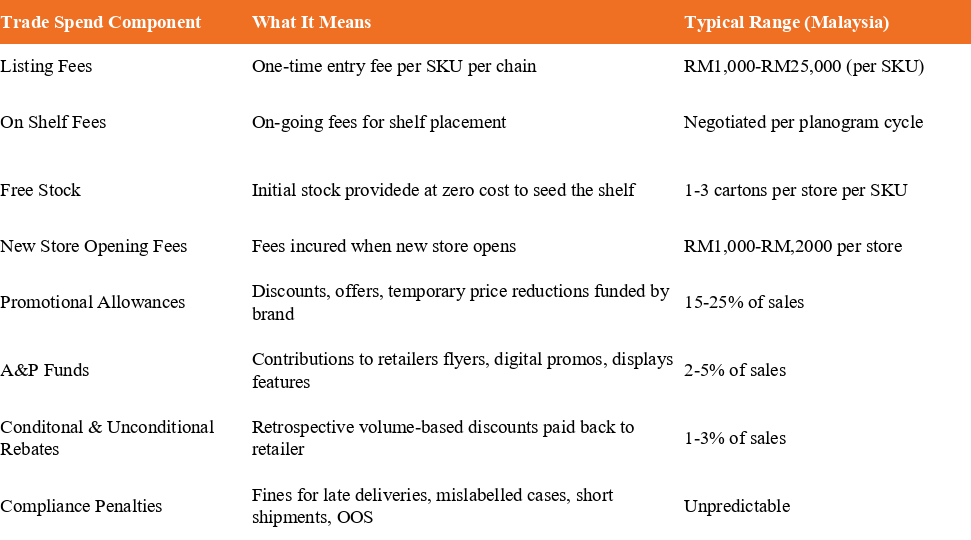
FMCG trade spend typically consumes 15% to 25% of gross revenue. For a brand doing RM3 million annually, that is RM450,000 to RM750,000 a year—before you have paid for raw materials, packaging, production, salaries, or logistics. McKinsey estimates CPG companies spend about 20% of revenue on trade promotions alone, yet 59% of promotions globally lose money. More than 60% of promotions actually destroy value. The money does not just disappear. It compounds the problem: every ringgit spent on an unprofitable promotion is a ringgit that cannot fund a profitable one.
The Gross-to-Net Waterfall: Where Your Margin Goes to Die
This is the single most important financial concept in FMCG, and it is the one that most small brands never learn until their cash has already evaporated.
Your gross list price is not your revenue. Your net revenue is what you actually receive after every deduction, discount, allowance, and penalty has been subtracted. The path from one to the other is called the gross-to-net waterfall.
Let me walk you through a realistic Malaysian example. A brand sells a premium snacks with a recommended retail price of RM12.90.
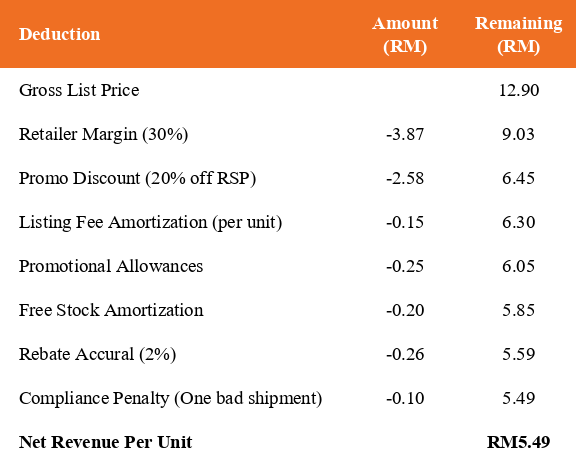
The product that the founder prices at RM12.90 delivers RM5.49 into the bank account. If COGS is RM4.50, the contribution margin is RM0.99 per unit—not RM5.80, not RM4.53. Ninety-nine sen. Out of that must come salaries, rent, warehousing, logistics, marketing, and everything else.
This is not an extreme example. Deductions from trade marketing programs and compliance penalties can consume up to 30% of gross revenue for brands that do not actively manage them. The waterfall is real, it is relentless, and it does not care about your brand story.
Why Trade Spend Hits Small Brands Hardest
Large FMCG companies have dedicated trade spend management teams. They have software that tracks every deduction, every promotion, every rebate accrual. They negotiate from a position of category dominance—the retailer needs them on the shelf more than they need any single retailer.
Small brands have none of this leverage. They pay higher listing fees per unit of revenue because they cannot spread the fixed cost across massive volume. They pay higher promotional rates because they lack the data to negotiate from strength. They suffer compliance penalties because their logistics are less mature. And they often do not even know how much they are really paying because trade spend is buried in dozens of invoices, credit notes, and deduction memos that no one on their small team has time to reconcile.
The result is a margin death spiral that looks like this: the brand enters retail to build awareness. Trade spend pushes net revenue below sustainable levels. The brand tries to compensate with more volume. More volume requires more distribution and more promotions. Trade spend rises as a percentage of revenue. Margins compress further. Cash reserves deplete. The brand cannot afford the next production run. Game over.
The Promotion Trap: Why You Cannot Discount Your Way to Profitability
Promotional discounts are the most visible and most dangerous component of trade spend. The industry-wide data is unambiguous: frequent, deep discounts hurt brand equity, erode reference price, and destroy profitability. Price discounts educate the buyer to focus on the lower price, and this negatively impacts perceived value. Consumers become more price sensitive and cost conscious. They no longer see your product as worth RM12.90; they see it as worth RM9.90, and only when on promotion.
The arithmetic is equally brutal. To maintain total gross profit after a discount, you must sell dramatically more units. The promotion breakeven formula:
Breakeven Volume Lift (%) = Discount (%) ÷ (Gross Margin (%) – Discount (%))
If your gross margin is 35% and you run a 20% discount:
Breakeven = 20% ÷ (35% – 20%) = 20% ÷ 15% = 133%
You must sell more than double your normal volume just to generate the same total gross profit. If the promotion does not reliably generate a 133% lift, you are destroying value.
Most promotions do not come close. And the hidden costs—cannibalization of other SKUs, forward buying by retailers, consumer stockpiling that depresses future sales—make the real breakeven even higher.
The Malaysian Playbook: How to Control Trade Spend Before It Controls You
Trade spend is not optional. You will pay it. The question is whether you manage it strategically or let it manage you.
Step 1: Build a Gross-to-Net Model Before You Enter a Single Store
Do not wait until you have 300 stores and 14 different deduction types to build your first gross-to-net waterfall. Build it now. For every SKU, in every channel, track:
- List price.
- Retailer margin.
- Every promotional discount, listed separately.
- Every allowance, rebate, and accrual.
- Every compliance penalty, categorized by cause.
The model does not need to be complex. It needs to be honest. Net revenue per unit, by SKU and channel, is the number that matters. Gross revenue is for marketing slides. Net revenue is for survival.
Step 2: Price Your Product With Trade Spend Baked In
The most common pricing mistake small brands make is setting their RSP based on COGS plus a desired margin, without accounting for the trade spend that will be deducted later. This guarantees margin erosion the moment the product hits a retail shelf.
The correct approach is to work backward from the net revenue you need to sustain the business, then add every expected trade spend deduction to arrive at the necessary list price. If the resulting RSP is uncompetitive for the category, you have a unit economics problem that no amount of distribution will fix.
Step 3: Shift From Price-Off to Value-Add Promotions
Every ringgit spent on a price discount reduces your net revenue directly and trains the consumer to value your product less. Value-add promotions—free samples of a new SKU, a branded premium gift, a limited-edition pack—preserve your reference price while still providing a reason to purchase.
Price-based promotions encourage people to buy more but also to value the product less. A value-add promotion adds perceived value without anchoring the brand to a lower price point. For small brands, this distinction is the difference between building a sustainable margin structure and slowly drowning.
Step 4: Trade Spend Negotiation Is a Skill—Develop It
You cannot negotiate listing fees the way Nestlé does. But you can negotiate. Ask for a lower listing fee in exchange for a trial period with measurable performance targets. Offer to fund a smaller, more targeted promotion rather than a blanket discount. Request that free fills be limited to a specific number of cases per store. Question every line item.
The buyer expects you to negotiate. If you accept the first offer without discussion, you signal that you do not understand the game. That signal costs you margin.
Step 5: Track Promotion Profitability Per Event, Not Just Total Revenue
After every promotion, run a simple post-mortem:
- What was the total cost of the promotion, including all deductions, free goods, and incremental logistics?
- What was the incremental volume generated during the promotion window?
- Did that incremental volume exceed the breakeven threshold?
- What happened to baseline sales in the four weeks after the promotion? Did they dip, suggesting stockpiling?
If a promotion consistently fails to pay for itself, stop running it. The data is telling you something. Listen to it.
The One Thing to Remember
Trade spend is not a cost of doing business. It is a cost of doing business poorly.
Every brand pays to be on the shelf. The brands that survive are not the ones that avoid trade spend—they are the ones that measure it, model it, negotiate it, and control it. They know their net revenue per unit to the sen. They know which promotions make money and which ones burn cash. They build their pricing from net revenue up, not from list price down.
The brands that die are the ones that look at their RM12.90 RSP and subtract their RM4.50 COGS and tell themselves they are making RM5.80. They are not. The trade spend waterfall has already swallowed most of that margin, and what remains is not enough to survive.
The waterfall does not care about your story. It cares about arithmetic. And the arithmetic of trade spend is the most important math you will ever do in FMCG.
Do it before the retailer does it for you.
