

Why This Toolkit Exists
You have read the blog post (if you have not, you might want to read them here first). You understand that a single “Aisyah” persona is a fantasy. You know that halal is a category entry requirement, not a positioning afterthought. You recognize that the Bumiputera, Chinese, and Indian communities are not just demographic lines on a census report—they are distinct markets with distinct purchase triggers, promotion preferences, and pack size expectations.
But knowing is not doing. Most brand teams nod along in the workshop and then return to their desks and brief the same pan-Malaysian campaign they were going to run anyway, just with a ketupat graphic added for Raya and a red packet graphic for CNY.
This toolkit is the bridge from awareness to action. It is a diagnostic instrument that forces you to score your brand’s current state against 10 critical multicultural readiness dimensions. It provides peer benchmarks so you know where you stand relative to the market. It delivers case examples so you learn from others’ mistakes instead of your own. And it concludes with a step-by-step remediation plan that tells you exactly what to fix, in what order, based on your score.
How to use this toolkit:
- Assemble a cross-functional team—at minimum, brand marketing, trade marketing, sales, and ideally someone who has lived experience in each of the three major ethnic communities.
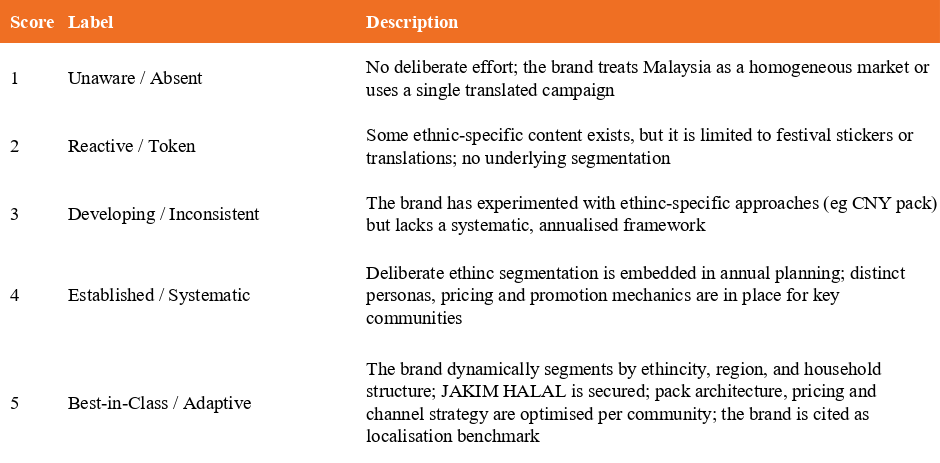
- For each of the 10 diagnostic questions, independently score your brand on the 1-to-5 rubric provided.
- Discuss discrepancies. The gap between a Chinese brand manager’s self-score and a Malay trade marketing executive’s score on Question 1 is itself diagnostic gold.
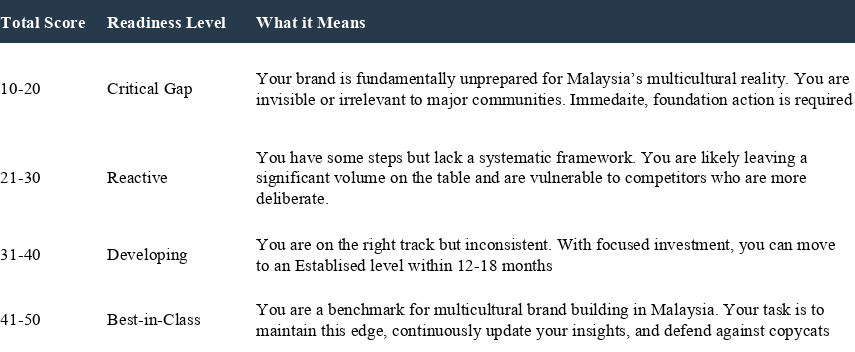
- Aggregate scores into the Overall Readiness Scorecard.
- Follow the Step-by-Step Remediation Plan mapped to your score range.
Disclaimer
This toolkit, including all diagnostic questions, scoring rubrics, peer benchmarks, and case examples, is provided for informational and educational purposes only. It does not constitute professional business, legal, or financial advice. You should consult with qualified professionals before making any strategic decisions based on the content herein.
Nature of Case Examples: The case examples presented in this toolkit serve illustrative and pedagogical purposes. Some examples are based on specific, publicly documented events involving named companies. Others are illustrative composites—scenarios constructed from aggregated real-world data, consumer surveys, census figures, market reports, and general industry patterns. These composites are not intended to represent the actual experience, strategy, or performance of any specific company, brand, or individual. Any resemblance to a particular entity’s actual circumstances is coincidental and not deliberate.
The author and publisher make no representations or warranties, express or implied, regarding the accuracy, completeness, or suitability of the information contained in this toolkit. To the fullest extent permitted by law, the author and publisher disclaim all liability for any loss, damage, or expense arising from reliance on this material.
By using this toolkit, you acknowledge that you have read and understood this disclaimer
The 10 Diagnostic Questions
Question 1: Have I designed my brand persona, messaging, and campaign with deliberate ethnic quota sampling—Bumiputera, Chinese, and Indian at minimum—rather than treating Malaysia as a homogeneous market?
Expanded Explanation: The foundational error is the “ASEAN consumer” composite. Malaysia’s three major ethnic communities differ in language, religion, household size, media consumption, festival calendar, and promotion response. If your consumer research is conducted only in English, only in Klang Valley, or only among urban 25-35 year-olds, you are seeing a sliver of the market. A deliberate quota sampling approach ensures your persona reflects the weighted reality of your category’s actual buyers.
Scoring Rubric:
1: All consumer research is aggregated; no ethnic quotas are applied in sampling; the brand persona is a single “Malaysian millennial.”
3: Some ethnic-specific focus groups have been conducted, but the findings are not systematically integrated into the annual brand plan; campaigns still default to a primary persona.
5: The brand maintains three validated consumer personas (Bumiputera, Chinese, Indian) for its core categories, updated annually with fresh quota-sampled research; all campaign briefs specify which persona(s) are being activated.
Peer Benchmark: Only a handful of multinational FMCG leaders—typically in categories like dairy, infant nutrition, and personal care—operate at Level 4-5. Most challenger brands and even some large local players sit at Level 2-3, doing occasional ethnic-specific activity without a systematic framework. The majority of global brands entering Malaysia for the first time are at Level 1.
Case Example: A global breakfast cereal brand launched with a single “health-conscious urban professional” persona. Sales flatlined outside Klang Valley. Post-mortem research with proper ethnic quotas revealed that Bumiputera mothers in suburban areas were the heaviest buyers—but they associated the brand’s English-only packaging with “expensive and not for us.” The brand was not rejected; it was invisible to its actual volume driver.
Question 2: For food, beverage, cosmetics, or pharmaceutical categories, have I secured JAKIM halal certification? If not, have I accepted that I am only addressing the non-Bumiputera 30% of the market?
Expanded Explanation: Halal is not a lifestyle choice for Muslim consumers. It is a religious obligation. JAKIM certification is the authoritative trust mark; self-declared “Muslim-friendly” or “pork-free” labels do not carry the same weight. A nationwide survey found that 69% of Muslim respondents specifically rely on JAKIM’s halal logo when making purchase decisions. In categories like cosmetics, where halal certification is less common, having it is a powerful competitive moat. Without it, your brand is structurally excluded from the Bumiputera majority—roughly 70% of Malaysian citizens.
Scoring Rubric:
1: No JAKIM certification; the brand uses “no pork, no lard” or “Muslim-friendly” messaging, believing it is sufficient.
3: JAKIM certification application is in progress for hero SKUs, but not all products are covered; the brand treats halal as a compliance task, not a strategic asset.
5: Full JAKIM certification across all relevant SKUs; the halal logo is prominently and proudly displayed on-pack; the brand communicates its halal credentials as a trust and quality signal, not just a religious checkbox.
Peer Benchmark: Most major multinational food and beverage brands in Malaysia hold JAKIM certification for their locally manufactured products. The gap is widest in imported premium categories (specialty cheeses, alcohol-free beverages, cosmetics), where smaller global brands often assume “no pork” is enough. In cosmetics, halal certification is a growing differentiator; brands like Safi and Wardah have built significant equity on it.
Case Example: A premium Korean skincare brand entered Malaysia without JAKIM certification, relying on “vegan” and “cruelty-free” messaging. It gained traction among Chinese consumers but could not penetrate the Malay majority. A competitor with JAKIM-certified products—priced similarly, with comparable formulations—captured the Malay market almost unopposed. The uncertified brand later found that 60% of its addressable category volume was locked behind the halal door.
Question 3: Am I reaching Bumiputera consumers in Bahasa Malaysia, Chinese consumers in their community dialect (Mandarin, Cantonese, Hokkien), and Indian consumers in Tamil—or am I defaulting to English for everything?
Expanded Explanation: English is the language of business, not necessarily the language of purchase motivation. Bumiputera consumers, particularly outside urban centres, respond to Bahasa Malaysia. Chinese consumers consume media in Mandarin, Cantonese, and Hokkien depending on dialect group and geography. Indian consumers are reached most effectively in Tamil. A brand that defaults to English is invisible in the feeds and search results of a significant portion of the population.
Scoring Rubric:
1: All brand communications are in English; social media captions are sometimes duplicated with a Google-translated Bahasa Malaysia version.
3: The brand maintains separate social media accounts or ad sets in Bahasa Malaysia and Mandarin, but creative is largely translated rather than original; Tamil is not addressed.
5: The brand creates original, culturally nuanced content in Bahasa Malaysia, Mandarin/Cantonese, and Tamil for each major festival and always-on campaigns; influencer partnerships are executed with creators who speak the community’s language authentically.
Peer Benchmark: Large FMCG players like Nestlé and Unilever operate at Level 4-5, with dedicated language-specific content teams. Smaller brands often start with English and add Bahasa Malaysia, neglecting Chinese dialects and Tamil entirely—leaving significant volume on the table.
Case Example: A local snack brand achieved breakout success by running entirely separate TikTok campaigns for Raya (Bahasa Malaysia, featuring Malay Muslim creators celebrating balik kampung) and CNY (Mandarin, featuring Chinese creators demonstrating the snack as a reunion dinner addition). The campaigns were not translations of each other; they were built from the ground up for the community. The result was a sales uplift that the previous “Happy Holidays” generic campaign never came close to.
Question 4: Do I know which promotion mechanics—price-off, bundle pack, multi-promo, free gift, PWP—resonate strongest with each of my target ethnic communities in my specific category?
Expanded Explanation: Promotion mechanic preference is culturally embedded. Malaysian Chinese consumers, for example, often respond more strongly to Purchase with Purchase (PWP), bundle deals, and gift-with-purchase because these mechanics trigger value calculation, gifting orientation, and scarcity responsiveness. Bumiputera consumers, especially for household staples, may respond more to straight price-offs and value pack discounts. Assuming a single promotion mechanic works across all communities is leaving volume on the table.
Scoring Rubric:
1: The brand runs the same promotion mechanic (usually a price-off) across all channels and communities; no ethnic-specific mechanic testing has been conducted.
3: The brand has tested different mechanics for different festivals (e.g., bundle packs for CNY, price-offs for Raya) but does not have a systematic, data-backed mechanic-by-ethnicity playbook.
5: The brand maintains a Promotion Mechanic Matrix that maps optimal mechanics to each ethnic community and festival, validated by at least 12 months of incrementality data; promotions are dynamically adjusted based on community response.
Peer Benchmark: Few brands outside the top tier operate at Level 4-5. Most run price-offs as the default because they are easy to execute. The brands that win in multicultural Malaysia are those that have invested in understanding mechanic preference at a granular level.
Case Example: Nature Republic’s failure (detailed in the companion case study post) is the standard example. The brand’s insistence on pure price discounts, while competitors like Innisfree offered PWP bundles and limited-edition gifts, meant it lost the Malaysian Chinese consumer—the core K-beauty demographic—to rivals that understood the mechanic preference.
Question 5: Have I designed pack sizes that match the household structures of my target communities? Am I offering larger formats for the average Bumiputera household of 4.1 people and smaller or premium formats for the Chinese household of 3.3?
Expanded Explanation: Household size directly impacts pack preference. A Bumiputera household averaging 4.1 people consumes more product more quickly and is more likely to buy larger packs or multi-packs for economy. A Chinese household of 3.3 may prefer smaller, more premium formats—fresher product, less storage space required, or higher per-unit willingness to pay for quality. A one-size-fits-all pack architecture ignores this structural reality.
Scoring Rubric:
1: The brand offers a single pack size; no consideration of household structure in pack architecture decisions.
3: The brand offers a few pack sizes, but they are designed around production efficiency rather than ethnic household needs; the link between pack size and community is not strategic.
5: Pack architecture is deliberately designed with ethnic household size in mind; larger value packs are targeted toward higher-density Bumiputera areas via specific retailers; premium compact packs are placed in channels that over-index on Chinese consumers.
Peer Benchmark: Brands like Mamee and Maggi have long understood this implicitly—offering both large family packs and smaller single-serve formats that appeal to different segments. In baby care, the differentiation is especially stark: a Mamilian (Chinese mom) shopping at a premium grocer may gravitate toward compact, premium, on-the-go wipe packs, while a Mak Andak (Malay mom) managing a larger household may buy bulk value boxes at a hypermarket.
Case Example: A baby wipe brand observed that its premium compact pack was selling strongly in urban stores with high Chinese foot traffic, while its bulk value pack dominated in suburban stores with predominantly Malay customers. By formalizing this insight—and adjusting distribution and trade marketing accordingly—the brand increased total category sales without cannibalizing itself, because each pack was serving a genuinely different household need.
Question 6: Do I know which retailers over-index among which ethnic and income groups, and am I placing the right SKUs in the right stores?
Expanded Explanation: Retail channel preference is not uniform. 99 Speedmart, for example, over-indexes among lower-middle-income Bumiputera households. Village Grocer and Jaya Grocer over-index among urban Chinese and expatriate communities. Lotus’s and AEON are broad-based but have different mall catchment demographics. Placing a premium, small-pack SKU in a 99 Speedmart in a rural area is a misallocation of inventory and listing fees. Placing a bulk value pack in a premium Bangsar grocer is similarly wasteful.
Scoring Rubric:
1: The brand uses a uniform distribution strategy; SKUs are pushed into all stores without demographic profiling.
3: The brand has a rough channel segmentation (e.g., premium SKUs to premium grocers) but does not drill down to store-level ethnic and income profiling.
5: The brand uses retailer loyalty card data (where available), Nielsen store-cluster data, or proprietary profiling to place specific SKUs in specific stores based on the ethnic and income profile of the catchment; planograms are customised accordingly.
Peer Benchmark: Large FMCG companies with dedicated category management teams operate at Level 4-5. Small brands typically operate at Level 2-3, relying on distributor push rather than pull-based assortment.
Case Example: A premium soy sauce brand noticed that its gift-box format sold out every Chinese New Year in AEON stores in Chinese-majority areas but gathered dust in similar-sized AEON stores in predominantly Malay areas. By shifting gift-box inventory to stores where the Chinese population index was above a certain threshold, the brand reduced markdown waste by 22% and increased festive revenue by 15%.
Question 7: Do I have distinct activations planned for Hari Raya, Chinese New Year, and Deepavali—not one “festive campaign” that lumps them together?
Expanded Explanation: The three major Malaysian festivals are not interchangeable. Hari Raya is driven by balik kampung, family gatherings, and rumah terbuka. Chinese New Year is about reunion dinners, gifting, and prosperity symbolism. Deepavali involves home decoration, sweet-giving, and religious observance. A single “Selamat Hari Raya, Gong Xi Fa Cai, Happy Deepavali” banner signals that the brand does not truly understand any of the communities it is targeting.
Scoring Rubric:
1: The brand runs a single festive campaign with all three festival greetings; creative is generic.
3: The brand creates separate visuals for each festival, but the underlying promotion mechanics and product offerings are identical.
5: The brand develops entirely distinct campaigns—creative, product assortment, pack formats, promotion mechanics, language, and media placement—for each festival, informed by the Racial-Ritual Map (see companion Fix post).
Peer Benchmark: Most FMCG brands at least create separate visuals, but far fewer tailor the commercial mechanics. The brands that do—designing a CNY gift-with-purchase that is meaningful to Chinese consumers, not a leftover premium—capture disproportionate festive volume.
Case Example: A beverage brand previously ran a “Malaysian Festive” campaign with the same “Buy 2 Get 1 Free” mechanic for all three festivals. After shifting to a CNY-specific “Buy 2, Get Limited-Edition Red Packet Set” and a Raya-specific “Family Pack Discount,” festive volume increased 34% without incremental trade spend—just reallocation.
Question 8: Have I researched and documented the distinct cultural purchase triggers for each community in my category, or am I assuming universal motivators?
Expanded Explanation: Purchase triggers differ. For example, in infant formula, Bumiputera mothers may prioritize halal certification and affordability, while Chinese mothers may prioritize premium imported origin and cognitive development claims. In cooking ingredients, a Malay consumer may be triggered by sambal compatibility, while a Chinese consumer may be triggered by wok-hei enhancement. Universal motivators like “quality” or “taste” are not sufficient; the cultural framing matters.
Scoring Rubric:
1: The brand assumes universal motivators; no ethnic-specific trigger research has been conducted.
3: Anecdotal or informal knowledge exists (e.g., from sales team feedback), but triggers are not formally documented or used in creative briefs.
5: Formal qualitative and quantitative research has identified the top three cultural purchase triggers for each major ethnic community for the category; these triggers are embedded in all communication briefs and NPD gate criteria.
Peer Benchmark: Very few brands do this systematically. Those that do gain a significant creative effectiveness advantage—they are speaking to a real, felt need rather than a generic benefit.
Case Example: A cooking oil brand discovered through research that Chinese home cooks associated “light, non-greasy” oil with high-heat wok cooking, while Malay home cooks associated “rich, fragrant” oil with deep-frying for kuih and gorengan. By developing two different SKUs with different sensory profiles and marketing them separately to the two communities, the brand increased total category share without cannibalization.
Question 9: Am I accounting for the fact that Klang Valley, Penang, Johor Bahru, and East Malaysia are different consumer landscapes with different ethnic compositions and different brand penetration levels?
Expanded Explanation: Malaysia is not Klang Valley writ large. Penang has a Chinese majority and a distinct Hokkien-speaking culture. Johor Bahru is influenced by Singaporean cross-border shopping. East Malaysia (Sabah and Sarawak) has its own indigenous ethnic groups, different dietary habits, and distinct logistics challenges. A national campaign that is optimized for Klang Valley may be irrelevant in Kuching.
Scoring Rubric:
1: The brand’s strategy is national in name only; all investment and creative testing happens in Klang Valley.
3: The brand acknowledges regional differences but does not adapt creative, pricing, or distribution strategies accordingly.
5: The brand has region-specific sub-strategies with dedicated budgets, adapted creative (language, cultural references), and tailored distribution plans; East Malaysia is treated as a distinct market.
Peer Benchmark: Many multinationals treat Malaysia as “Klang Valley plus the rest.” Local brands with strong distributor networks often have better regional penetration. East Malaysia is chronically underserved by premium brands.
Case Example: A coffee brand found that its Klang Valley-oriented “urban lifestyle” campaign performed well in Kuala Lumpur and Penang but flopped in Sabah and Sarawak, where local coffee culture is strong and national brands are viewed with some suspicion. By partnering with local East Malaysian influencers and highlighting the product’s compatibility with local breakfast rituals, the brand rebuilt trust and recovered volume.
Question 10: Does my brand messaging reflect the multicultural reality of Malaysia—acknowledging distinct identities while celebrating shared national experiences like food and sports—or does it feel like a global template with local stickers?
Expanded Explanation: Malaysians are proud of their multiculturalism. Research shows 67% identify as Malaysian first, and 76% believe brands have a role in promoting unity. The winning brand persona does not erase ethnic identity; it celebrates the distinct parts while finding common ground in shared passions—food, badminton, teh tarik, nasi lemak, the national football team. A global template with a hastily added ketupat graphic is visually and emotionally dissonant.
Scoring Rubric:
1: Brand messaging is a direct translation of a global campaign; local elements are limited to visual stickers.
3: The brand has a “Malaysianised” version of the global campaign, but it still feels like an adaptation rather than a locally born idea.
5: The brand consistently produces locally originated, culturally fluent campaigns that resonate across communities while honouring distinct identities; the brand is perceived as authentically Malaysian.
Peer Benchmark: Brands like Petronas (festive films), Milo (grassroots sports), and Khazanah (Merdeka campaigns) are the gold standard. In FMCG, most brands are at Level 2-3—localised adaptation but not local origination.
Case Example: A global instant noodle brand’s attempt to create a “Malaysian unity” ad by showing a Chinese family, a Malay family, and an Indian family all eating the same noodle bowl felt forced and was met with social media mockery. A competing brand instead focused on a specific shared ritual—the mamak supper—and showed real, unscripted diversity in a natural setting. The authenticity resonated; the ad became a cultural talking point and drove measurable sales uplift.
Bonus Section : Step-by-Step Remediation Plan
For Brands Scoring 10–20 (Critical Gap): The 90-Day Foundation Sprint
Week 1–2: Commission quota-sampled qualitative research—minimum three focus groups per major ethnic community (Bumiputera, Chinese, Indian) in your primary category. Do not outsource to a generic agency; brief them specifically on the 10 diagnostic questions above.
Week 3–4: Secure a JAKIM halal application consultant. Begin the certification process for your hero SKUs immediately. If certification is impossible in the short term, formally acknowledge that your addressable market is the non-Bumiputera segment, you might want to adjust all sales forecasts and trade spend accordingly.
Week 5–8: Build your first three proto-personas—one for each community—based on the research. Include language preference, household size, promotion mechanic preference, and primary purchase trigger. These will be rough, but they are your starting point.
Week 9–12: Audit your current pack sizes, channel distribution, and promotion mechanics against the proto-personas. Identify the three biggest mismatches (e.g., “We have no bulk pack for Malay households,” “We run only price-offs when Chinese consumers want PWP,” “We are not listed in any Tamil-language
For Brands Scoring 21–30 (Reactive): The 6-Month Systematisation Plan
Month 1: Formalise your ethnic segmentation framework. Move from anecdotal “we did a CNY pack last year” to a documented annual calendar that mandates distinct activations for each community and each major festival.
Month 2–3: Build a Promotion Mechanic Matrix. Using historical sales data (or a pilot), test at least two alternative mechanics for each community during the next available festival window. Measure incremental volume, not just total sales.
Month 4: Develop a Retailer Ethnic Profiling Map. Work with your sales team to assign a dominant ethnic and income profile to each of your top 50 stores. Adjust assortment and trade marketing accordingly.
Month 5–6: Create a regional adaptation playbook, starting with East Malaysia if it is part of your distribution. Commission small-scale research in Kuching and Kota Kinabalu. Adjust creative and media plans.
Re-score at Month 6. You should be approaching Level 4 on several questions.
For Brands Scoring 31–40 (Developing): The 12-Month Excellence Push
Quarter 1: Close any remaining halal or language gaps. If Tamil-language content is missing, commission it now. If East Malaysia is underserved, dedicate a budget line.
Quarter 2: Commission a full Racial-Ritual Map (see companion post). Integrate it into your annual brand planning cycle so that festive planning begins 6 months in advance, not 6 weeks.
Quarter 3: Pilot an original, locally originated campaign—not a global adaptation—that celebrates a shared Malaysian ritual (food, sports, balik kampung). Test it with all three communities before launch. Measure brand health metrics, not just sales.
Quarter 4: Conduct a full re-assessment using this toolkit. Aim for a score of 41+. Identify any remaining gaps and address them in the following year’s plan.
For Brands Scoring 41–50 (Best-in-Class): The Defence & Deepen Agenda
Defend: Monitor copycat activity. Use your established brand codes (colours, shapes, rituals) to make imitation obvious and costly.
Deepen: Expand your persona set to include sub-segments (e.g., young urban Malay professionals vs. suburban Malay families; English-educated Chinese vs. Chinese-educated Chinese). Invest in continuous panel data to track shifts in community-level preferences.
Export: If you are a local brand, consider whether your multicultural competence can be a competitive advantage in other diverse Southeast Asian markets (e.g., Singapore, Indonesia).
Share: Publish case studies. Present at industry forums. Become the benchmark. This attracts talent, retail partners, and investor interest
Appendix: Key Definitions
Quota Sampling: A sampling method that ensures subgroups (in this case, ethnic communities) are represented in proportion to their presence in the target population.
Purchase with Purchase (PWP): A promotion mechanic where the consumer buys a product at full price and is then entitled to purchase a related item (often a gift, limited edition, or complementary product) at a heavily discounted or nominal price.
Racial-Ritual Map: A strategic framework that documents, for each major ethnic community, which festivals drive what percentage of category volume, and the optimal pack, price, promotion, and placement strategy for each window.
JAKIM: Jabatan Kemajuan Islam Malaysia—the Department of Islamic Development Malaysia, the authoritative body for halal certification in Malaysia.
