

I have sat through exactly two types of marketing budget meetings in my corporate FMCG years. The first is the “spray and pray”: the founder divides RM100,000 equally across a radio spot, a few Instagram ads, a booth at a bazaar, and an influencer they personally like. The second is the “brand manager’s playground”: RM70,000 goes into a glossy TVC that airs during a Ramadan drama, RM20,000 into a press launch, and the remaining RM10,000 is clawed back by finance before any consumer ever touches the product.
Both meetings end the same way. Six months later, the brand has zero attributable trial, a shelf full of expired stock, and a founder who says, “Marketing doesn’t work.”
It does work. It just works in a specific sequence, and RM100,000—if you strip away trade funds, listing fees, and promotional subsidies—is not a branding budget. It is an awareness‑to‑trial engine. Your only job with that money is to make someone who has never heard of your product become someone who has bought it once. If the product is good, the repeat purchase will take care of itself. But if the trial does not happen, nothing else matters.
The Two Jobs of Every Marketing Ringgit
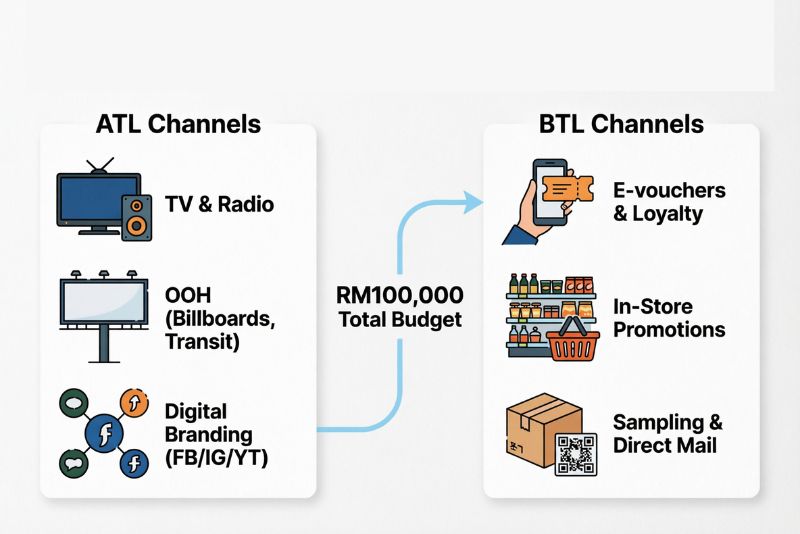
In FMCG, marketing spend outside of trade funds does two things. Above‑the‑Line (ATL) builds reach: it makes a large number of people aware that your brand exists. Below‑the‑Line (BTL) drives conversion: it puts the product into a specific person’s hand or mouth, often in a way that is measurable and trackable.
In the Malaysian context, the line between the two has blurred. A Shopee Live session with an affiliate is simultaneously a broadcast (ATL, reaching thousands of viewers) and a conversion event (BTL, because viewers can click the yellow basket and buy). A TikTok video made by a nano‑creator is ATL when it goes viral and BTL when it drives 50 direct sales via an affiliate link. But for budgeting purposes, the mental model is still useful: ATL makes them look. BTL makes them taste.
The fatal mistake I see most often is an allocation that fails to do either job properly. RM50,000 is spent on a radio campaign that reaches a million people, none of whom remember the brand name. The remaining RM50,000 is spent on a sampling activation at a single weekend bazaar that reaches 400 people. The brand has awareness without conversion, and conversion without awareness—and neither at sufficient scale to move the needle.
The RM100,000 Allocation Framework
Here is the rule of thumb I have developed from watching launches succeed and fail across multiple categories in Malaysia: spend 40% on reach (ATL), 50% on trial (BTL), and 10% on measurement and contingency. The framework is deliberately weighted toward BTL because, for a brand with no existing awareness, the most powerful awareness driver is word of mouth from someone who has tried the product. If you are not yet known, your trial is your ATL.
| Bucket | Allocation (RM) | Job to be Done |
| ATL: Reach & Awareness | 40,000 | Make 50,000 - 2 million people aware your brand exists within a defined target segment |
| BTL: Trial & Conversion | 50,000 | Put the product into the hands or mouth of at least 3,000-5,000 target consumers, with a measurable path to purchase |
| Measurement & Contingency | 10,000 | Track which ATL and BTL activities actually produced trial and fund the inevitable small crises |
Let me break down exactly what sits inside each bucket, with Malaysian‑specific costs and tactics.
ATL (RM40,000): The Reach Bucket
Your goal here is not to close a sale. It is to make a consumer feel a flicker of recognition when she sees your product on a shelf, in a Shopee feed, or in the hands of a friend. At RM40,000, you cannot afford television, billboards on the LDP, or a sustained radio campaign. You can afford targeted digital reach with creative that earns its attention.
Tactic 1: Meta and TikTok Advertising (RM20,000–RM25,000)
This is the workhorse of ATL for small FMCG brands in Malaysia. A well‑targeted campaign on Meta (Facebook and Instagram) and TikTok can deliver between 500,000 and 2 million impressions, depending on your cost‑per‑mille (CPM), which in Malaysia typically ranges from RM8 to RM25 for quality, conversion‑optimised audiences. The key is not to optimise for clicks or sales at this stage—you are optimising for reach and video views among a tightly defined audience that matches your target consumer profile. For a premium granola brand, that might be women aged 25–45, living in Klang Valley, Penang, and Johor, with interests in health, fitness, and premium groceries. For a mass‑market sambal, it might be a broader age range, nationwide, with an interest in local cooking content.
Creative for ATL should be a 15‑30 second video that shows the product being used in a real kitchen by a real person, ending with a simple brand name and tagline. No discount codes. No “Shop Now” button. Just a clear, memorable image of your product doing the job it was made to do.
Tactic 2: Nano‑Creator Seeding for Organic Reach (RM10,000–RM15,000)
I have argued before that a RM100 nano‑influencer strategy outperforms a RM10,000 celebrity. For the ATL bucket, nano‑creators function as a reach multiplier. Send your product to 50–100 nano‑creators (RM50–RM150 each in product value and a small fee). Do not script them. Ask them to use the product in their own kitchen, in their own way, and post an honest review. A percentage of those videos will perform well organically, generating tens of thousands of views and comments that your paid ads can then amplify. This is ATL earned through authenticity, not bought through media spend.
A practical allocation: RM5,000 in product samples and shipping, RM7,000 in small cash fees for the top 50 creators, and RM3,000 to boost the best‑performing organic posts into paid reach.
Tactic 3: Niche Digital Audio or Contextual Placements (RM5,000–RM10,000)
If your target consumer is a specific demographic—for example, urban Chinese professionals—consider a targeted placement on a popular Mandarin podcast or a sponsored segment on a food review YouTube channel with a loyal following. These placements are not cheap on a CPM basis, but they deliver attention and trust that a generic Meta ad cannot. One well‑negotiated podcast sponsorship at RM5,000 can generate more brand recall than RM15,000 of untargeted display ads.
BTL (RM50,000): The Trial Bucket
Your goal here is to put the actual product into the actual hands of a potential buyer, in a context where she can immediately purchase more. BTL without a purchase pathway is a hobby. BTL with a purchase pathway is a trial engine.
Tactic 1: Shopee and TikTok Shop Affiliate Live Tastings (RM15,000–RM20,000)
This is the most capital‑efficient BTL tactic in Malaysia right now. Affiliates on Shopee Live and TikTok Live will cook with your product, taste it on camera, and answer viewer questions in real time—all while the yellow basket sits on the screen, ready for purchase. As I have documented, brands like Arwaafood have built communities of hundreds of thousands of viewers through exactly this method, and the Shopee 11.11 campaign saw content‑driven sellers recording up to 14 times more orders.
Allocate RM8,000 in affiliate commissions (typically 4–13% per sale, so you pay only when a sale occurs), RM6,000 in free product for affiliates to sample live, and RM4,000 to boost the highest‑performing live replays into paid reach. This tactic simultaneously generates trial, creates permanent content, and produces attributable sales data.
Tactic 2: Guerrilla Sampling at Point of Purchase (RM15,000–RM20,000)
I have written an entire playbook on this. A founder‑led demo at a premium grocer on a Saturday morning costs essentially nothing except the product samples and the founder’s time. A customer‑turned‑promoter paid RM100 for a two‑hour shift is infinitely more convincing than a rented agency promoter at RM3,000 a weekend. A surprise‑and‑deliver drop of sample packs to 50 target offices, gyms, or co‑working spaces generates word‑of‑mouth that no paid ad can buy.
Your RM20,000 BTL sampling budget could fund:
- 20 founder‑led weekend demos at your top five retail stores over four months (RM5,000 in product samples and disposables).
- 10 customer‑turned‑promoter shifts (RM1,500 in cash, RM1,000 in free product).
- 500 surprise‑and‑deliver sample packs to offices, gyms, and community groups (RM7,000 in product and packaging, RM2,500 in delivery).
- 50 store‑champion incentive kits for independent grocer owners (RM3,000).
Each of these tactics puts your product into a specific hand, with a specific story, at a specific moment. That is BTL.
Tactic 3: Community Event and Partnership Sampling (RM10,000–RM15,000)
Malaysia is a country of weekend markets, food bazaars, and community events. A booth at a pasar malam or a weekend artisanal market costs RM200–RM500. A shared sampling station at a food truck, a pop‑up, or a fitness studio costs a partnership conversation and some free product. Allocate RM5,000 for booth fees and event logistics, RM5,000 for product samples and branded disposables, and RM5,000 for a simple, reusable pop‑up kit that makes your brand look credible. The goal is not to sell 500 units at the event. The goal is to generate 500 real conversations with real consumers who leave with a sample and a QR code to your Shopee store.
The Measurement and Contingency Bucket (RM10,000)
This is the bucket that separates professionals from amateurs. RM5,000 should fund a simple measurement system: unique QR codes on all sampling materials that lead to a dedicated landing page or a Shopee store with a unique voucher code, so you can track exactly which BTL tactic is generating trial and purchase. The remaining RM5,000 is your contingency: the influencer who cancels, the event that gets rained out, the production batch that needs an extra QA test. If you do not ring‑fence this money, you will cannibalise it into “just one more ad campaign” and lose the ability to measure anything.
What This Allocation Looks Like in Practice
| Tactic | Bucket | RM | Expected Reach / Trial |
| Meta & TikTok ads (reach-optimised video) | ATL | 22,000 | 800,000-1.5 million impressions among target segment |
| Nano-creator seeding (50 creators, boosted post) | ATL | 13,000 | 200,000-500,000 organic + boosted views |
| Niche podcast / Youtube placement | ATL | 5,000 | 20,000-50,000 highly engaged listens/views |
| Total ATL | 40,000 | ||
| Shopee / TikTok affiliate live tastings | BTL | 18,000 | 1,000-3,000 attributable trial purchases, 100,000+ live views |
| Guerrilla demos & customer-promoter shifts | BTL | 18,000 | 2,000-3,000 direct consumer samplings |
| Community event & partnership sampling | BTL | 14,000 | 500-1,000 direct consumer samplings |
| Total BTL | 50,000 | ||
| QR-code tracking, voucher codes, dashboard | Measurement | 5,000 | Attributable trial data by channel |
| Contingency | Contingency | 5,000 | Covers one major unforeseen event |
| Total Marketing Budget | 100,000 | ||
The result: you have reached roughly 1–2 million target consumers with a memorable brand impression, put your product into the hands of 3,500–5,000 potential buyers in a measurable, purchase‑linked way, and built a content library of demos, reviews, and UGC that will continue working long after the RM100,000 is spent.
The RM100,000 ATL/BTL Audit Checklist
Before you spend a single ringgit, run through these 10 questions. A “No” to any question means your allocation is not yet ready.
- Have I defined my target consumer segment with sufficient precision—age, income, geography, language, ethnicity, shopping behaviour—so that every ATL and BTL ringgit is aimed at the right person?
- Does my ATL creative pass the “Three‑Second Recall Test”—can a viewer remember my brand name and product category after three seconds?
- Have I allocated at least 50% of my total budget to BTL activities that result in a direct, measurable trial event (a taste, a sample, a first purchase)?
- Is every BTL tactic linked to an immediate purchase pathway—a QR code to Shopee, an affiliate link, a store‑specific voucher code—so that trial is never disconnected from a sales transaction?
- Am I using nano‑creators and affiliates on a performance basis (pay per sale or for product only) rather than paying large upfront fees to celebrities or macro‑influencers?
- Have I designed my sampling activities to generate content—live demos, customer reactions, behind‑the‑scenes videos—that can be repurposed as ATL reach assets?
- Is my measurement system (unique QR codes, voucher codes, tracked landing pages) in place before the first ringgit is spent, so that I know exactly which activities drive trial?
- Have I ring‑fenced at least RM5,000 as a genuine contingency, separate from the measurement budget, for the crisis I have not yet imagined?
- Does my budget allocate different creative, language, and channel mixes for the different ethnic communities I am targeting, rather than a single “pan‑Malaysian” campaign?
- Have I accepted that my first RM100,000 is not a branding exercise—it is a trial‑generation machine—and that the brand will be built by the repeat purchase of consumers who tried and loved the product?
Get the Full ATL/BTL Allocation Toolkit: The checklist above is the diagnostic. The full toolkit—available for purchase—includes an editable RM100,000 budget planner for five FMCG launch scenarios, a media cost benchmarking sheet for Malaysia (Meta, TikTok, radio, podcast, and event costs), a nano‑creator briefing template, and a QR‑code measurement setup guide. [Purchase the Full ATL/BTL Allocation Toolkit Here.]
RM100,000 spent on marketing should feel uncomfortable in its focus. If you are trying to be everywhere, you will be remembered nowhere. Spend 40% to make them look. Spend 50% to make them taste. Keep 10% to prove it worked. Everything else is corporate theatre.
