

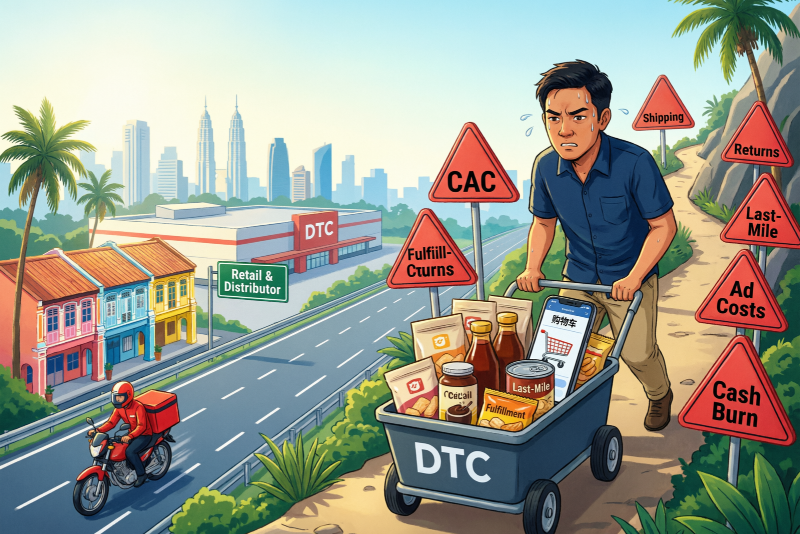
In my last post, I drew a line between three types of FMCG websites. Credibility engines. Discovery funnels. And shops. Then I made a claim that deserves a proper explanation: if you sell direct-to-consumer from your own site, that is a much harder business, and most FMCG brands should not start there.
Every founder I know has been seduced by the DTC dream. It usually sounds like this:
“If I sell on my own website, I own the customer. I get their email. I get their data. I don’t pay Shopee a commission. I control the margin. I build a real brand, not a marketplace listing.”
Every word of that is true. And every word of it is a trap for a small brand with limited resources.
Let me walk you through why DTC is the hardest path for a Malaysian brand. Not to talk you out of DTC forever. But to make sure that if you do it, you do it with your eyes open—and that you do not accidentally choose the hardest possible path before you have the resources to survive it.
Hard Truth #1: The Shipping Math Does Not Work at FMCG Price Points
This is the single biggest reason DTC is brutal for FMCG, and it is purely arithmetic.
FMCG products are cheap and heavy relative to their price. That is the definition of the category. A RM12.90 jar of sambal weighs 300 grams. A RM19.90 bottle of cold-pressed juice weighs half a kilogram. A RM8.90 packet of cookies weighs 200 grams.
Now let us look at what it costs to ship that product to a customer’s doorstep in Malaysia.
| Product | Retail Price | Typical Courier Cost (Pen Mal) | % of Shipping fees from Retail Price |
| Sambal Jar (300g) | RM12.90 | RM7.00-RM9.00 | 54-70% |
| Cold-pressed juice (500ml) | RM19.90 | RM8.00-RM10.00 | 40-50% |
| Cookies (200g) | RM8.90 | RM6.00-RM8.00 | 67-90% |
| Granola (400g) | RM18.90 | RM7-00.RM9.00 | 37-48% |
Pay attention to the last column. For most FMCG products, the cost of shipping is between forty and ninety percent of the retail price. Which means that if you offer free shipping—and in Malaysia, free shipping is table stakes—you are giving away most of your gross margin before a single ringgit of profit.
Now compare that to your unit economics. If your COGS is RM4.50 and your retail price is RM12.90, your gross margin is RM8.40. Subtract RM8.00 for shipping, and you have RM0.40 left to cover packaging, payment gateway fees, customer service, returns, and marketing. You are not running a business. You are running a charity with a logistics problem.
On Shopee, the platform subsidises shipping through vouchers, free shipping programmes, and its own logistics network. You cannot match that alone. So you either eat the cost and lose money on every order, or you charge for shipping and watch your conversion rate collapse.
Hard Truth #2: You Have to Buy Every Customer. Every Single Time.
On Shopee, when a customer searches for “sambal paste,” she finds your listing alongside your competitors’. You did not pay for that discovery. Shopee’s traffic—built over years and billions of ringgit of marketing—is now working for you.
On your own website, there is no traffic. There is no search engine that sends you shoppers in buying mode. There is you, a Meta ads account, and the cold, unforgiving arithmetic of customer acquisition.
Here is what that arithmetic looks like in Malaysia:
Meta ads CPC: RM0.40–RM1.50 depending on targeting.
Click to purchase conversion rate: 1–3% for a new brand with no existing trust.
Cost to acquire one customer: RM30–RM80.
Your gross margin on the first order: RM8.40 minus shipping = often negative.
You are paying RM30 to RM80 to acquire a customer whose first purchase loses you money. The entire DTC model depends on that customer returning three, four, five times, until their accumulated lifetime value finally exceeds your acquisition cost.
For commodity FMCG—the kind of product a shopper buys on impulse and does not think about again—the repeat rate is often low. She tries your granola, finishes the bag, and buys whichever granola is cheapest on Shopee next month. The DTC thesis assumes loyalty that most FMCG categories do not produce.
Hard Truth #3: The Malaysian Consumer Defaults to Marketplaces
This is the cultural reality that global DTC playbooks miss entirely.
In the United States, a consumer who hears about a brand might Google it and buy from the brand’s own website. In Malaysia, the reflex is different. She opens Shopee. She opens TikTok Shop. She searches for the product there, compares reviews, checks the voucher, and buys from whichever seller offers the best deal.
Shopee alone dominates the market, with seven in ten Malaysians having shopped there in the past six months. Marketplace trust—built on buyer protection, reviews, ratings, and returns—does the credibility work for you. A standalone website, particularly one belonging to a brand she has never heard of, triggers a different question: Is this real? Will I get scammed? What if the product never arrives?
That trust deficit is expensive to overcome. You must build reviews, establish a visible presence, offer guarantees, and prove yourself repeatedly. On Shopee, the platform has already done all of that for you. You are borrowing its trust.
Hard Truth #4: You Become a Fulfilment Operation
When you sell on Shopee, you still pack and ship orders—but the platform handles payment processing, buyer protection, dispute resolution, and returns infrastructure. When you sell on your own site, all of that is yours.
You need:
- A payment gateway. iPay88, Billplz, Stripe, or similar. Each takes 2–3% per transaction.
- Fraud management. Because chargebacks and fraudulent orders are now your problem, not the platform’s.
- A returns process. FMCG returns are often unsellable—opened products, perishables, damaged goods. The cost of processing a return often exceeds the value of the product.
- Customer service. Someone to answer the “where is my order” messages, which will arrive in volume.
- Warehousing and inventory management. You now hold stock, manage expiry dates, and absorb the cost of slow-moving SKUs.
This is a real operational capability, not a side task. Most small FMCG founders are already stretched thin. Adding a fulfilment operation is how they burn out in Month Eight.
When DTC Does Make Sense
Its not that DTC is never the right answer. It is the right answer under specific conditions:
High average order value. If your product sells for RM150 or more, the shipping cost becomes a manageable percentage of the transaction, and the gross margin can absorb the acquisition cost. Premium skincare, supplements, and gifting hampers can work. A RM12.90 sauce cannot.
Subscription or replenishment model. If your product is consumed regularly and customers want it delivered on a schedule, DTC becomes a retention machine. Coffee, pet food, and baby products are natural fits. It is also why DTC works for certain categories and fails for others.
An existing community that trusts you. If you have built a following on social media, a WhatsApp list, or through physical retail—and your customers already know and love you—the cost of acquiring them on your own site is dramatically lower. You are not buying strangers. You are inviting people who already want what you sell.
A genuine data and relationship need. If you are building a brand where understanding your customer’s preferences, purchase cycles, and feedback is strategically critical, owning that data justifies the DTC investment.
You have the capital to fund customer acquisition. DTC is a pay-to-play model. You need working capital to acquire customers at a loss for the first six to twelve months while you build lifetime value. If you do not have that capital, do not start.
The Smarter Path for Most Malaysian FMCG Brands
Here is what I would recommend to almost every small FMCG founder in Malaysia.
Start on Shopee. Build your listing, generate your first reviews, learn what your customer actually wants, and use the platform’s traffic and trust to get your product into the market. It is the cheapest way to discover whether your product has genuine demand.
Use your brand website as a credibility and discovery engine. It tells people you are real. It ranks in Google. It hosts your content library. It pushes traffic to your Shopee listing. But it is not your primary sales channel.
Then—only then, after you have proven demand and built a community and have the cash flow to support it—consider building DTC capabilities. Maybe start with a small, invitation-only DTC channel for your most loyal customers. Offer subscription. Offer bundles. Test the economics on a small scale before committing.
The sequence matters. Shopee first, website second, DTC third. Founders who reverse this sequence burn their capital on customer acquisition before they have proven they have a product worth acquiring customers for.
The DTC Readiness Checklist
Before you commit to selling direct from your own website, run through this. If you answer “no” to more than three, DTC is not your next move.
- Is my average order value above RM100, such that shipping costs less than 15% of the transaction?
- Do I have a product that customers repurchase on a predictable cycle, making a subscription or replenishment model viable?
- Have I calculated my fully loaded customer acquisition cost—including ad spend, shipping, payment fees, and returns—and confirmed it is lower than my gross margin per order?
- Do I have at least 12 months of working capital to fund customer acquisition at a loss while building lifetime value?
- Do I already have a community of customers who trust my brand, or would I be acquiring cold traffic from scratch?
- Have I proven product-market fit on Shopee or through physical retail before attempting to build my own sales channel?
- Do I have the operational capability—or the willingness to hire it—to manage payment processing, fraud, returns, and customer service?
- Have I built a retention mechanism (email flows, WhatsApp broadcast, loyalty programme) that will drive repeat purchases without additional ad spend?
- Do I have a content library that generates organic traffic, reducing my dependence on paid acquisition?
- Am I prepared to accept that DTC is a slower, more expensive path to profit than marketplaces—and that it only works if I can sustain the investment?
DTC is not a better business. It is a harder business. It is harder because you own everything—the traffic, the trust, the logistics, the returns. Ownership is only valuable if you can afford to carry it. For most small FMCG brands in Malaysia, the smarter move is to borrow someone else’s infrastructure until you are strong enough to build your own.
