

I have a confession to make. I’ve seen countless small brand owners walk into pitch meetings carrying a burden they simply do not need to carry. They believe that to own a distinctive brand code—a color, a shape, or a visual asset that lives in the consumer’s mind—you need a media budget the size of Petronas’s annual marketing spend.
They see the Tiffany Blue Box. They see Coca-Cola’s contour bottle. They see Maggi’s yellow and red packaging screaming at them from the instant noodle aisle at 99 Speedmart. And they think: “We can’t compete with that. We don’t have RM10 million for a TVC during Anugerah Juara Lagu.”
This is the single most expensive misconception in Malaysian FMCG brand building.
Here is the truth that corporate executives know but rarely say out loud: You don’t need a big marketing budget to own a brand code. You need consistency, audacity, and the willingness to look a little bit weird at first.
What Is a Brand Code in FMCG Marketing?
Before we dive into the brand code strategy that works for small FMCG brands, let’s define it clearly.
A brand code is a distinctive visual or sensory asset that triggers instant brand recognition—even when the logo is completely absent. It’s the thing that makes a consumer think of you before they’ve consciously read your brand name.
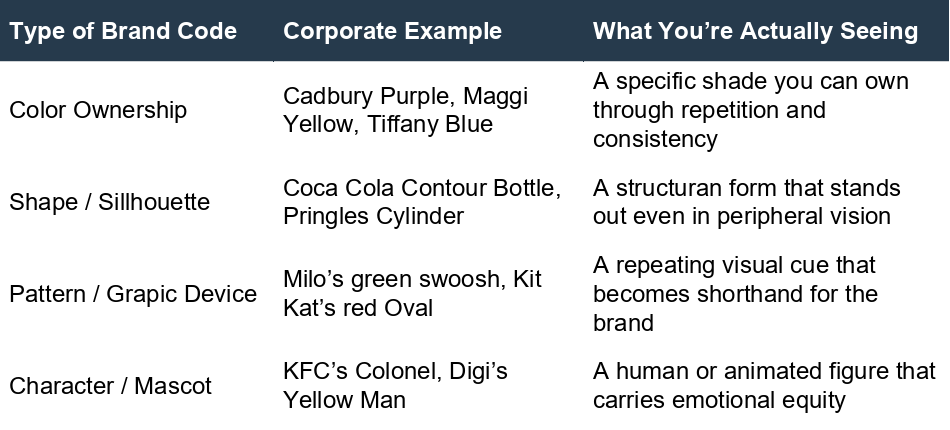
The FMCG shelf is a battlefield of visual noise. According to industry analysis, category codes—the visual cues that define “what good looks like” on shelf—have become so systematized that private label brands now brazenly copy them. When Carrefour can mimic Nescafe’s iconic red mug, you know the game has changed.
But here’s the brand building opportunity hiding in plain sight: Most categories in Malaysia have no clear brand code owner yet.
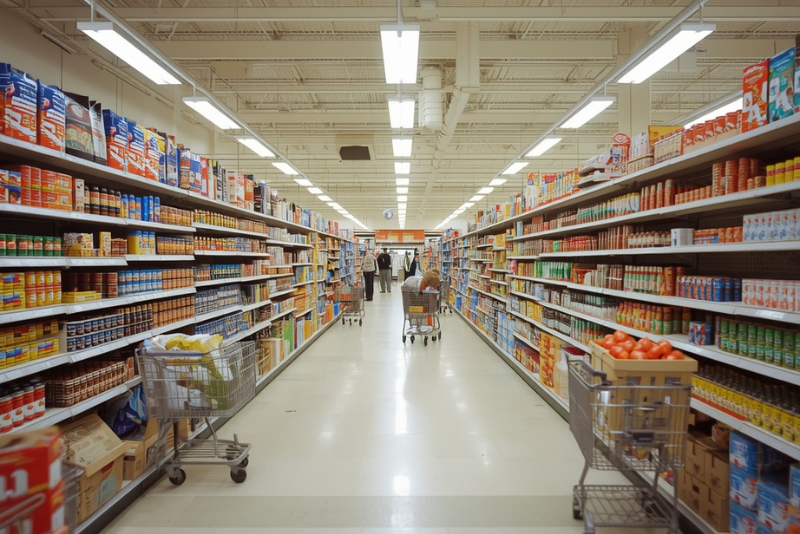
Go to the chili sauce section at Lotus’s Malaysia. What do you see? A sea of red labels with pictures of chili peppers. Go to the granola aisle at Village Grocer. Beige bags with pictures of oats. Nobody owns a distinctive color. Nobody owns a distinctive shape. The door is wide open for small brand differentiation.
Why Small FMCG Brands Actually Have the Advantage in Brand Code Ownership
This is the part that makes corporate innovation teams genuinely jealous.
In a large multinational FMCG company, changing a brand code required approximately 47 meetings, three rounds of regional approval, and a nervous video call with the global brand guardians in New York or Vevey, Switzerland.
You? As a small FMCG brand owner or startup founder, you can decide tomorrow that your brand will only use a specific shade of Malaysian batik-inspired blue. You can decide that your jar will have a hexagonal base because it reminds people of honeycomb and your product contains wild honey from Tualang trees.
Constraints drive creativity. Big budgets breed timidity.
The most iconic brand codes in history were not born from massive media spend. They were born from desperation mixed with clarity. When Oreo created its distinctive cookie-and-creme visual language, it was an imitator itself—not a category leader. When Tiffany & Co. chose that specific robin’s egg blue, it was a jeweler trying to stand out in a sea of black velvet boxes, not a conglomerate with a Super Bowl budget.
The Malaysian FMCG Playbook: How to Build a Brand Code on a Shoestring Budget
Here’s a brand code strategy framework every startup should have before they print their first label. It requires zero media budget. It requires discipline.
Step 1: Audit the Category’s Visual Clichés (Competitive Analysis)
Go to the aisle where your product will live. Not metaphorically. Physically go to AEON, Lotus’s, or Village Grocer. Stand there for 15 minutes. Take photos with your phone.
Now ask yourself three brand audit questions:
What color does EVERYONE use? (If you’re in tea, it’s brown and green. If you’re in dairy, it’s white and blue.)
What shape is EVERY package? (Round jars. Rectangular boxes. Stand-up pouches with a tear notch at the top.)
What image is on EVERY label? (A picture of the ingredient. A bowl of the prepared dish.)
This is your category code map. Your job is to find the empty space on this map.
Step 2: Choose ONE Thing to Invert (Brand Differentiation Strategy)
You cannot afford to be different at everything. You can afford to be different at one thing.
Here is the menu of brand code options, ranked by cost to execute for small FMCG brands:
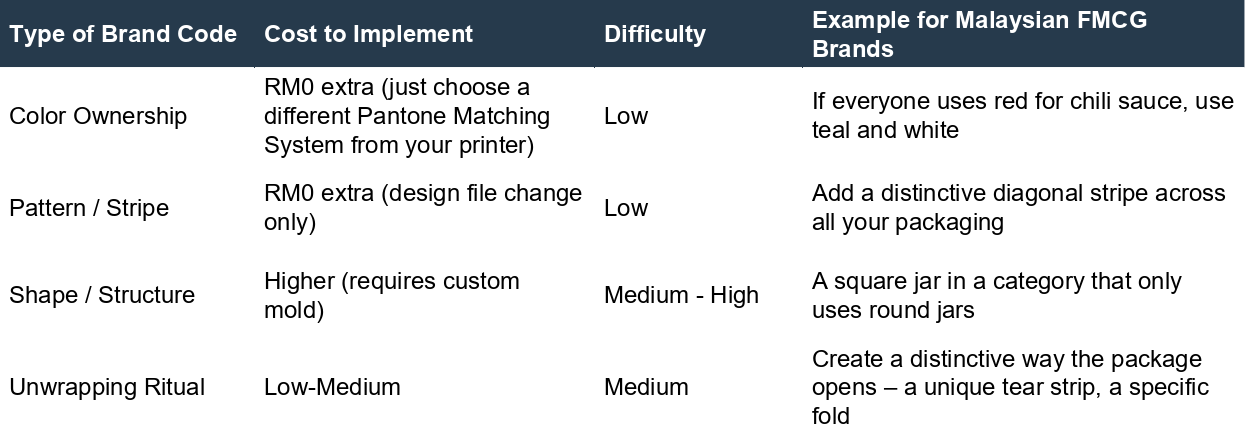
Step 3: Pick Your Color and Defend It With Your Life (Color Ownership Strategy)
In my FMCG days, we had a term for this: “Color DNA.”
Choose one color. Not two. One. Make it your non-negotiable. Every piece of packaging, every social post, every trade show banner—same exact hex code.
The University of Illinois brand guidelines teach a principle that applies perfectly to FMCG brand building: consistent use of branded language and visual assets strengthens reputation and increases visibility across all platforms. The same applies to color. One consistent hex code does more for brand recognition than RM50,000 in Facebook ads.
Step 4: Find the “Empty Shelf” in the Consumer’s Mind (Psychological Branding)
This is a psychological trick I learned from a very senior marketer at Unilever.
The human brain organizes categories visually. When someone thinks “milk,” they see a white carton. When someone thinks “coffee,” they see a brown jar. These are category codes—visual shortcuts that help us navigate shelves quickly.
Your job as a small brand is to find the unoccupied code. What color does NOT exist in your category? What shape has NOBODY claimed?
Malaysian FMCG Brand Code Case Studies
KACANG + CO: Bold Color Blocking for Heritage Snacks
Look at KACANG + CO, a Malaysian startup that launched in November 2022 with a mission to elevate traditional kacang putih snacks—murukku, pakoda, curry nuts—into a modern heritage brand. Their visual identity is a masterclass in brand code execution on a startup budget.
Rather than following the typical beige-and-brown aesthetic of traditional snack packaging, KACANG + CO distinguishes its products with a hybrid design concept: bold, solid colors framing delicate, whimsical illustrations that evoke the joys of snacking the Malaysian way. Each product variant uses a distinct, vibrant color block that creates immediate shelf recognition—even before the consumer reads the flavor name.
Founder Leeson Lee, a former multinational marketing agency professional, understood instinctively what many founders miss: in a category dominated by generic transparent plastic bags and factory-produced snacks, visual distinctiveness is the first purchase trigger. By consistently applying their bold color-blocking system across all five products in their arsenal—Kacang Soya Curry, Kacang Tanah Curry, Mixture, Pakoda, and Star Murukku—KACANG + CO built a cohesive brand code system that signals “premium heritage” without a premium media budget.
The lesson for small FMCG brands: You don’t need a massive product line. You need a consistent visual language that makes your limited SKUs look like a deliberate, confident collection.
ZUS Coffee: Minimalist Brand Code Success Story
ZUS Coffee didn’t just compete on price with their RM7-10 specialty coffee. They built a distinctive black-and-white minimalist visual system that signals “premium but accessible.” In a category dominated by Starbucks green and Coffee Bean purple, ZUS claimed monochrome.
When you see that clean blue cup with white typography in someone’s hand at the LRT station, you know it’s ZUS before you see the logo. That’s the power of consistent brand codes in action.
The “Consistency Over Creativity” Rule for Brand Codes
Here is the hardest lesson for creative founders to accept: Your brand code is not the place for artistic expression. It is the place for discipline.
I once seen a brand that changed their packaging accent color three times in over the course of 3 years. They wondered why consumers couldn’t find them on shelf. The answer: Consumers weren’t looking for their logo. They were looking for their color—and the color kept disappearing.
Brand codes work through repetition, not innovation.
As industry analysis confirms, successful branding strategy in FMCG requires consistent visual identity—colors, typography, and packaging that create a cohesive look and feel. The components are simple: a memorable name, distinct colors, and packaging that catches the eye. But the execution requires discipline that most small brands lack.
How to Protect Your Brand Code Without a Legal Team
“But what if someone copies our brand code?”
First: Celebrate. Being copied means you’ve created something worth stealing.
Second: Understand what you can actually protect as a small FMCG brand.
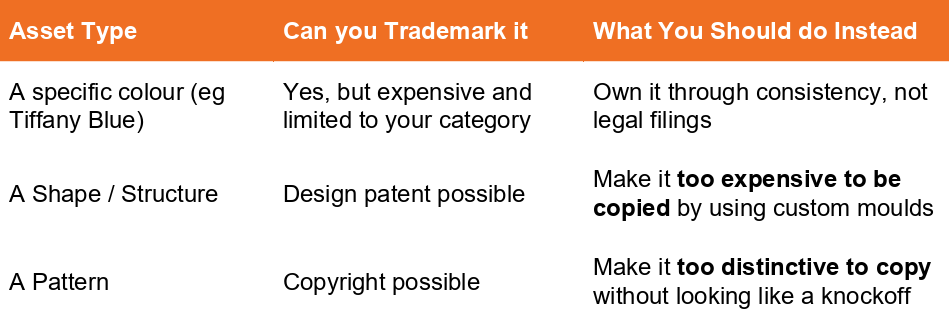
The best defense against copycats is being so distinctive that copying you makes them look desperate.
When Carrefour copied Nescafe’s packaging, the similarity was so blatant it triggered a lawsuit. But here’s the lesson: Nescafe’s brand codes were so established that any imitation was immediately recognizable as an imitation. That’s the position you want. Not “impossible to copy”—but embarrassing to copy.
The RM0 Brand Code Audit Checklist for Small FMCG Brands
Before you spend another ringgit on marketing, complete this brand code audit:
Color: Do we have ONE distinctive color that appears on 100% of our touchpoints?
Shape: Does our packaging have a silhouette that stands out from the category?
Pattern: Do we have a graphic device (stripe, dot, wave) that repeats across all communications?
Consistency Score: In the last 12 months, have we used the EXACT SAME color on every piece of content? (If not, fix this immediately.)
Competitor Check: Is there another brand in our category using our color or shape? (If yes, choose again.)
Frequently Asked Questions About Brand Codes for Small FMCG Brands
Q: What is a brand code in marketing?
A: A brand code is a distinctive visual or sensory asset—such as a specific color, shape, pattern, or sound—that triggers instant brand recognition without requiring the logo to be visible.
Q: How can a small brand create a brand code without a big budget?
A: Small brands can create effective brand codes by choosing one distinctive color that no competitor uses, maintaining absolute consistency across all touchpoints, and focusing on repetition rather than expensive media campaigns.
Q: What are examples of successful brand codes in Malaysia?
A: ZUS Coffee’s black-and-white minimalist aesthetic, KACANG + CO’s bold color-blocked packaging for heritage snacks, and Maggi’s iconic yellow-and-red color combination are all examples of effective brand codes in the Malaysian market..
Q: Can you trademark a color as a brand code?
A: Yes, in some jurisdictions you can trademark a specific color within a specific product category. However, this process is expensive. Small brands should focus on owning the color through consistent use rather than legal protection.
Q: How long does it take to establish a brand code?
A: Brand codes are established through repetition over time. With consistent application across all consumer touchpoints, a distinctive color or shape can begin to build recognition within 6-12 months.
Conclusion: Brand Codes Are Memory, Not Media Budget
Brand codes are not about being the loudest voice in the room. They’re about being the most familiar face in the crowd.
You don’t need a RM10 million media budget to build a distinctive brand asset. You need the courage to pick a color and the discipline to never, ever change it.
The Malaysian FMCG landscape is filled with brands that spent millions on advertising and zero on visual distinctiveness. They are forgettable. They are interchangeable. They are one private-label copycat away from irrelevance.
Don’t be them.
Be the brand that a shopper can spot from three aisles away at AEON, before they even see your logo, because they know your color.
