


Here is a scene I have witnessed more times than I care to remember.
A young founder walks into a buyer meeting at a major Malaysian retail chain. He is brimming with confidence. He pulls out a slide that says: “We sold 50,000 units last quarter!”
The buyer—a person who has been managing the snack aisle since before the founder finished secondary school—glances at the number, scrolls through a spreadsheet, and asks one question that bursts the entire balloon:
“That’s across 500 stores. So you’re doing about 1.9 units per store per week. Do you know that our house brand kerepek moves 12 units per store per week from the same shelf?”
Silence.
This is the moment most small FMCG brands realize the brutal truth about retail: Volume is vanity. Velocity is survival.
The Metric That Actually Matters
Corporate boardrooms across the Klang Valley track many numbers. But when a category manager sits down for a range review, there is one number that determines whether your product lives or dies. It is not your total revenue. It is not your year-on-year growth percentage. It is your Units Per Store Per Week (UPSPW), also known as your sales velocity.
Velocity describes how quickly your product sells relative to its distribution. It is often expressed as units per store per week and is one of the most important metrics retail buyers use to evaluate which products earn their place on the shelf.
The fundamental retail equation is simple: Sales = Distribution × Velocity.
A product may boast wide distribution, but if it is not moving off the shelves, the brand is underperforming. On the other hand, strong retail velocity can justify expanding distribution channels and negotiating premium shelf space.
You can have a million ringgit in sales. But if that revenue comes from 2,000 stores each selling half a unit a week, you are one range review away from oblivion.
Why Volume Lies to You (and to the Buyer)
Many founders confuse volume and velocity. Let me make the distinction painfully clear with a table:
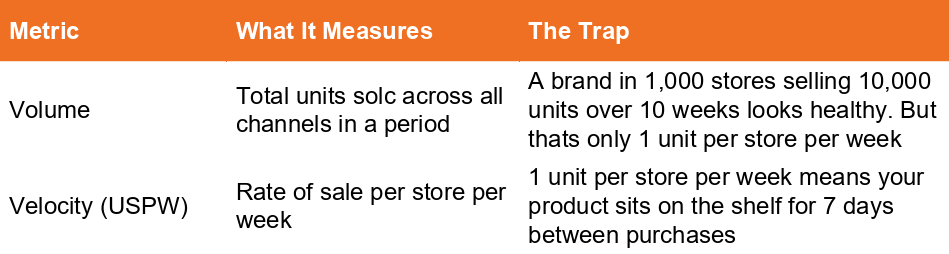
Here is the retail reality as bluntly as I can put it: The shelves are not made of rubber. Category managers will range SKUs that shoppers want. They use ranking reports by USPW to highlight low-performing SKUs that may be delisted.
If your product sells below 1.0 USPW, you are at serious risk of discontinuation. Most retailers will not keep items on the shelf that move less than one unit per store per week. A velocity of 1.0-2.0 USPW might be acceptable for specialty or niche items, but you are not a strong performer. Between 2.0 and 5.0 USPW is solid—you are earning your shelf space. Above 5.0 USPW, you are a strong performer and may be in line for expanded distribution or better placement.
And here is the part that keeps founders awake at night: the velocity continuum is a universal function for all CPG brands, but it is especially pronounced for startups that have not built awareness. Velocity varies by store because its driven by foot traffic differences and demand for premium offerings. Delisting occurs when a store manager just does not see enough movement to preserve your slot.
The Private Label Threat Multiplier
If you are a small brand, you are not just competing against Nestlé. You are competing against the retailer’s own private label, and the rules are not fair.
Private label products are not just the cheap alternative anymore. They are a strategic lever for retailer growth and shopper loyalty. Nearly half of consumers say they are buying more private label than ever. Private label meets evolving expectations for quality, innovation, and purpose.
Here is what keeps corporate executives like me awake: private label wins on speed. They can copy winning trends, test in small batches, and scale overnight. A store brand can launch a new product faster than a giant FMCG company. If data shows shoppers want something, the chain can test a house line in weeks.
This means your velocity bar is not just “good enough.” It has to be better than the store’s own brand, which enjoys built-in margin advantages and preferential placement. At the top 20% of SKUs typically generate 70-75% of facings in a well-managed category. If you are not in that top tier by velocity, you are fighting for scraps.
The Three Levers: How to Fix a Velocity Problem Before the Buyer Notices
If your velocity is weak, do not wait for the delisting letter. Use these three levers immediately.
Lever 1: Diagnose Before You Dose
Velocity problems fall into two categories, and they require completely different solutions.
- Distribution Problem. A product with low distribution but high retail velocity signals untapped potential. The product resonates where it is available, and the strategy should focus on securing increased distribution based on strong performance metrics.
- Velocity Problem. A product with high distribution but low retail velocity demands internal optimization. The goal is to fix factors impacting velocity such as pricing, packaging, or shelf placement.
Lever 2: The Trial-to-Repeat Engine
Here’s a framework I used often previously as a category manager:
Trial plus velocity equals demand.
You get trial, then you have to work for velocity. Velocity is the consistent weekly movement that you look for.
If your product is not moving, ask yourself brutally: Is it a trial problem or a repeat problem?
- No trial means nobody knows you exist. Fix this with in-store sampling, demos, or eye-level placement.
- Trial without repeat means your product disappoints. That is a product quality or pricing issue, not a marketing issue.
Lever 3: Defend Your Shelf with Data, Not Emotion
Here’s a tactic I learn over the years. Two weeks before a scheduled range review—you do know when your retail partner’s range reviews are, right?—request your own velocity data from the retailer.
Look for stores where your velocity is strong. Build a simple one-page argument:
- Here is my velocity in your top 20 highest-traffic stores.
- Here is the velocity benchmark for this category.
- Here is my plan to improve the underperformers.
Walk into the category manager’s office and say: *”I know my national average USPW is 2.1, but in your A-stores, I am doing 4.7. Let me tell you why, and let me show you my plan to fix the bottom quartile.”*
That conversation is entirely different from arriving unprepared to defend 50,000 units of empty volume.
The Malaysian Founder’s Survival Checklist
Before your next production run, complete this audit:
- Know Your Number: What is your current USPW in your top two retail partners? If you cannot answer this immediately, you are already late.
- Benchmark Your Category: Is your category high-velocity (beverages, snacks, dairy) where 5+ USPW is expected, or low-velocity (specialty foods, supplements) where 1-2 USPW may be acceptable?
- Watch the Trend: An SKU with declining velocity is a fundamentally different business problem than one with stable velocity and growing distribution. Understand which problem you have.
- Check Private Label Competition: Are you at least matching the velocity of the store’s own brand in your sub-category? If not, you are the next SKU on the chopping block.
- Prepare for Range Reviews: Do you know when your retail partners hold their category reviews? If you miss this window, you have no voice in the decision.
The One Thing to Remember
Here is the truth I have learned from sitting on both sides of the FMCG table:
Volume is what you brag about at founder meetups. Velocity is what keeps you alive.
The retailer does not care about your total units sold. They care about how fast your product moves in their store, because their shelf space is the single most expensive piece of real estate you will ever rent. If you are not paying that rent with consistent, weekly movement, they will find someone who will—and that someone increasingly wears a private label badge.
Stop chasing volume. Start chasing velocity. Your shelf space depends on it.
