


Here is a core problem: FMCG startups are treating Shopee as a Direct-to-Consumer (DTC) channel, when in reality, Shopee behaves like a hyper-competitive, low-loyalty grocery aisle. And in a grocery aisle, the rules are completely different.
The DTC Dream vs. The Grocery Aisle Reality
When founders hear “sell online,” they imagine the DTC dream. A beautiful Shopify store. Customer data they own. Email marketing flows. Full-price purchases from loyal fans. Healthy 60-70% margins.
Then reality hits.
In Malaysia as of 2025, e-commerce continues its explosive growth, with nearly two-thirds of Malaysians now buying online. Shopee dominates the market, with seven in 10 Malaysians having shopped there in the past six months.
The temptation to go where the traffic is—rather than building your own—becomes overwhelming.
But here is what changes the moment you move from your own store to a third-party marketplace: everything.
You do not own the customer. The platform owns the customer. You do not set the terms of competition. The platform sets the terms, and the terms are brutal. As industry observers note, Shopee, Lazada, and TikTok Shop now dominate the space, but they have also stripped brands of their pricing autonomy—prices are driven lower and margins squeezed thinner, with brands reduced to tactical tools for the platforms rather than genuine business owners.
This is not DTC. This is a digital grocery aisle. And you are a jar on the shelf.
The Margin Math That Destroys FMCG Startups
Let me show you a simplified but realistic margin calculator for an FMCG product sold on Shopee Malaysia in 2025. Assume a product retails for RM25.
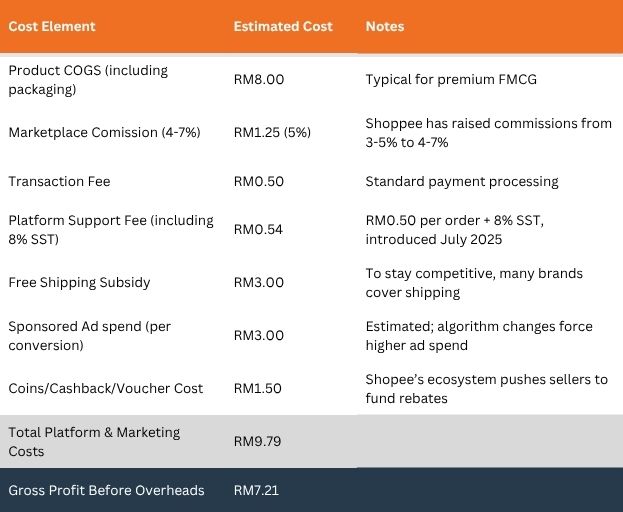
RM7.21 in gross profit per unit. Out of which you still have to pay your own staff, warehousing, and operating overheads.
And if you join the Shopee Cashback Programme (SCP), the service fee rate has been adjusted to 5.5% per item, capped at RM100 per item. For a brand selling RM25 products, that 5.5% replaces the lower commission rate.
The brutal reality: brands selling on Shopee can lose 30-40% of their margin to platform fees, commissions, and mandatory advertising costs just to maintain visibility. This is not an occasional expense. It is a permanent tax on every transaction.
The Algorithm Trap: You Do Not Control Your Shelf Position
In a physical grocery store, you might be stuck on the bottom shelf with poor visibility. But at least you know where you stand.
On Shopee, your position on the “shelf” (search results) changes without warning and without explanation.
Sellers across the region are reporting sudden shifts to the search and recommendation algorithms that dramatically affect product visibility and sales—often overnight. Updates frequently re-rank products, forcing sellers into constant re-optimization.
Here is the cost structure: Organic search accounts for approximately 40-50% of traffic on Shopee. If the algorithm decides to deprioritize your listing, that free traffic vanishes. You then must buy it back through sponsored ads. This transforms what was once a sales channel into a pay-to-play auction, where keywords are bid up and only the highest spenders win.
This is the fundamental difference between a real DTC website and a marketplace. On Shopify, you own the search results. You write the content. You control the tags. On Shopee, an invisible force decides whether shoppers see your product.
The Data Trap: You Are Building the Platform’s Asset, Not Yours
This is the trap that makes me most frustrated for FMCG founders.
When a customer buys from your own website, you capture:
- Their email address.
- Their purchase history.
- Their browsing behaviour.
- The ability to remarket to them.
When a customer buys from Shopee, you get:
- A Shopee username.
- A delivery address.
- That is it.
Shopee and Lazada are convenient platforms, but they control access to customer data—and you never own it. The platforms hold the relationship, and the seller is merely a temporary supplier.
This means:
- You cannot build an email list. The customer relationship stays inside Shopee.
- You cannot retarget lapsed customers. Shopee owns the retargeting channel.
- You cannot drive repeat purchases directly. You must rely on Shopee’s notification system, which the customer may have already turned off.
Brands building their own commerce channels recognize that a strong DTC presence increases brand value. Investors and customers trust businesses that own their sales channel. The reverse is also true. When a founder tells me they do 100% of their sales through Shopee, what I hear is: “We have built exactly zero proprietary assets. Our entire business is on rented land.”
The Loyalty Trap: A Shopper, Not a Customer
Here is the hardest truth for founders who grew up with the DTC dream.
On your own website, a repeat buyer is a customer. They chose you over the infinite internet. They came to your dot com. They trust you enough to enter their credit card on your domain.
On Shopee, a repeat buyer is a shopper. They searched for “teabags,” saw your listing next to five competitors, compared prices, checked voucher eligibility, and chose the cheapest option that met a minimum quality threshold. Next week, they will search “teabags” again and buy from whoever has the best deal.
The data confirms what I have observed on the ground. Malaysian shoppers are growing more intentional. While in 2024, 42% of respondents prioritized discounts and low prices, by early 2025, 58% now prioritize product quality and seller credibility when deciding whether something is truly worth buying. Shoppers are becoming smarter and more discerning.
But smart shoppers are not loyal shoppers. They use Shopee’s tools—livestreams, affiliate content, and reviews—to validate purchases. Nearly 83% of users now rely on Shopee Live to inform buying decisions, and 70% trust creator recommendations when backed by strong seller ratings. This means even a repeat purchase on Shopee is not a vote of brand loyalty. It is a vote of competitive validation. The customer chose you after comparing you against your competitors, and they will run the same comparison again next time.
This is exactly how shoppers behave in a grocery aisle. They stand in front of the shelf, scan the options, compare prices, reach for the familiar-but-not-necessarily-loved brand, and move on.
The Bottom Line
The Shopee Trap is not that Shopee is a bad platform. It is that Shopee is a grocery aisle, and too many FMCG startups are living in it like it is their forever home.
In a grocery aisle, you do not own the shelf. You do not set the rules. You pay rent to the retailer, you compete on price, and your customer belongs to the store—not to you.
That is fine, if you remember that your job on Shopee is the same as your job in AEON: get discovered, get tried, and get the customer into a longer-term relationship elsewhere.
Stay on Shopee long enough to be found. But do not stay so long that the platform fees, the algorithm shifts, and the price wars become your entire P&L.
Because when Shopee changes the rules—and it will—you want to have somewhere else to go.
