

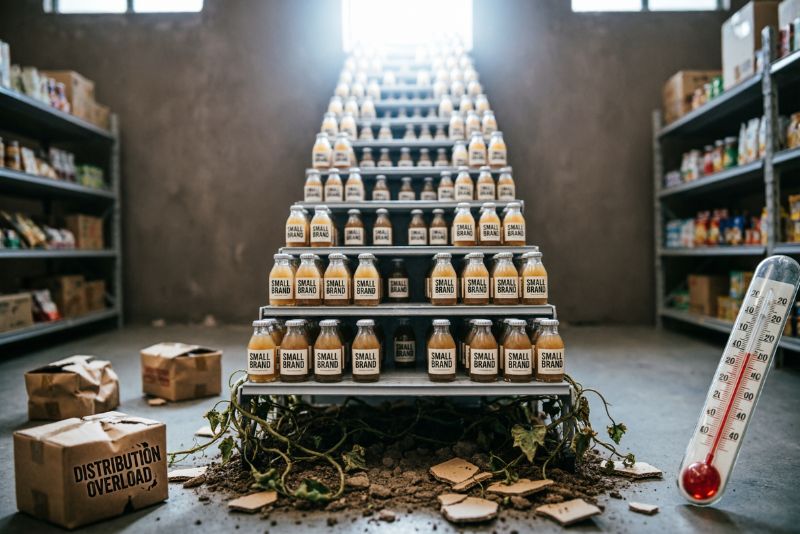
Brands obsess over the number of storefronts they’re in. But on a long enough timeline, every founder learns the same truth: Distribution is not validation. Distribution is a loan. And if you’re not moving fast enough to pay it back with velocity, the interest will bury you.
I’ve seen founders pop champagne because a buyer for a 300-store chain sent them a purchase order. I watch the joy. Then I watch the cash flow statement six months later. The champagne is flat. The stock is on clearance. And the company is drafting a “strategic pivot” email to its investors.
In the Malaysian FMCG scene, this story repeats like a broken record. The brand gets into a major retailer—99 Speedmart, AEON, or a chain of premium grocers. The founder immediately starts receiving calls from regional distributors who promise to put the product in “another 500 outlets by end of quarter.” The Excel model gets updated. Revenue projections go vertical.
Twelve months later, 70% of those stores haven’t placed a second order. The product is delisted. The company is holding RM180,000 in dead inventory. And no one can figure out why.
This is death by distribution. It is not dramatic. There is no single catastrophic moment. It is a slow, quiet bleed caused by confusing shelf presence with market pull. I have been the person in the corporate office who signs the delisting notice. This is how to make sure you never get yours signed.
The Numbers That Sentence You
Before I walk through the mechanics of why rapid distribution kills brands, I need to make something painfully clear about the odds already stacked against you.
Industry-wide research from Nielsen finds that 70 to 85 percent of new consumer packaged goods fail within their first year. This is not a Malaysian statistic, but I have seen nothing in two decades of working in FMCG to suggest we are any different. If anything, our fragmented retail landscape—spanning 99 Speedmart, Lotus’s, AEON, Village Grocer, independent Chinese medical halls, and the kedai runcit that still command nearly 46% of retail market share—makes survival harder, not easier.
Now, add to that a rapid, unfocused expansion into hundreds of stores you cannot support, and that 85% failure rate is the floor. Not the ceiling.
The Four Horsemen of Distribution Death
When a small brand expands too quickly, it is not one problem that kills it. It is four, arriving simultaneously. Let me walk you through them.
Horseman 1: The Listing Fee Abyss
Most founders think the cost of distribution is the cost of producing the goods. This is laughably incomplete.
In Malaysian grocery retail, listing fees are charges imposed by retailers on suppliers for the right to place products in their stores. They include entry fees, annual renewal fees, eye-level shelf rental, chiller placement, end-cap displays, catalogue promotions, in-store campaign participation, product launch fees, and warehouse or barcode fees. Large FMCG corporations pay these routinely because it secures dominance. Local SMEs rarely have the budget, which results in an uneven marketplace where only a handful of companies control what consumers see.
The fee for a single new product can range from approximately RM1,000 for a limited regional launch to well over RM25,000 in highly competitive categories. Multiply that by five SKUs. Multiply that by multiple retail chains. Now add the cost of free fills—introductory allowances where you supply initial stock at no charge to seed the shelf. Now add promotional deductions for temporary price reductions, BOGO offers, and digital features. Now add compliance chargebacks for mislabeled cases, short shipments, or missed delivery windows.
A brand entering 500 stores with three SKUs can easily burn through RM150,000 to RM300,000 in non-recoverable listing and promotional costs before a single consumer has tasted the product.
Horseman 2: The Velocity Dilution
I wrote extensively about this in a previous post, so I will not belabor the point here. But the math is merciless and must be repeated.
Sales = Distribution × Velocity. A product in 1,000 stores selling 1 unit per store per week is moving 1,000 units a week. A product in 100 stores selling 10 units per store per week is also moving 1,000 units a week. The total volume is identical. But the first brand is in 900 more stores, paying 900 more listing fees, managing 900 more delivery points, and exposing itself to 900 more locations where the product might sit and gather dust.
As I noted earlier in the velocity-versus-volume post, Units Per Store Per Week (USPW) is the metric that determines whether you live or die. Velocity variation by store is driven primarily by two factors: variations in store-level foot traffic and demand for premium offerings in your category. A sleepy health food store with low foot traffic might produce 0-1 units per store per week. A mainline supermarket with 10,000-30,000 weekly visitors operates on a completely different scale.
Delisting occurs when a store manager just does not see enough movement to preserve your slot on the shelf. When you expand too fast, you are putting products into stores where the foot traffic and consumer demographics cannot support the velocity needed to survive. The product sits. The dust accumulates. The delisting notice arrives.
Horseman 3: The Cash Flow Crunch
FMCG distribution operates on credit. You produce the goods. You ship them. And then you wait.
In Malaysia, standard payment terms range from Net 30 to Net 90—meaning the retailer pays you 30 to 90 days after the invoice date. Now map that against your own cash obligations. You paid your co-packer upfront. You paid for packaging upfront. You paid for shipping upfront. Your listing fees were due on signature. Your promotional allowances were deducted from the first invoice.
Meanwhile, FMCG trade spend typically consumes 15-25% of revenue, funding temporary price reductions, shelf placement fees, and feature advertising. Deductions—from trade marketing programs to compliance penalties—can consume up to 30% of a brand’s gross revenue.
You are now in a position where every new store you enter requires you to spend cash today for revenue you will not see for three months. Expand fast enough, and the cash gap between production outflows and receivables inflows widens into a chasm. I have watched brands with RM5 million in annual revenue collapse because they could not bridge a RM300,000 working capital gap caused by exactly this timing mismatch.
Horseman 4: The Operational Overload
A brand that goes from 50 stores to 500 in six months is not just selling more. It is running a logistics operation it was never built to handle.
This means managing relationships with multiple distributors, each with their own margin structures, delivery windows, and reporting formats. It means navigating a competitive retail landscape with fragmented distribution channels where reliable logistics infrastructure is essential to ensure product availability and freshness. It means handling merchandising across hundreds of locations, each with its own store-level compliance requirements, shelf layouts, and restocking cycles. And then there are returns, damages, expired stock, and the administrative overhead of reconciling retailer deductions that may or may not be accurate.
One Malaysian F&B chain—a brand that had expanded to 60 outlets with over RM60 million in revenue—reported a net loss of RM3 million in 2024, driven in significant part by over RM9 million in depreciation from rapid expansion. Their core business was healthy, with stable EBITDA. But the financial weight of aggressive scaling, when translated through accounting realities, turned a fundamentally sound business into a loss-making one on paper. The lesson is not that expansion is bad. The lesson is that expansion has a carrying cost, and that cost compounds faster than most founders expect.
The Bungkus Kaw Kaw Case Study: When Expansion Outruns Economics
The story of Bungkus Kaw Kaw is instructive. Here is a Malaysian F&B brand that scaled from approximately 30 outlets to over 60 in roughly two years—a pace of expansion that in the FMCG and food service world is considered breakneck. The stores were visibly busy. The queues were real. The consumer demand was not the problem.
Yet the audit report revealed a RM3 million net loss in 2024. The culprit was not weak sales. It was the weight of capital expenditure—renovations, equipment, systems—that must be depreciated over five years. The company carried over RM9 million in depreciation alone that year. The cash had already been spent. But the accounting reality meant that cost would continue to appear on the P&L for years.
This is a food service story, but the principle applies identically to FMCG distribution. Every store you enter requires an upfront investment—listing fees, free fills, promotional support, distribution setup. You pay that cost today. The revenue trickles in over 30, 60, 90 days. The full return on that investment may take 12 to 18 months to materialize, if it ever does. Expand too fast, and the upfront costs form a wall that the delayed revenue cannot climb.
The One Thing to Remember
So here’s the thing I have learned from sitting on both sides of the FMCG table
Distribution is not a growth strategy. It is a magnifier. It makes a product with strong velocity stronger and a product with weak velocity extinct.
The brands that survive are not the ones in the most stores. They are the ones in the right stores, at the right pace, with the right velocity, the right cash reserves, and the right content infrastructure to support every new shelf they occupy.
The RM100,000 listing fee you pay to get into a chain that your product is not ready for is not an investment. It is a donation to a retailer who will delist you in 12 months and pocket the fee.
Expand patiently. Prove velocity first. Let the data tell you when to grow. Because the store count on your investor deck does not matter if your product is not on the shelf anymore.
Coming next: The full Velocity-First Distribution Audit —the 7‑question diagnostic I use to decide whether a brand is ready to expand or about to walk into a cash crisis. I’ll post it here for free. Subscribe so you don’t miss it
