

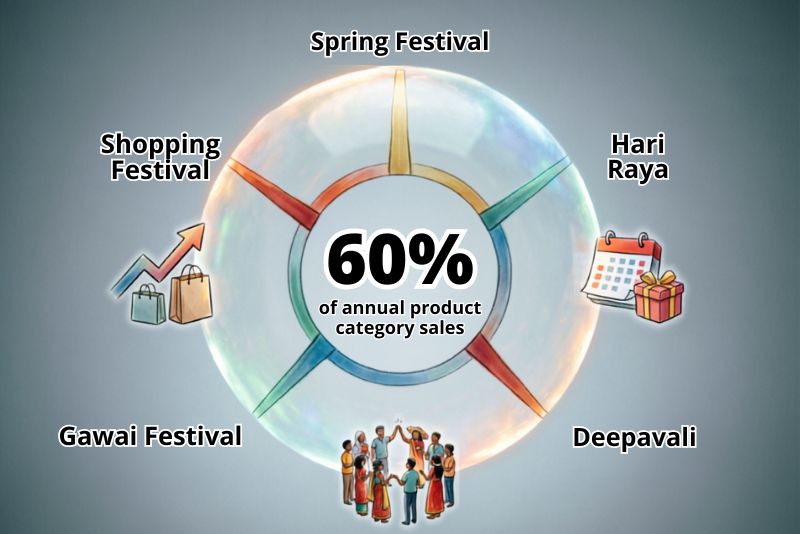
There is a spreadsheet that every Category Manager at every major Malaysian retail chain maintains. It is not shared with suppliers. It is never presented at trade marketing reviews. But it is the single most powerful document in Malaysian FMCG.
It maps, week by week, how the volume of every major category redistributes itself across the calendar year. It shows that for many categories, the four weeks before Hari Raya account for 25-35% of annual volume. It shows that Chinese New Year preparation drives a 120-180% volume spike above baseline for food, beverage, and home decor categories. It shows that Deepavali, while smaller in absolute volume, commands disproportionate category share in specific product segments—sweets, snacks, dairy, and home goods.
I call this document a Racial-Ritual Map. And if you are a small FMCG brand in Malaysia without one, you are allocating your trade spend, your production schedule, and your marketing budget blindfolded.
The Calendar That Runs Malaysia: Why Festive Season Dominates FMCG
Malaysian e-commerce experiences multiple high-intensity shopping periods throughout the year—unlike Western markets with concentrated Q4 holiday seasons. “Most foreign-owned fulfillment companies struggle with Malaysian seasonal patterns,” explains one logistics consultant. “They’re prepared for Christmas, but not for the 200-300% volume spikes during Ramadan or the complex timing of Chinese New Year preparations.”
The numbers are staggering. During Hari Raya, e-commerce volume increases 200-300% above baseline in fashion, beauty, home decor, and gift sets. Chinese New Year drives a 120-180% volume increase above baseline. Malaysia’s wholesale and retail trade value during Hari Raya season reached RM154.0 billion, marking a solid 5.7% year-on-year growth, with Food & Beverage growing 8.1% and Fashion growing 7.3%.
But the aggregate numbers obscure the ethnic dimension. These festivals are not national holidays in the commercial sense. They are culturally specific consumption engines. Hari Raya is the dominant volume driver for the Bumiputera community. Chinese New Year dominates for the Chinese community. Deepavali for the Indian community. Each festival has its own product categories that spike, its own pack size preferences, its own promotion mechanics that convert, and its own shopping timeline.
A brand that treats all three festivals as a single “festive season” with a single campaign will capture some volume—but it will leave the majority of the available volume on the table.
The 60% Question: Which Festival Moves Your Category?
In my years in corporate FMCG, I have learned that for most packaged food categories in Malaysia, the three major festivals—Hari Raya, Chinese New Year, and Deepavali—collectively drive between 45% and 60% of annual volume.
Malaysia’s 2025 first-quarter retail sales growth was primarily driven by multiple festivals, including Chinese New Year at the end of January and Hari Raya at the end of March. The data shows that 84% of Malaysians plan to increase their spending during Ramadan, and 76% are willing to try new brands during this period.
This creates both an opportunity and a trap. The opportunity: if you can capture even a small share of festive volume, you can build an annual business on 8-12 weeks of intense activity. The trap: if you misallocate your festive investment—wrong pack, wrong promotion, wrong timing, wrong ethnic community—you burn your entire annual marketing budget in a single quarter with nothing to show for it.
The Racial-Ritual Map is the tool that prevents this.
How to Build a Racial-Ritual Map in Four Steps
You do not need a Nielsen subscription or a six-figure consultancy. You need discipline, a spreadsheet, and a willingness to ask uncomfortable questions about your own assumptions.
Step 1: Map Your Category’s Festive Volume Contribution by Ethnicity
For each major festival, ask: what percentage of my category’s annual volume is transacted during the four weeks preceding this festival? And within that volume, what percentage is transacted by consumers from the community that celebrates that festival?
For example, a premium soy sauce brand might discover that 35% of annual volume occurs in the four weeks before Chinese New Year, and 80% of that volume is purchased by Chinese consumers. Another 15% occurs before Hari Raya, driven by Malay consumers preparing festive meals. The remaining 50% is spread across the rest of the year. This single insight reshapes the entire annual plan.
Step 2: Document the Pack Size, Price Point, and Promotion Preference by Festival
Festive consumption is not just more of the same consumption. It is structurally different. Shoppers are buying bigger packs to get better value for money. They are buying for gifting, for hosting, for balik kampung—not for everyday use. Price-offs and bundle packs prove most effective in driving festive purchases.
A Racial-Ritual Map documents, for each festival and each target ethnic community:
- The preferred pack format (bulk, gift set, trial, multi-pack).
- The culturally appropriate price anchor (RM68 or RM88 for Chinese New Year bundles).
- The promotion mechanic that converts (bundle deals and gifts for Chinese New Year, price-offs and value packs for Raya).
Step 3: Align Production and Inventory to the Festival Calendar
The biggest operational mistake small brands make is producing for average monthly demand and then being surprised when festive demand is 2-3x the average. The Racial-Ritual Map forces you to plan production runs, raw material procurement, and inventory buildup against the festival calendar—not the Gregorian calendar.
Pre-positioning 60% of projected festive inventory a full month before the rush is a strategy that successful brands adopt. The brands that wait until two weeks before Chinese New Year to order stock are already too late.
Step 4: Design Creative That Enables the Ritual, Not Just Advertises the Product
The power of festive marketing in Malaysia lies in its deep cultural roots. During Hari Raya, people service their vehicles for balik kampung and purchase new clothes called baju raya. During Chinese New Year, people buy new red items to wish for good fortune and open their wallets generously for reunion dinners. During Deepavali, they decorate their homes with lights and exchange gifts of gratitude.
These are not optional activities. They are duties and essential traditions for family and community. Successful festive marketing does not advertise a product’s features. It shows how the product enables the cherished cultural ritual. Your soy sauce is not “premium brewed.” It is what makes the reunion dinner taste like home.
The 10-Item Racial-Ritual Map Audit Checklist
The following 10‑point overview is a teaser of the full Racial-Ritual Map Toolkit. For the complete checklist—with ready‑to‑fill templates, volume projection calculators, and examples from five FMCG categories—purchase the paid resource.
10 questions that reveal your festival readiness (teaser):
- Have I calculated the percentage of annual category volume that occurs during the four weeks before Hari Raya, Chinese New Year, and Deepavali?
- For my dominant festival, what percentage of the volume is purchased by consumers from the celebrating community versus cross‑cultural purchasing?
- Have I designed distinct pack formats for each festival—culturally priced bundles for CNY, value packs for the larger Bumiputera household of 4.1?
- For baby care: do I know that a Mamilian (Chinese mom) may prefer compact, premium, on‑the‑go formats, while a Mak Andak (Malay mom) often prioritises bulk, value‑driven multi‑packs?
- Am I running PWP and gift‑with‑purchase for Chinese New Year and price‑off/value bundles for Hari Raya—or a single mechanic across all festivals?
- Does my festive creative show the product enabling the cultural ritual (reunion dinner, balik kampung, rumah terbuka, Deepavali gifting), not just a product shot with a festive border?
- Are my festive campaigns running in the language of the celebrating community—BM for Raya, Mandarin/Cantonese for CNY, Tamil for Deepavali—and using authentic visual codes?
- Have I aligned production and inventory schedules so that buffer stock is positioned at least four weeks before each peak?
- Have I shared my Racial-Ritual Map with key retail partners to secure shelf placement and promotional space during peak windows?
- After each festival, am I tracking whether baseline sales return to pre‑festival levels, decline, or increase—to measure true new‑buyer acquisition?
Get the full toolkit: The paid Racial-Ritual Map Toolkit includes the complete checklist with scoring logic, a 12‑month festival volume projection template, and a creative briefing guide for each major festival. [Purchase the Racial-Ritual Map Toolkit here.]
The Racial-Ritual Map is not a marketing document. It is a survival document. It tells you where your volume lives, which community drives it, and how to show up in a way that respects the ritual rather than interrupting it. The brands that build this map survive the 200-300% volume spikes. The brands that don’t get washed away by them—overstocked on the wrong SKU, understocked on the right one, and invisible to the consumer who was ready to buy if only the product had been there, in the right pack, at the right price, with the right gift, during the right festival.
In Malaysia, the calendar is culture. Build your map accordingly
