

There is a moment in the life of every successful FMCG founder when the floor drops out of her stomach.
It is not a bad Nielsen report. It is not a slow month at 99 Speedmart. It is the Tuesday morning when a loyal customer forwards a photo with the caption: “Is this you?”
The photo shows a product sitting on the shelf at AEON or Village Grocer. Same category. Same format. Same price band. The packaging is just different enough to avoid a lawsuit but just similar enough that anyone scanning the aisle would mistake it for yours. The brand on the label is not a random startup. It is one of the Big 3. A company with a marketing budget larger than your entire annual revenue. A company that could buy your co-packer, your distributor, and your entire product line without blinking.
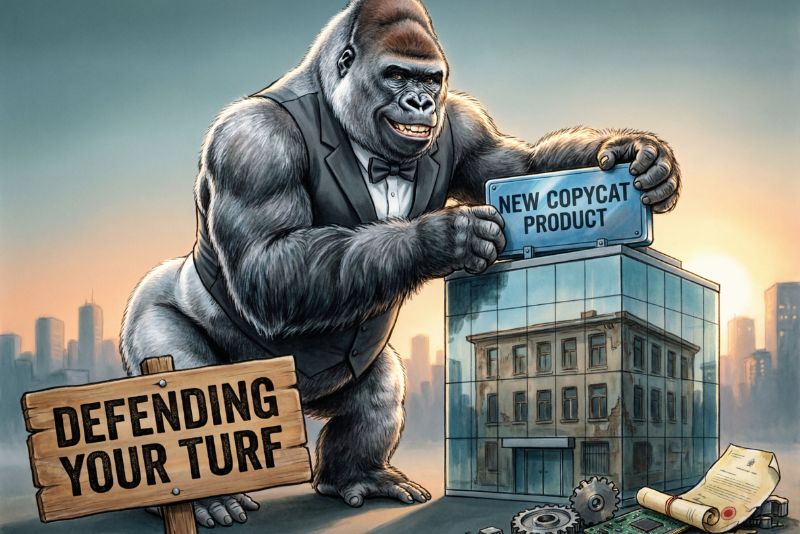
The 800-pound gorilla has just launched a copycat.
I have watched founders cycle through disbelief, rage, and despair in under an hour. And I have watched too many of them make the exact same mistake: They try to fight the gorilla on the gorilla’s terms.
This post is about what to do instead. The moves that actually work. The plays that turn the copycat’s launch from an existential threat into the best brand-building moment you never asked for.
Why the Gorilla Copies: Understanding the Economics of Copycatting
Before we talk about your response, let us understand what is actually happening. Don’t kid yourself because the copycat product is not a compliment. It is not validation. It is a cold, calculated financial decision.
Copycatting is a widespread strategy. An estimated 50% of store brands in the United States utilise some form of imitation. The copycat brand imitates the distinctive, perceptual features of the consumer’s favourite product to free-ride on the latter’s equity. It is not about innovation. It is about rent-seeking: capturing margin from a demand pool that you spent years and ringgit building, without incurring any of the upfront cost.
Large FMCG companies have two choices when they see a small brand gaining traction. They can launch their own small brand to compete—risking fragmentation of attention and resources. Or they can copy the successful product and leverage their existing distribution muscle and shelf dominance to crowd the smaller player out. The second option is cheaper, faster, and structurally favoured by every incentive in the retail system.
This is the fundamental imbalance: The gorilla spent zero on consumer education and zero on category creation. You financed both. And now the gorilla is using your own consumer demand data against you, supplied freely by the retailers who carry both your products.
The Five Moves: How to Defend When the Gorilla Lands
After watching this battle play out across dozens of categories—some ending in quiet extinction, others in surprising victory—I have distilled the response into five specific moves.
Move 1: Refuse to Compete on the Gorilla’s Terms
The most dangerous instinct after a copycat launch is to try to beat the gorilla at its own game. Lower your price. Expand your SKUs. Match their trade spend. This instinct has killed more small brands than every copycat product combined.
If a small business competes on anything that a large company can copy and make money from, a large company will eventually start providing those goods or services. The path to survival is not to become a smaller version of the gorilla. It is to double down on the attributes the gorilla cannot or will not replicate.
The gorilla cannot tell your founder story with authenticity. It cannot post behind-the-scenes content from a real kitchen, not a corporate innovation lab. It cannot respond to every customer DM personally. It cannot source a single-origin ingredient from a specific Kelantanese farm and name the farmer on the label. It cannot make the batch size small enough to feel artisanal.
When a bigger player copies you, your survival depends on leaning more into differentiation, not less. The gorilla has forced you to become more of what you already were. That clarity is a gift.
Move 2: Weaponise Your Community’s Sense of Injustice
Here is a piece of data that should reshape how you think about this moment: Research shows that consumers respond more negatively to copycats when the original brand is small rather than large. Consumers experience greater moral concern about the fairness of the copycat action specifically because the original firm is more vulnerable to harm. The copycat triggers moral foundations of fairness, harm, and loyalty.
This means your community is already primed to be angry on your behalf. Do not suppress that anger. Channel it.
In Malaysia, llaollao faced exactly this situation when a new froyo store named ll.la.lo launched with similar branding, similar spoons, and obvious copycat intent. llaollao’s response was not a legal letter. It was a meme: Will Smith slapping Chris Rock at the Oscars, with llaollao as Smith and “copycat” as Rock. Social chatter surged. Most of the positive sentiment was around how llaollao responded to the situation. The copycat was not ignored, nor was it dignified with a formal legal threat. It was publicly, playfully, and mercilessly called out.
Give your community the language, the visuals, and the permission to call out the copycat. Share comparison photos. Invite your followers to taste both and report back. The copycat product exists in a moral grey area—legal, but ethically questionable. Your community wants to protect you. Let them.
Move 3: Tighten Your Retailer Relationships Before the Copycat Does
When a copycat product enters the market, the retail buyer is watching both products carefully. Her decision to keep you on the shelf will not be emotional. It will be driven by category performance data: velocity, margin, and incremental contribution to the category.
Your job is to make sure your data tells a better story than the copycat’s data.
This means:
Track your USPW relentlessly in every store where the copycat has appeared alongside you. If your velocity holds steady while the copycat underperforms, that is the single most powerful argument you can make to a buyer.
Quantify your incremental contribution to the category. Are you bringing in new buyers who were not previously shopping the category at all? If so, make sure the buyer knows it. Small brands disproportionately drive category growth from new buyers.
Invest in in-store visibility—wobblers, shelf talkers, QR codes to your content library—to defend your physical presence against the copycat’s potentially larger trade marketing budget.
Move 4: Launch the Innovation You Were Saving for Next Year
The copycat has just validated your category thesis. The gorilla does not copy products in dying categories. It copies products where it sees growth, margin, and consumer demand. This means your category is hot.
Accelerate your innovation pipeline. Launch the limited-edition flavour you were planning for next year. Announce the new format. Release the collaboration product. The copycat is now reacting to your current offering, not your next one. Maintain a six- to twelve-month innovation lead, and the copycat is perpetually chasing your past.
Move 5: Protect What You Can, and Make Everything Else Too Distinctive to Copy
Intellectual property is your first line of defence. In Malaysia, trademark protection is governed by the Trademarks Act 2019 and administered by MyIPO. Malaysia operates on a first-to-file system: the first person to register owns the trademark, regardless of who used it first.
Beyond formal IP registration—which every FMCG brand should pursue—the key to success on shelf is finding something truly ownable for your brand. Even if a copycat replicates your product format, your distinctive brand code should be so embedded in the consumer’s mind that the imitation does not detract from your perceived value. As I argued in the Brand Codes post, a colour, a shape, or a pattern owned through relentless consistency is a legal defence in the court of consumer perception.
Register your trademark. Register your industrial design. And then make your packaging so distinctively yours that a copycat looks like exactly what it is: a cheap imitation.
When the Gorilla Is the Retailer Itself: The Private Label Threat Multiplier
There is a darker version of this story that deserves its own section. Sometimes the gorilla is not a competing brand. It is the retailer that stocks your product.
Private-label products now make up a significant share of food and grocery sales globally. Retailers increasingly offer their own private-label products next to branded products on the same shelf. They have access to your sales data. They know your velocity, your margin structure, and your consumer demographic. And they can launch a competing product at a lower price, in a better shelf position, with zero listing fees.
This is a genuinely difficult fight. But the same principles apply. The retailer’s private label cannot replicate your authenticity, your community, your content library, or the trust you have built directly with consumers. Fifty-one percent of shoppers feel small brands are more authentic and trustworthy than their larger competitors. That trust is an asset the private label cannot purchase.
The Copycat Defence Audit Checklist
Before you do anything else after discovering a copycat, run through this:
- Emotional Reset: Have I taken 24 hours to process the anger before making any public statement or strategic decision?
- IP Audit: Have I verified my trademark registrations with MyIPO? Do I have registered industrial designs for my packaging? Is there a legal case for trademark opposition or passing off?
- Velocity Monitoring: Have I established a tracking system to monitor USPW in every store where the copycat has appeared, comparing my trend line to theirs?
- Community Mobilisation: Have I developed a plan to communicate the situation to my community honestly and give them the tools—language, visuals, comparison content—to advocate for my brand?
- Retailer Conversation: Have I scheduled meetings with my top retail buyers to present my velocity data, my category incrementality argument, and my innovation pipeline?
- Innovation Acceleration: Have I pulled forward at least one product development milestone to demonstrate momentum and maintain my first-mover advantage?
- Brand Code Reinforcement: Have I reviewed my packaging, my content, and my physical shelf presence to ensure my distinctive brand code is unmistakably mine and impossible to confuse?
The One Thing to Remember
The gorilla copies your product. It cannot copy your relationship.
The gorilla can replicate your ingredients, your format, your price point, and even elements of your packaging. It has the supply chain to do it at scale and the distribution muscle to place it in stores you cannot yet reach. But it cannot replicate the trust you have built through years of showing up in the DMs. It cannot replicate the content library you have accumulated, where real customers demonstrate your product in real kitchens. It cannot replicate the founder standing at a Saturday demo table in Village Grocer, answering questions and building relationships one shopper at a time.
When the copycat launches, your instinct will be to look at what the gorilla has that you do not. The bigger shelf presence. The bigger marketing budget. The bigger production capacity. This is a trap. The gorilla is structurally incapable of replicating your deepest competitive advantages: your authenticity, your agility, your community, and your story.
Do not try to out-gorilla the gorilla. You will lose that fight every time. Instead, become more unmistakably yourself. Lean into the attributes that attracted your customers in the first place. Let the copycat validate your category. Let the community rally around you. And let the retail data show what consumers already know: the original is better.
The copycat is a threat. But it is also proof that you built something worth copying. That is not a small thing. In a market where most products fail within their first year, being worth copying is a form of victory. The next twelve months determine whether the copycat is a footnote in your brand story—or the end of it.
Choose your moves wisely.
