

I have a meeting that has played out, with minor variations, at least a dozen times. A founder—bright, passionate, already a few hundred thousand ringgit deep into her dream—slides a pitch deck across the table. The final slide says: “Launch Budget: RM100,000.”
She looks at me expectantly. She is waiting for the nod. The validation. The moment when the seasoned FMCG executive leans back and says, “That’s tight, but doable.”
I lean forward instead. “RM100,000,” I say. “What do you think that buys you?”
She lists: product development is done. Packaging design is done. The RM100,000 is for the launch. The listing fees. The first production run. The sampling. The social media campaign. Maybe a small influencer push.
I let the silence sit for a moment. Then I ask the same question I always ask: “Have you costed the trade displays?”
The colour drains from her face.
This is the conversation we need to have—publicly, honestly, and with the actual numbers that nobody puts in the pitch deck. Because RM100,000 is not a launch budget. It is a down payment on a series of expenses that will extract every remaining sen from your bank account before a single consumer has tasted your product. And if you do not know where that money is going, you will wake up in Month 6 with RM12,000 left, no velocity, and a delisting notice from the retailer who gave you a chance.
The Fantasy vs. The Spreadsheet
When a founder imagines a RM100,000 launch, she sees a tidy allocation: RM30,000 for production, RM20,000 for a launch event and sampling, RM20,000 for social media and influencer marketing, RM15,000 for packaging, and RM15,000 as a buffer. The product flies off the shelf. Reorders roll in. The budget is replenished by sales by Month 3.
Here is what the spreadsheet actually looks like, based on real Malaysian FMCG launches I have either managed, funded, or performed the post‑mortem on.
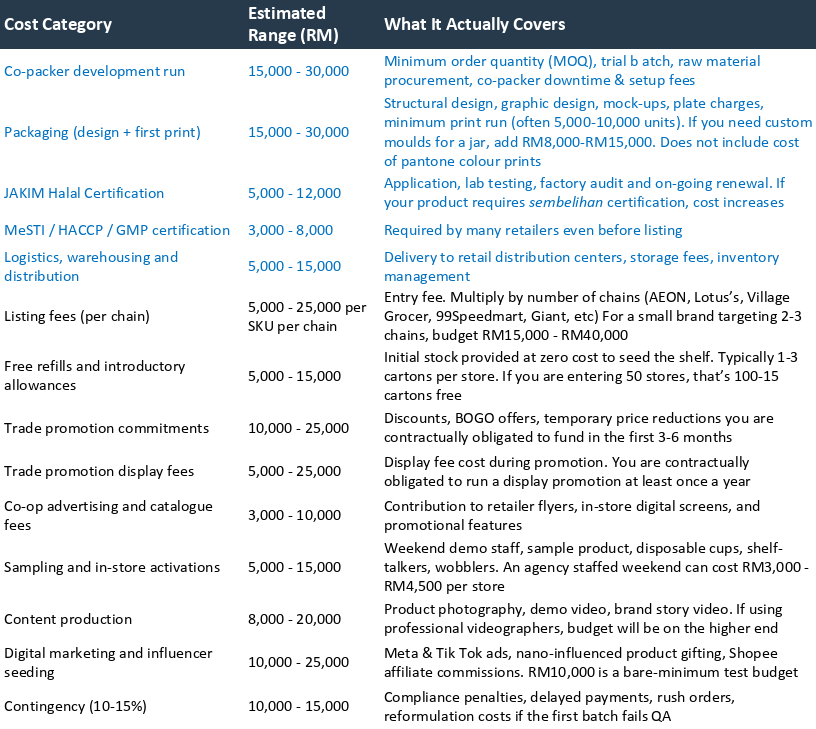
Add those up—using mid‑range estimates—and you are looking at RM110,000 to RM175,000 for a single‑SKU launch into two retail chains (even if I exclude the costs in blue which you could probably allocate that as part of production and operation cost, you are still looking at RM70,000 + RM110,000). And that is without any salary allocation for the founder or a single full‑time employee.
RM100,000 does not buy you a launch. It buys you a carefully chosen subset of these costs—and a prayer that velocity catches up before the bills do.
Where RM100,000 Actually Goes: Three Realistic Scenarios
Rather than give you a generic budget, let me show you what RM100,000 buys in three common launch scenarios. These are based on actual Malaysian FMCG cases I have observed or advised on.
Scenario 1: The Premium Food Product (1 SKU, 2 Retail Chains, 30 Stores)
You are launching a RM18.90 artisanal granola or sambal paste. You are targeting Village Grocer and Jaya Grocer—premium chains with moderate listing fees but high expectations for trade support.
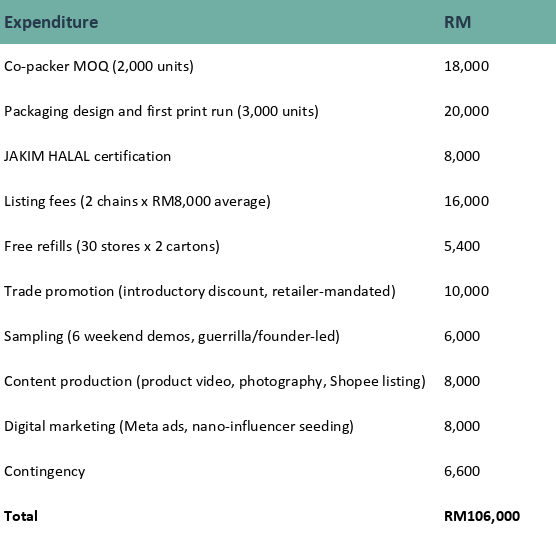
Notice: no salary, no office rent, no logistics beyond basic delivery. The founder is the delivery driver, the demo staff, and the customer service team. This budget is already over RM100,000 before you have paid yourself a single ringgit.
Scenario 2: The Mass‑Market Snack (1 SKU, 99 Speedmart, 50 Stores)
You are launching a RM5.90 snack into 99 Speedmart. Listing fees are lower per store, but the store count is higher, free‑fill obligations multiply, and the pressure to fund trade promotions is intense.
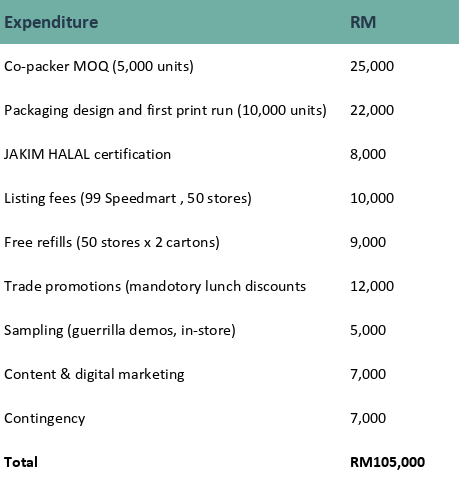
Again, no salary. No warehouse cost beyond what the co‑packer charges for storage. And the margin on a RM5.90 snack is thin; you need velocity of at least 3–4 units per store per week just to break even on the trade spend within six months.
Scenario 3: The Online‑Only Launch (1 SKU, Shopee + DTC Website)
You decide to bypass physical retail entirely and launch exclusively online. This is the most capital‑efficient path—but it requires heavy investment in content and advertising to drive traffic to a product nobody has heard of.
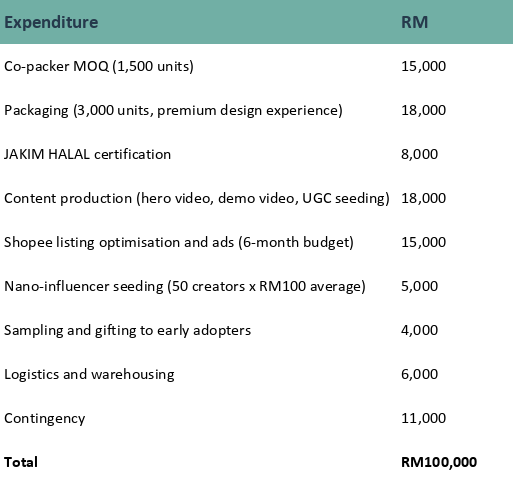
This scenario exactly fits the RM100,000 budget—but it leaves zero room for error. If the Shopee ads do not convert, or the influencer content underperforms, there is no backup plan. The brand is entirely dependent on digital visibility, and the cost of acquiring a customer on Shopee (after platform fees, advertising, and shipping subsidies) can easily exceed the gross margin on the first purchase.
The Five Places to Spend It (and the Three Traps That Eat It)
If you have exactly RM100,000 and you cannot raise more, here is where you place your bets—and where you refuse to spend a single sen.
Spend Here:
- Packaging (RM20,000–RM25,000). Your packaging is your primary salesperson on the shelf, in the Shopee feed, and in the hands of the influencer. Do not outsource this to a freelance designer who charges RM500. Pay for a professional structural design, a distinctive brand code, and high‑quality photography. A RM3,000 saving on packaging can cost you RM50,000 in missed sales and a rebrand 12 months later.
- Product Quality and Consistency (RM15,000–RM25,000 on co‑packer development). Do not launch with a batch that tastes different from the sample that won you the listing. Invest in a trial run, a QA process, and a co‑packer who understands that “almost the same” is not acceptable. The most expensive thing in FMCG is a product that consumers try once and never repurchase.
- Content That Lives Forever (RM10,000–RM18,000). As I have argued before, content is stock, not flow. A single well‑produced product demonstration video, a compelling founder story, and a library of 5–6 usage or recipe videos will sell your product for years. This is the asset that works while you sleep. Do not spend RM10,000 on a TikTok ad campaign that vanishes in a week. Spend it on permanent content that sits on your Shopee listing, your website, and your YouTube channel.
- Sampling That Converts (RM5,000–RM8,000 on guerrilla demos). I have written the playbook for this. A founder‑led demo at a premium grocer, a nano‑influencer live tasting on Shopee, a surprise‑and‑deliver drop to 50 target consumers. Do not pay a staffing agency RM3,000 a weekend for bored part‑timers. Use that money to put yourself, your most passionate customer, or a trusted creator in front of the right shopper.
- Contingency (RM10,000–RM15,000). Something will go wrong. The co‑packer will delay. The retailer will deduct an unexpected compliance penalty. A shipment will arrive with damaged labels. If you have no contingency, a RM2,000 problem becomes a RM20,000 crisis because you cannot afford to fix it immediately. Ring‑fence at least 10% of your budget for the disaster you have not yet imagined.
Do Not Spend Here (Yet):
- Celebrity or Macro‑Influencer Endorsements. A single post from a Malaysian celebrity will consume RM10,000–RM30,000 of your budget and generate precisely zero attributable sales. As I argued in the RM100 influencer post, nano‑creators and affiliates deliver higher engagement and measurable ROI at a fraction of the cost. Spend your first RM5,000 on 50 nano‑creators, not one D‑list celebrity.
- A Big Launch Event. The “grand launch” with media, canapés, and a rented venue is a vanity expense that serves the founder’s ego and impresses nobody who actually buys groceries. Cancel it. Use the RM15,000 you just saved to fund three months of sampling and content.
- A Full‑Time Sales Team. In the first 12 months, the founder is the best salesperson the brand will ever have. A hired sales rep, however experienced, will not sell your product with the same passion, knowledge, and desperation as you will. Save the headcount cost and reinvest it in velocity‑building activities until you have proven the model.
RM100,000 is not a launch budget. It is a test budget. It buys you the right to discover whether consumers want your product, whether your co‑packer can deliver, and whether your unit economics survive contact with reality. Spend it on the things that generate data, trust, and velocity. Do not spend it on a party. The party comes later—if you survive.
