

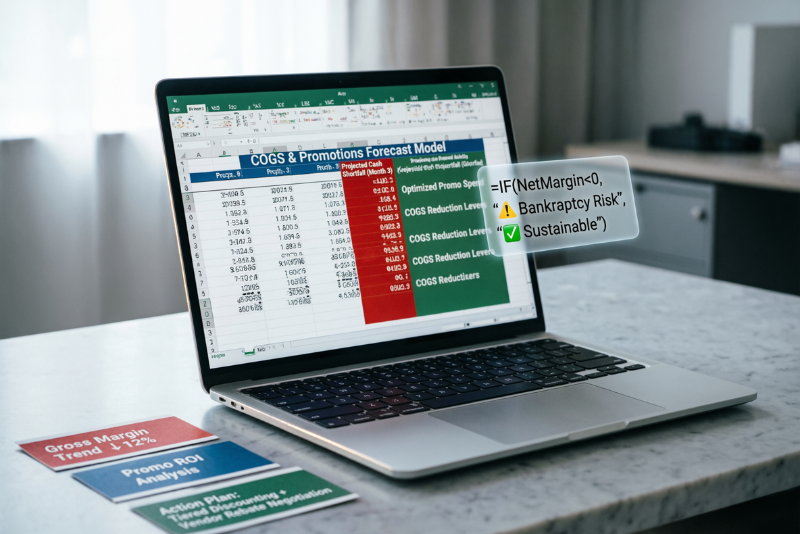
Here is the uncomfortable truth: most FMCG brands that fail do not die because of a bad product. They die because of a bad Excel model. Specifically, the cell where COGS, promotion depth, and incremental volume interact to produce what looks like growth—but is actually a countdown timer to zero.
The Spreadsheet That Tells the Future
Before we go any further, I need to define the two villains in this story.
COGS (Cost of Goods Sold): The direct costs of producing your product. Raw materials, direct labour, and manufacturing overhead allocated to production. Revenue minus COGS equals your gross profit. This number tells you how efficiently you produce before considering operational costs.
Trade Promotion: The discounts, free goods, listing fees, rebates, and incentives you provide to retailers or consumers to stimulate purchase. In Malaysian FMCG, trade spend now drives 28.6% of all value sales—up from 25.8% the previous year—and the promoted items share has increased from 20.0% to 21.6%.
These two forces are locked in a toxic relationship in most FMCG spreadsheets. Here is how it unfolds.
Year 1: The brand launches. It prices responsibly. It makes a modest gross margin. The co-packer or factory is running at decent yield.
Year 2: The brand enters its first major retail chain. The buyer requests a launch promotion. The brand offers a Buy One Get One Free deal for four weeks—funding it entirely from its own margin. Volume skyrockets. The founder celebrates.
Year 3: The retailer asks for a repeat promotion. And another. Competitors respond with their own discounts. The brand now has to run promotions just to maintain shelf space. The “promoted price” becomes the consumer’s reference price. Meanwhile, raw material costs have risen approximately 6% for many food inputs. But the brand cannot raise its base price—because consumers are now trained to wait for the discount.
Year 4: The brand is doing RM3 million in revenue. It is also losing RM180,000 a year. The founder increases ad spend to “buy more volume” and make up for the margin shortfall. It does not work.
Year 5: The brand closes. The founder blames the economy. The spreadsheet knew all along.
The COGS Math: What Malaysian Brands Are Actually Working With
The days of 35% COGS are gone for most food brands in Malaysia. Benchmark data from a supply chain executive familiar with notable local brands now puts the floor closer to 40%. And that is before trade spend.
For public reference, a major Malaysian F&B player maintains a gross profit margin of approximately 31%. That is considered solid. Now imagine a small brand operating at the same 30% gross margin.
For every RM100 in revenue, RM70 goes to making the product, leaving RM30 to cover everything else: rent, salaries, marketing, logistics, listing fees, and—critically—trade promotion costs.
The FMCG industry typically allocates 15% to 25% of total revenue to trade promotions. McKinsey estimates CPG companies spend about 20% of revenue on trade promotions, yet 59% of promotions globally lose money. More recent industry analysis confirms that more than 60% of promotions actually destroy value rather than create it. Research on discounting shows that frequent, deep discounts can cut overall profit by 3–10% globally, even when headline sales look strong.
Now do the arithmetic.
If gross margin is 30%, and you are spending 20% on trade promotions, you have 10% left for all overheads. If your trade spend climbs to 25%—which it will do when you chase volume—you have 5%. That will not cover salaries, rent, or logistics. You are now funding operations with cash reserves, debt, or hope.
The Excel model flags yellow. Then red. Then black.
The 7-Step Path to the Excel Reaper (aka the excel model that predicts bankruptcy)
I reverse-engineered the financial model that predicts FMCG bankruptcy. It has seven cells that turn from green to red, one by one.
Cell One: The Gross Margin Mirage
The founder builds a P&L assuming a 40% gross margin. But the model treats co-packer yield as if it were actual margin. It isn’t. Every production run has waste. Every new SKU has changeover costs. Downtime is a hidden cost that silently reduces OEE and increases operating costs. The most common mistake: forgetting to allocate manufacturing overhead—indirect costs of production that underaccounting standards must be absorbed based on normal capacity, not actual output volumes. The real gross margin lands at 28-30%.
Cell Two: The Promotion Discount That Compounds
A RM12.90 product goes on promotion: 20% off. Now it is RM10.32. Still profitable? On paper, yes. But the product now needs to sell more units just to maintain the same ringgit gross profit. And that is before you account for the fact that a meaningful share of those promotional purchases were going to happen at full price anyway.
Cell Three: Cannibalization and Forward Buying
This is where the model gets lethal. Trade promotions create three hidden costs:
Cannibalization: A promotion for one SKU unintentionally reduces the demand or sales of another SKU in the same brand, or steals from future sales when customers stockpile.
Forward buying: Retailers purchase more during the promotion period than they intend to sell immediately, then sell the excess at regular prices after the promotion ends. The supplier funds the discount, but the retailer captures margin on the post-promo sell-through.
Stockpiling: Consumers buy extra units during the promotion, reducing their need to purchase for weeks afterward. The brand does not just lose margin on the promoted units—it also loses future full-price sales.
Cell Four: The Gross-to-Net Waterfall
This is the single most important concept in FMCG finance that small brands never learn until it is too late. If you learn nothing else from this post, learn this.
Net revenue per unit is what you actually receive after every discount, allowance, and deduction. A product with an RM12.90 shelf price might seem like RM12.90 in revenue. But after subtracting a RM0.50 promotional allowance, a RM0.20 co-op advertising allocation, and RM0.30 in freight, actual net revenue per unit drops materially—and the contribution margin calculation changes just as dramatically.
For a product listed on Shopee, the math gets even worse. After platform commission, the RM0.54 platform support fee, shipping subsidies, and advertising costs, a product can appear to be profitable at the top line while delivering negative contribution margin on every unit sold.
Cell Five: The Incremental Volume Decay
In year one, the 20% discount generates a 40% volume lift. In year two, the same discount generates a 25% lift. By year three, you need a 30% discount to generate the same volume you used to get at 20%.
The consumer has been trained. As industry analysts note, price discounts educate the buyer to focus on the lower price of the product, and this negatively impacts the perceived value. Consumers become more price sensitive and cost conscious. They no longer see your product as “worth RM12.90.” They see it as “worth RM9.90—and only when on discount.”
Cell Six: The Competitor Response
While you are steadily eroding your margin, your competitors are not standing still. They match your discount. Then they deepen theirs. The category descends into a price war. Every brand loses margin, but the smallest brands lose first—because they have the thinnest cash buffers and the weakest supplier negotiation power.
Cell Seven: The Sunk Cost Trap
Here is the psychological dimension of the model. The founder has now invested in the co-packer relationship, the retail listing, the promotion calendar, and the inventory pipeline. Walking away means those costs cannot be recovered. This is the sunk cost fallacy—decision-makers prefer to invest more in a failing course of action rather than withdraw and lose everything, believing they can turn the situation around.
So they double down. More promotions. More volume. Less margin. Faster cash burn.
Real-World Warnings
This is not a theoretical model. The historical record is clear.
A well-known Malaysian retail chain that expanded aggressively—its parent company went into liquidation with short-term debts. London Biscuits sold its land, buildings, and intellectual property for RM70 million as part of its liquidation and debt repayment.
Poor cash flow management remains the primary reason for a vast proportion of business failures. Malaysian startups face a high failure rate, with around 60% of new businesses struggling to survive beyond their third year. Nearly 29% fail specifically because they run out of money.
The pattern repeats across different brands, categories, and decades: expanding sales volume funded by margin-destroying promotions, with cash reserves drained before anyone realizes the unit economics do not work.
The Reaper (aka the excel model that predicts bankruptcy) Audit Checklist
Now before you open Excel and convince yourself that the model works this time, run through this checklist: Click Here to Buy
The One Thing to Remember
Here is the foundational truth that the Excel model does not bend for:
Revenue is not profit. Volume is not cash. And a spreadsheet that only adds can lie to you for years before it finally tells you the truth.
The Reaper aka the excel model that predicts bankruptcy does not care about your brand story, your five-star reviews, or your plans for international expansion. It cares about exactly three numbers:
- How much it costs to make your product.
- How much you actually receive after every deduction.
- How many cycles remain before the gap between those two numbers consumes your cash.
Fix the gap. That is the only answer.
In my following post, I will share exactly how you can rebuild your spreadsheet but before that, audit your current excel using this checklist: Click Here to Buy
